
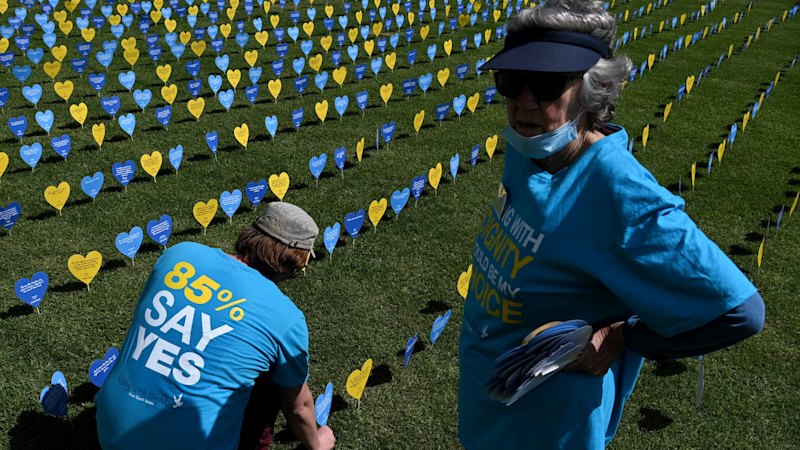
November 24, 2026 — 7:30pmMore people chose to end their lives in NSW under the state’s voluntary assisted dying (VAD) program than any other jurisdiction, but access for regional and rural applicants remains limited by an effective ban on telehealth.In the 12 months to the end of June this year, 1419 people died in NSW after administration of a voluntary assisted dying substance, an average of nearly four people per day and an increase of 38 per cent in the second full year of the state’s assisted dying program. NSW was the last state to introduce voluntary assisted dying.NSW MPs voting during the successful passage of the Voluntary Assisted Dying Bill in 2021.Dean Lewins / AAPThe figures are contained in the NSW Voluntary Assisted Dying Board’s annual report, released on Monday.Advocacy group Go Gentle’s chief executive Linda Swan said it was expected NSW would have the most people dying in this way, as it has the highest population.“Even so, VAD deaths account for a tiny proportion of all deaths in the state,” Swan said.Go Gentle chief executive Dr Linda Swan says forcing seriously unwell people to travel long distances for assessments is cruel and unnecessary.James BrickwoodIn Queensland, 1082 people died during the same reporting period, a slightly larger proportion of that state’s population.Victoria reported 780 deaths among people issued a permit, but 268 of those died without being administered a voluntary assisted dying substance. WA recorded 541 deaths.The ACT’s program began operating last year and the Northern Territory’s will begin in 2028.Services in NSW are also well-funded in comparison to other jurisdictions and ensure people have access to multiple end-of-life options, Swan said.“There is also a growing awareness of the VAD option, partially as a result of several recent high profile VAD deaths – James Valentine and Lex Marinos,” Swan said.But the chief executive of Right To Life UK said the NSW figures were deeply alarming.Alisdair Hungerford-Morgan urged against any expansion, calling for a review of the state’s system “including whether claimed safeguards in current legislation are protecting vulnerable people in practice”.The state’s VAD board is an independent oversight body which decides whether people applying for access to voluntary assisted dying can access the program, among other functions.Advocates spread messages of support behind NSW Parliament during the campaign to legalise voluntary assisted dying.Nick MoirThe report notes equity of access regardless of location is a key principle of the state’s laws and more than two-thirds of the 2875 initial assessments for access in the reporting period were for people outside the Greater Sydney area. Regional areas generally have older populations than major cities.Board chair Jenni Millbank said the board is an advocate for changing federal laws to remove “restrictions on the use of carriage services for steps in the voluntary assisted dying process that would otherwise be lawful and clinically appropriate to occur via audiovisual communication such as telehealth”.Swan said people looking to access telehealth were seriously unwell and in no condition to travel long distances for assessments.“Expecting them to do so when an alternative exists in the form of telehealth is cruel and unnecessary.“This is about putting the needs of dying people first, rather than forcing them to navigate unnecessary barriers at the end of their lives,” Swan said.Because of a Federal Court ruling in 2023 that voluntary assisted dying is considered suicide, laws preventing the use of a carriage service (such as voice or video calls and emails) to incite or provide information about suicide have prevented doctors providing telehealth consults on euthanasia. It has also led to prolonged suffering for some, due to delays in accessing substances in some states where scripts had to be sent by mail rather than electronically.Health ministers from Victoria, South Australia, Tasmania, Western Australia and the ACT wrote to federal Health Minister Mark Butler and Attorney-General Michelle Rowland in October urging the laws be amended to allow for patients to be assessed for euthanasia via telehealth.“For many people in our states and territories, access to VAD is restricted by where they live,” the ministers wrote.“This is an issue of equity.”Attorney-General Michelle Rowland speaking at Labor’s national conference in July.Dominic LorrimerBut NSW and Queensland did not join the call.Health Minister Ryan Park said changing the law was a federal responsibility but NSW supports eligible patients to access the scheme in all parts of the state.“The report shows voluntary assisted dying is meeting the needs of those who require it, and that its systems and processes are working effectively,” Park said.“Ensuring safe and equitable access for all eligible people underpins the approach to voluntary assisted dying in NSW.”Labor Party members voted in July to amend the criminal code to allow telehealth assessments but also guaranteed MPs a conscience vote on the issue if it goes to parliament.Rowland cited concerns that changes could facilitate elder abuse and said it was “fundamentally a health policy issue”.Get alerts on breaking news as it happens. Sign up for our Breaking News Alert.From our partners
NSW leads in voluntary assisted dying but telehealth barriers persist
Full Article
Original Source
Read the full article at Smh →KhanList aggregates and links to publicly available news content. We do not host full articles from third-party sources. Always verify important information with original sources.