
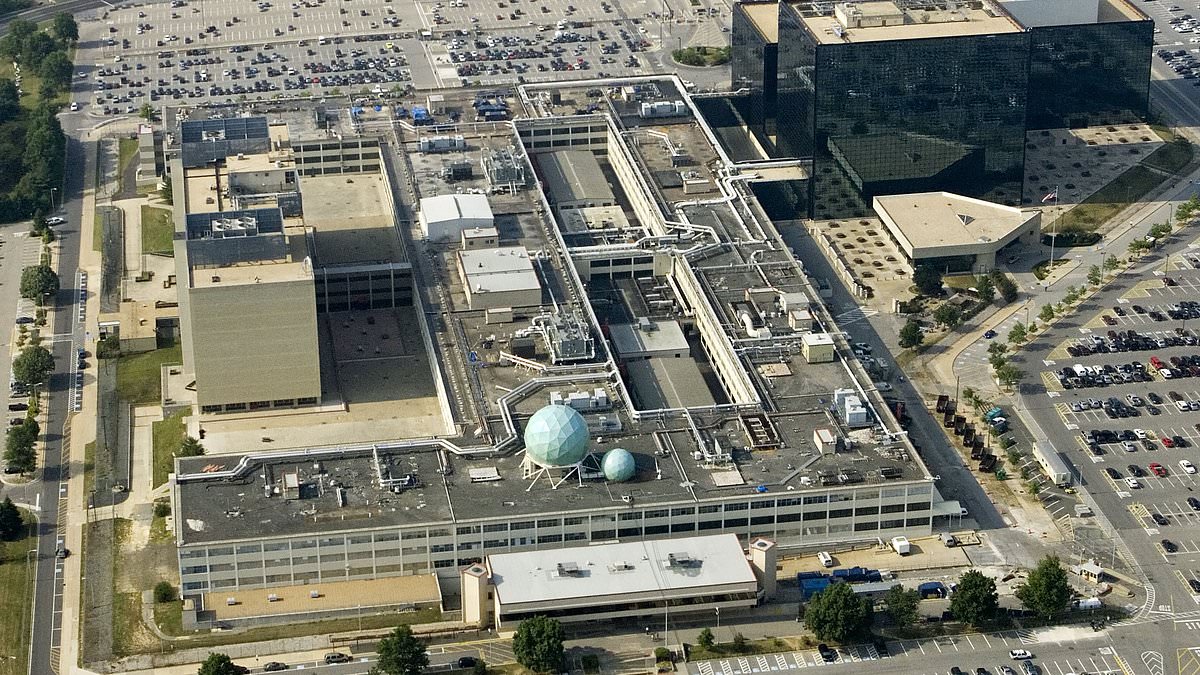
National Security Agency (NSA) workers have been told to come to work late amid a 'heightened security threat' as the agency's top secret internal communications network goes down.The NSA Net network, which employees use for highly classified internal communications, went down Tuesday morning, six people familiar with the situation told CNN.At this point it is unclear what caused the outage, but officials say there is no evidence of a cyberattack.The NSA Net collapse occurred as President Donald Trump is away on a three-day trip to Asia where he is expected to hold talks with China's President Xi Jinping and Russian President Vladimir Putin.The network crash comes just hours after a massive cyberattack hit 178 of the world's biggest companies on Monday.Trump, upon his arrival in the Philippines Tuesday, dismissed concerns about the string of tech, aviation and banking outages that have plagued the US recently.'It's life. When you're big and powerful and have all the money, things like that happen,' the president told reporters ahead of the Association of Southeast Asian Nations summit. 'It's fine.'President Donald Trump is away on a three-day trip to Asia where he is expected to hold talks with China's President Xi Jinping and Russian President Vladimir Putin The National Security Agency in Fort Meade, Maryland, a suburb of Washington, DCHackers on Monday compromised some of the world's most visited websites in a sweeping cyberattack targeting users' money and credit card details. Security researchers identified malicious code in website tools used by 178 organizations, including Zoom, CNN, the BBC, HSBC, Equifax, Salesforce, Peacock, IKEA, Fox News, NPR, the ASPCA and Invisalign.The attack, detected Monday evening, targeted Optimizely, a service companies use to test different website layouts and features.Hackers used its customization tool to insert malicious code into webpages. It was delivered alongside genuine software through Optimizely's trusted systems, making the threat harder to detect.The cybercriminals' malicious software was designed to steal cryptocurrency payments, capture credit card details entered into certain online forms and hack iPhones and iPads with security weaknesses. Researchers reported cryptocurrency transfers to wallets controlled by the attackers, amounting to more than $7,000 so far. However, the number of people whose card details were stolen or devices successfully hacked remains unknown. The cyberattack follows a string of disruptions to essential services, including a global Microsoft outage and Friday's nationwide grounding of flights.The Federal Aviation Administration issued the rare ground stop after experiencing a system failure, which the agency attributed to a router overload. The National Security Agency monitoring electronic transmissions around the world as part of the United States intelligence networkCustomers at several major US banks also reported problems accessing online services on Monday, adding to a turbulent few days for the country's critical systems.JPMorgan Chase, Wells Fargo, Bank of America and US Bank were among the institutions impacted by the outage.Trump said Tuesday that he has spoken to the banks, alleging: 'It's going to be very much under control.' It was not clear which financial institutions he spoke to.He also said that Americans did not need to worry about travel disruptions ahead of the Thanksgiving holiday, one of the busiest travel times of the year.'No, not at all. People are safe,' he added. This is a breaking news story. Check back for updates.
NSA's top secret communications network goes down with staff told to come in late amid 'heightened' threat, hours after cyberattack hit 178 of world's biggest companies while Trump is in Asia
Full Article
Original Source
Read the full article at Dailymail →KhanList aggregates and links to publicly available news content. We do not host full articles from third-party sources. Always verify important information with original sources.