
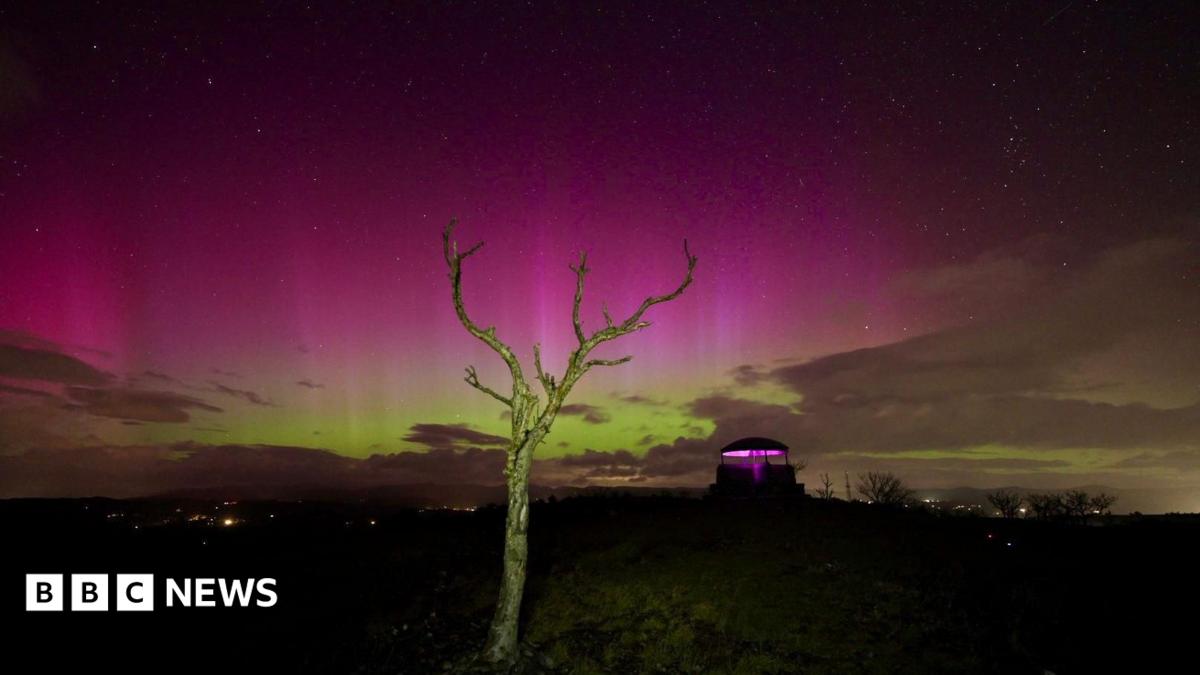
Image source, BBC Weather Watchers / Jonny GiosImage caption, Kendal in Cumbria paid host to the breathtaking scenes on SaturdayResidents across the UK were left stunned as the sky was illuminated by the spectacular colours of the Northern Lights on Friday and Saturday evenings.The natural phenomenon, known as the Aurora Borealis, is the result of increased solar activity.Such occurrences are mostly visible near the Arctic Circle and northern Scotland, but particularly strong activity levels meant they could be seen as far south as Devon, Hampshire and Kent on Saturday night.The Met Office has said sightings could continue to be possible during clear skies until Tuesday.Image source, BBC Weather Watchers / Simon Luckman 1988Image caption, The phenomenon was visible as a pink haze in Winterton-on-Sea, Norfolk, on FridayImage source, BBC Weather Watchers / Isle ExplorerImage caption, Owston Ferry in North Lincolnshire was graced by a stunning purple haze Image source, BBC Weather Watchers /ChelseaPhilImage caption, Sightings stretched to Herne Bay in Kent Northern Lights are caused by powerful solar eruptions from the Sun, called coronal mass ejections (CMEs).Towards the end of last week, the Sun was observed to unleash CMEs directed towards the Earth.This stream of charged particles can get captured by the Earth's magnetic field and directed into our atmosphere, especially towards polar regions.When these charged particles collide with oxygen and nitrogen, photons of coloured light are emitted - this is the aurora.Image source, BBC Weather Watchers / Sarah n EssieImage caption, Revellers were able to take in a mix of green and purple in Saltburn-by-the-Sea, Redcar and Cleveland Image source, BBC Weather Watchers / HolImage caption, Stenness on Scotland's Orkney Islands served as a strong location for the phenomenonImage source, BBC Weather Watchers / Hannah and BenImage caption, The sky was illuminated in Holmwood, SurreyThe chances of seeing the aurora vary across the UK depending upon its strength. When activity levels reach 200nT (nanotesla) the aurora would be visible in the north of the UK, but not the south.On Saturday evening, those levels reached 600nT, meaning it would be visible across the whole of the UK, even in the south, which is a much rarer phenomenon.Experts have previously said 2026 will be a peak year for aurora-spotting as the Sun has been in a heightened state of activity as part of its 11-year natural cycle.Image source, BBC Weather Watchers / Carolyn RImage caption, A purple glow could be seen across the sky in Salisbury, Wiltshire on SaturdayImage source, BBC Weather Watchers / Rick1Image caption, North Yorkshire did not miss out on the action, as shown here in ScarboroughImage source, BBC Weather Watchers / RockdodgerImage caption, An array of pink, blue and green could be seen in Gourock, InverclydeIf you missed out this time, the aurora may return on Sunday.The Met Office has said sightings remain possible across Scotland and similar geomagnetic longitudes during clear skies until Tuesday.To see them, you need to look northwards, away from bright streetlights, and look through a mobile phone camera.The reason you need to use a camera is because in low-light conditions at night our eyes use rod cells to see - these cells do not perceive colour and so we actually see in black and white. Cameras do not have the same limitations.More on this story
Northern Lights stun UK down to England's south coast
Full Article
Original Source
Read the full article at Bbc →KhanList aggregates and links to publicly available news content. We do not host full articles from third-party sources. Always verify important information with original sources.