
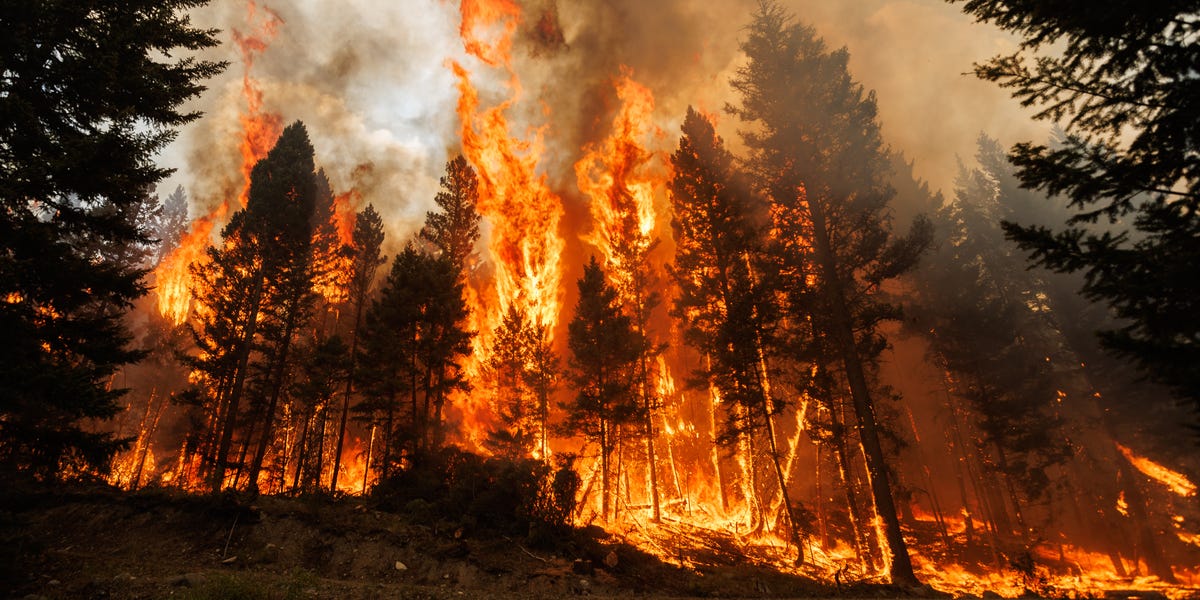
3 min readHere’s what you’ll learn when you read this story:July 2026 was the warmest month in recorded history in the contiguous U.S., and wildfire smoke impacted at least 120 million Americans during the summer.Even moderate exposure to wildfire smoke can be disastrous to public health because it often contains elevated levels of toxins such as lead and mercury. Wildfire smoke is becoming more prevalent across the U.S., but research funding to study its effects on human health is drying up.At the end of June, just days before the U.S. was set to celebrate 250 years of independence, the National Weather Service (NWS) placed 180 million Americans—half of the country’s population—under a “major” or “extreme” heat advisory. The following month brought no relief, as July 2026 became the hottest recorded month in the history of the contiguous U.S., and all that heat brought lots and lots of wildfires with it.According to the National Interagency Fire Center, 53,233 fires have burned nationwide as of early September, with more than 8.3 million acres burned in total. In Canada, that number clocks in at an incredible 11.1 million acres, sending dangerous toxins and particulate matter (PM) into the air we breathe. Mid-July saw the worst of it, with 120 million Americans impacted by wildfire smoke as air quality dipped into “unhealthy” and sometimes “hazardous” zones. A toxic cloud of wildfire smoke even settled over New Jersey’s Met Life Stadium as it hosted the World Cup Final.With so many people now regularly impacted by wildfire smoke, scientists are racing to understand its short-term and long-term impacts on human health. So far, the results are not encouraging. Wildfire pollution is measured using concentrations of PM2.5, or particulate matter 2.5 millimeters in diameter or less. While other types of particulate matter exist, such as PM10, the smaller the particles, the more likely they’ll embed on walls deeper within the lungs, causing tissue damage, lung inflammation, and even premature death.One of the challenges of studying the health impacts of wildfires is that no two fires are the same. For example, a blaze burning in Los Angeles—such as the Palisades fire in 2025—contains more toxins than a wildfire in a remote corner of the Pacific Northwest. That’s because in a city, a fire can consume cars, building materials, electronics, and other products in its path and carry the toxins they release for miles. According to preliminary results from researchers at the UCLA Fielding School of Public Health, firefighters who battled the L.A. blazes had five times more lead in their blood plasma, and even their cells, than firefighters fighting more rural fires.Of course, the threat isn’t limited to just firefighters. A collection of studies gathered by The New York Times shows how wildfire smoke can be directly linked to cancer, impaired cognition, and complications in diabetes and pregnancy. A study in 2024 also linked wildfire smoke with increased risk of cardiovascular disease, endocrine issues, and chronic kidney problems, leading to the estimate that wildfire smoke caused roughly 12,000 deaths from 2007 to 2020—a number that’s been growing year after year.And wildfires have mental as well as physical impacts. The U.S. Environmental Protection Agency reported in 2023 that just a few hours of exposure to wildfire smoke can reduce adult attention, while other studies have shown that prolonged exposure can exacerbate dementia or cerebrovascular disease.And while this overwhelming mountain of evidence inches higher and higher, the U.S. government is actually making it harder to study the impact of climate change on public health. In early March 2025, the National Institutes of Health (NIH) ended funding for research on the health impacts of climate change. Around the same time, federal agencies began removing climate science information from their websites, including climate.gov, which had distilled the government’s climate research for the public. (A group of scientists and volunteers has since re-established the site as a nonprofit under the name climate.us). Meanwhile, “climate hushing” has swept the halls of Congress, with mention of the crisis plummeting in congressional press releases since 2025, which is at odds with the public’s growing call for the government to act.Climate change can’t be ignored, and its impacts on the health of humans and the planet are very real and growing more dire every day. Governments have the means to tackle this problem head on while researching ways to safeguard human health, whether they have the will remains to be seen.But time is running out.Darren lives in Portland, has a cat, and writes/edits about sci-fi and how our world works. You can find his previous stuff at Gizmodo and Paste if you look hard enough.
North America’s Wildfire Smoke Is Becoming Deadly. It’s Only Going to Get Worse.
Full Article
Original Source
Read the full article at Popularmechanics →KhanList aggregates and links to publicly available news content. We do not host full articles from third-party sources. Always verify important information with original sources.