
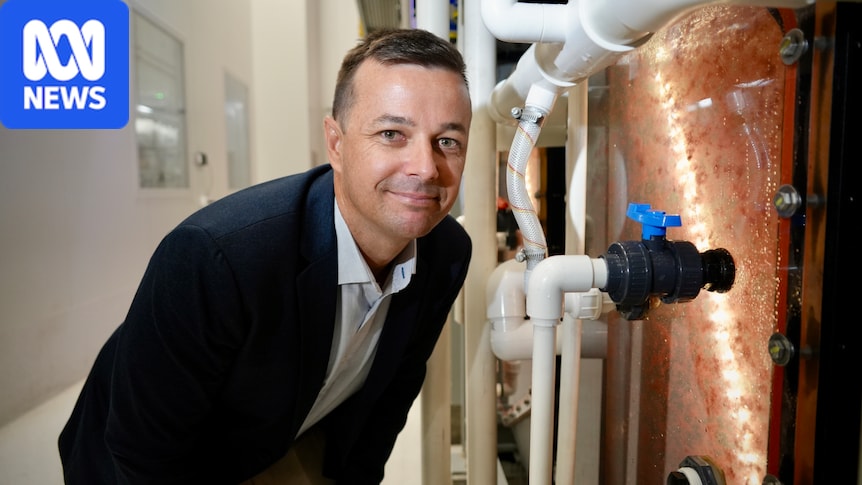
Affordably reducing methane emissions from Australia's 30 million burping cattle is a step closer, researchers say, after reaching a milestone at an industrial estate minutes from Noosa's Main Beach.In a shed stacked high with self-cleaning tanks, swirling red algae is being mass-produced under strobing lights.Nusque Spanton takes a walk through the algae growing room. (ABC News: Jessica Ross)Founded eight years ago, Provectus Algae has developed what it describes as a library of photosynthetic microbes.Among its work, it's using algae to make granular and liquid cattle feed additives for feedlots, paddocks and dairy farms.Now a $3.8 million Queensland government grant will help the company commercialise its cattle feed supplement.The recipe was built on CSIRO's 2011 discovery that native Asparagopsis seaweed could significantly reduce methane emissions from livestock.However, a 2024 Murdoch University study found cattle avoided feed with higher Asparagopsis concentrations, and there was evidence of ulceration and inflammation in cows' stomachs.Asparagopsis seaweed growing in the Provectus Algae laboratory. (ABC News: Jessica Ross)Provectus Algae CEO Nusqe Spanton said his company swapped the native seaweed out and recreated its processes using other algae and photosynthetic microbes."It's a bioidentical product to what's found in the Asparagopsis itself," he said."We've been able to bio-mimic the exact constituents we found in the algae species that was originally developed by the CSIRO."Mr Spanton said livestock happily ate the supplement.The algae has been turned into a dry cattle feed supplement. (ABC News: Jessica Ross)"We have done extensive safety testing, and we've proven that there is no residue within the animal, and we've proven safety throughout the animal supply chain."The CSIRO has estimated ruminant animals, including cows, sheep and goats, which produce methane through digestion, are responsible for more than 10 per cent of Australia's total greenhouse gas emissions.A lot to learnScientists have fitted cattle with unusual-looking high-tech headgear to quantify exactly how much methane they produce, mainly through their burps.A 2025 study found Australia's grain-fed cattle emissions were 56 per cent lower than previously believed.The technology to measure methane emissions involves tight-fitting headgear strapped to cows' heads. (Credit: Supplied)Provectus Algae has run pilot trials with more than 3,000 cattle, including on Mort and Co feedlots on Queensland's Darling Downs."We target a range in the feedlot industry, pastoral and dairy applications of around 65 per cent emissions reduction," Mr Spanton said.He said the supplement worked by targeting microbes in the guts of ruminant animals."It's extremely effective … it doesn't affect the broader digestibility microbes that are found in the rumen and therefore doesn't impact the ability for that animal to grow or be healthy in its life cycle," he said.Nusqe Spanton showed state minister Tony Perrett around the factory. (ABC Rural: Jennifer Nichols)Queensland Primary Industries Minister Tony Perrett said the state contained half the national cattle herd, worth more than $14 billion to the Queensland economy."That's why we're continuing to back smart research, smart people and taking those opportunities into commercialisation," he said.Race to reduce methaneThe Victorian, Tasmanian, South Australian and Western Australian governments have also invested in businesses to accelerate efforts to lower livestock emissions.University of Melbourne carbon farming professor Richard Eckard said additives worked better in feedlots, where supplements were continuously eaten."If you had to deliver it in the northern grazing industry — where we measure our properties in hundreds of square kilometres — well, it's a different challenge," he said."It's why we need a mixture of options."Richard Eckard would like to see the costs of the supplements come down to less than 10 cents per animal. (ABC News: Sean Warren)Price the problemProfessor Eckard said the cattle industry needed either major productivity gains, or very low priced additives, to get a return on investing in methane-reducing supplements."We really needed to get it [supplement costs] below 10 cents an animal per day to get the carbon credit value."He recommended cattle producers build direct relationships with restaurants and retailers to seek a premium for low-emission food, sought out by environmentally conscious customers.The algae for the supplements is grown inside this Noosaville factory. (ABC Rural: Jennifer Nichols)Mr Spanton said he believes his Surf'n'Turf product has a price advantage, with an average cost of 8 cents per animal per day at a ratio of one gram per kilogram of feed.He said while major gains had been made in cattle genetics, there had been "limited development in improving feed digestibility"."It could be one of the largest emissions-reductions loads out of any industry over the next 10 years if we are able to succeed in delivering this to a wider market."Since 1961, the global cattle population has increased by 67 per cent, from 942 million to an estimated 1.5 billion head.
Noosa startup's solution to tackle burping cattle's methane emissions
Full Article
Original Source
Read the full article at Abc →KhanList aggregates and links to publicly available news content. We do not host full articles from third-party sources. Always verify important information with original sources.