
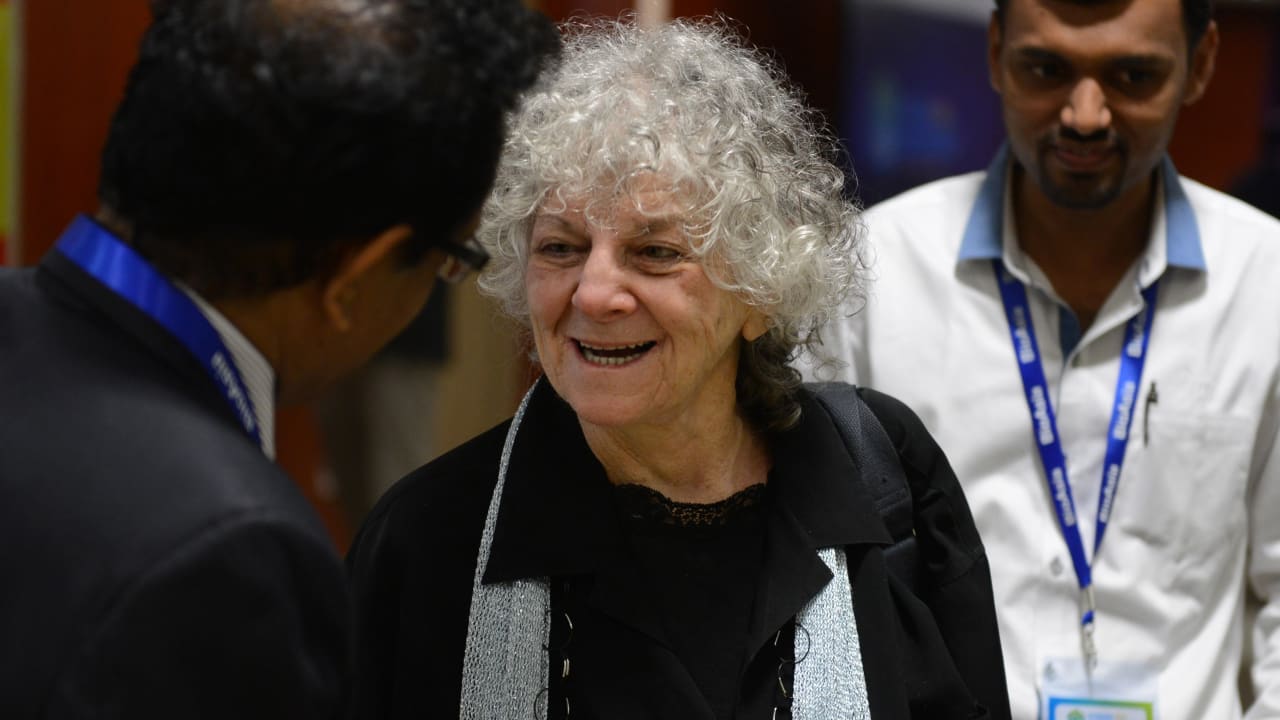
Jerusalem Post/Israel NewsProfessor Ada Yonath won the Nobel Prize in Chemistry in 2009 and the Israel Prize in Chemistry in 2002. She was born in Jerusalem and worked at Weizmann Institute of Science, Rehovot.Follow us on GoogleIsraeli Nobel laureate Ada Yonath pictured in 2016.(photo credit: NOAH SEELAM/AFP VIA GETTY IMAGES)AUGUST 31, 2026 19:09Updated: AUGUST 31, 2026 19:49Professor Ada Yonath, who won the Nobel Prize in Chemistry in 2009 and the Israel Prize in Chemistry in 2002, died on Monday at age 87.Born in Jerusalem, Yonath worked at the Weizmann Institute of Science, Rehovot’s Structural Biology and Chemistry Department, where she led the Ribosome Group, according to the institute's website.A ribosome is a "tiny particle made up of RNA and proteins that specialize in protein synthesis and are found free or bound to the endoplasmic reticulum within cells," according to the Encyclopedia Britannica.She was the daughter of Polish immigrants, whose father tried to earn a living by running a grocery store, despite having qualifications as a rabbi, according to a biography on the Nobel Prize website.The Yonath family moved to Tel Aviv after her father passed away, and Ada studied chemistry at the bachelor's and master's levels at the Hebrew University of Jerusalem, graduating in 1962 and 1964, respectively. She later earned her PhD from the Weizmann Institute in 1968, researching X-ray crystallography.Ada Yonath (credit: Wikimedia Commons)She was elected a member of the Israel Academy of Sciences and Humanities in 2000 and the US National Academy of Sciences in 2003, according to the Encyclopedia Britannica."An organism's vital functions are managed by large, complex protein molecules produced in cells' ribosomes. There, genetic information from messenger RNA is translated into chains of amino acids that then build proteins. In the 1970s, Ada Yonath began a project that culminated in 2000 in her successful mapping (together with other researchers) of the structure of ribosomes, which consist of hundreds of thousands of atoms, using x-ray crystallography. Among other applications, this has been important in the production of antibiotics," the Nobel Prize biography said, describing her work.Weizmann Institute eulogizes Prof. Yonath“Professor Yonath is an example and a role model for how scientific vision, courage in choosing a great scientific question, and dedication to a goal can lead to tremendous success and expand the boundaries of knowledge for the future of all humanity. May her memory be a blessing,” the Weizmann Institute said in a statement."Ada was an exceptional scientist who never hesitated to choose a path that others considered impossible and to pursue it for decades with determination, curiosity and courage. Her breakthrough in the study of the ribosome transformed our understanding of one of life’s most fundamental processes and opened up new possibilities for combating antibiotic resistance," Weizmann Institute President Prof. Alon Chen said."But Ada’s legacy extends far beyond her scientific achievements. She showed generations of scientists what can be accomplished when one dares to ask big questions and persists in the search for answers. Ada was an Institute Professor – the highest title the Weizmann Institute bestows on a select group of outstanding scientists – and she continued to conduct research and publish papers, run an active laboratory and maintain scientific collaborations until the very last days of her life," Chen added.Follow us on Google
Nobel Prize, Israel Prize laureate, Ada Yonath, dies aged 87
Full Article
Original Source
Read the full article at Jpost →KhanList aggregates and links to publicly available news content. We do not host full articles from third-party sources. Always verify important information with original sources.