
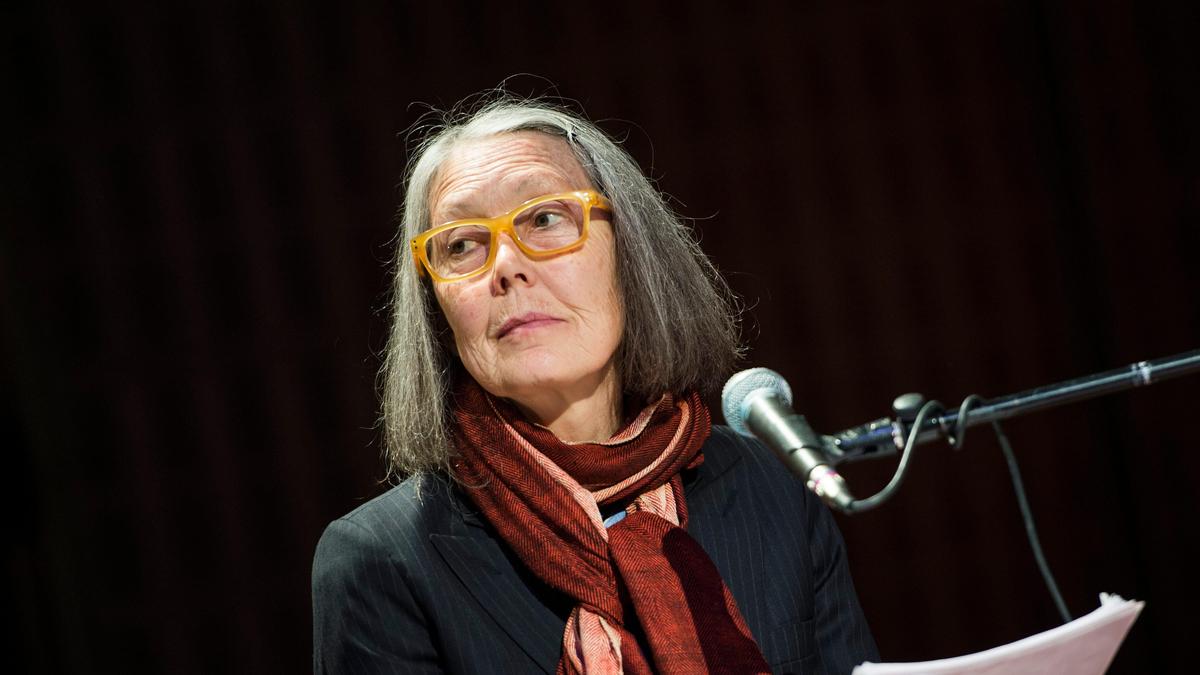
In Plainwater (1995), Anne Carson writes, “I will do anything to avoid boredom. It’s the task of a lifetime.” Asked once in an interview with Brick, A Literary Journal, why she fears boredom so much, she replied, “Largely because it’s the condition next to death.”Unsurprisingly, Carson, a Canadian, has spent a lifetime being intellectually restless, reading voraciously, writing prolifically, experimenting with form, and resisting the rigid categories of literature. Drawing on Greek classics and mythology, she straddles the worlds of poetry, scholarship, and prose, creating works that occupy the unexplored, unnamed spaces between genres.Asked on the day she won the 2026 Nobel Prize in Literature to describe her writing, she gave a characteristically witty reply: “Inadvertent. Inadvertent is how I’d describe it. Always trying to do something else.” She then said she would spend the rest of the day avoiding calls and spending time with her husband in a forest in Iceland, where she holds citizenship as well.A fascination with the classicsCarson was born in Toronto, Canada, in 1950. When she was 15 and roaming around a shopping mall in Hamilton, Ontario, she came across a bilingual edition of Sappho by Willis Barnstone. The book left a mark on her. A year later, after moving to Port Hope, she learned that her high school Latin teacher, Alice Cowan, knew Greek. Realising Carson’s interest in the subject, Cowan offered to teach her during lunch breaks.This passion remained — Carson has said that the “mental activity of being inside a translation” is “like doing an endless crossword puzzle but with a valuable product”. It eventually led her to a PhD in classics at the University of Toronto. Over the years, she taught classics, ancient Greek, Latin, comparative literature, and poetry at universities across the U.S. and Canada. She has called Homer her greatest literary inspiration, and the writer she recommends everyone read. She also once said she had not read any new books that year: “Mostly the books I read are published in 500 BC.” She has published several translations of ancient Greek tragedies.Carson’s first book, Eros the Bittersweet (1986), grew out of her doctoral research on the ancient Greek poet Sappho. It examines desire as stemming as much from longing as from lack. In one passage, she imagines a city without desire, where people continue to eat, drink, and procreate mechanically but no longer theorise, speak figuratively, or give gifts. “A city without desire is, in sum, a city of no imagination,” she writes. The book became a critical and cultural success.In 1998, Carson published what arguably remains her best-known work, Autobiography of Red. Reimagining the ancient Greek myth of Geryon and Herakles as a queer coming-of-age story, it combines poetry and prose to explore desire, vulnerability, and identity. Carson has described it as perhaps her most accessible book.A life in fragmentsShe did not initially set out to become a poet. In an interview with The Guardian, when asked whether poets choose their vocation or whether poetry chooses them, she responded: “I preferred drawing, but wasn’t very good at it.” Her first book of poetry, Short Talks (1992), began, in fact, as a bunch of drawings. She put titles on them and eventually, the drawings disappeared altogether. What was left was a series of brief prose poems, each exploring a subject — from Van Gogh to walking backwards — through unexpected observations and surprising turns of thought.Her later works too elude easy categorisation. Men in the Off Hours (2000) brings together short poems, translations from ancient Greek and Latin, epitaphs, interviews, and other forms. In the first essay, she uses Thucydides and Virginia Woolf to talk about time. It was when she was writing this collection that her mother Margaret, whom she has described as the “love of her life”, died. Margaret became the subject of the closing piece, ‘Appendix to Ordinary Time’. The work combines intellectual inquiry with lived experience.The following year, she published The Beauty of the Husband (2001), a semi-autobiographical work of narrative verse about the painful disintegration of a marriage. The speaker says her husband spitefully grabbed her books and took them away after their marriage ended; Carson later revealed that her own husband did the same, but returned them later. Drawing on the imagery of tango and opening its sections with lines from John Keats, it won her the T.S. Eliot Prize, making her the first woman to receive the award.Nox (2010), created in memory of her only brother Michael, is at once a book, an elegy, and an art object, while Float (2016), which takes the form of 22 chapbooks housed in an acetate case, contains a poem about her uncle Harry.Asked once by the Louisiana Channel about writing about people in her own life, Carson said: “I’m appalled by it. I am determined not to do that, but really, you have no other story to tell, no other understanding of reality except the one you’ve lived. I don’t have imagination and cannot make up stories.”Yet it is her vivid imagination, her bold, inventive work, and the economy of words that have earned her admiration from writers and critics, including Emily Wilson, Harold Bloom, Susan Sontag, Margaret Atwood, and Annie Dillard. About the possibilities of language, Carson once wrote:words can squirt sideways, mute and mad; you think they are tools, or toys, or tame, and all at once they burn all your clothes off and you’re standing there singed and ridiculous in the glare of the lightning.Her honours include fellowships from the Guggenheim Foundation and the MacArthur Foundation, a Lannan Literary Award, and the Griffin Poetry Prize, among many others. She is often asked whether classical literature remains relevant today. Her answer reverses the question. “It’s more our task to be relevant to them,” she said. “Listen to the ancients rather than replacing them with your own ideas of how they are relevant to you.”
Nobel Laureate Anne Carson’s flight from boredom
Full Article
Original Source
Read the full article at Thehindu →KhanList aggregates and links to publicly available news content. We do not host full articles from third-party sources. Always verify important information with original sources.