
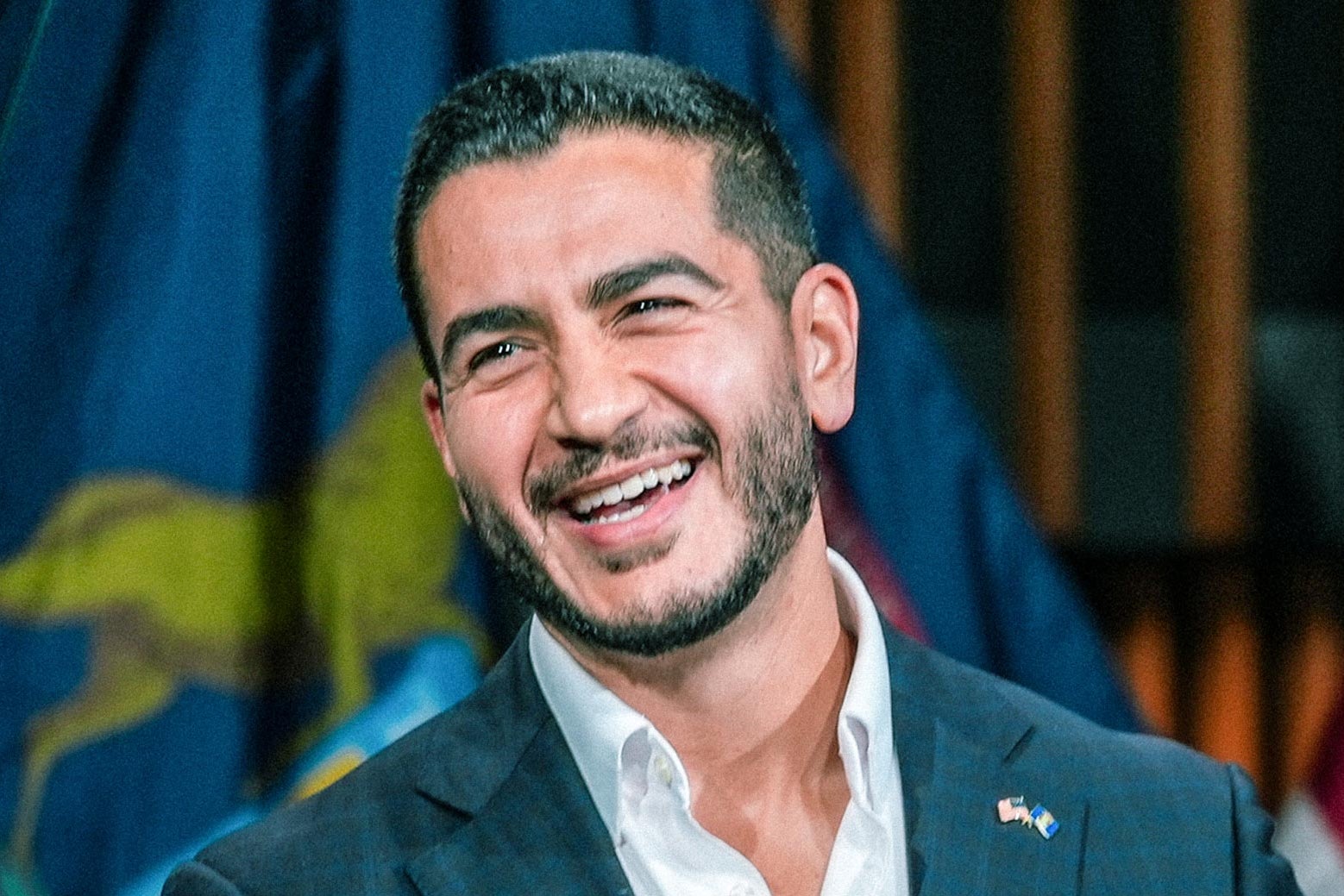
Politics What Michigan Means Abdul El-Sayed’s win in his home state was a seismic event—but even his supporters are trying to figure out what comes now. By Enter your email to receive alerts for this author. Sign in or create an account to better manage your email preferences. Unsubscribe from email alerts Are you sure you want to unsubscribe from email alerts for Aymann Ismail? Nov 13, 20265:40 AM Salwan Georges/Getty Images Sign up for the Slatest to get the most insightful analysis, criticism, and advice out there, delivered to your inbox daily. Abdul El-Sayed arrived to the Capitol on Monday as a senator-elect with the air of a rising political force. Since his win last week over Mike Rogers in Michigan, he’s been on a ubiquitous media tour, confronting issues like U.S. support for Israel and healthcare for all (he offered to name the bill “Trumpcare” if they got it done) with the same brashness he had during the campaign. He posed for beaming photos with other newly elected Democrats and posted a sly, widely shared shot outside his office with his new name plate. It was clear he was enjoying himself. It was all hard to reconcile with what I’d seen on the campaign trail barely even a week earlier in Michigan. Polls showed he held an advantage, but it often wasn’t obvious to me from the ground that he could win. On Election Day, outside Burns Seventh-day Adventist Church in Detroit, a light conversation I had with three men near the entrance took an awkward turn. One had noticed a number of Arab voters, and he wasn’t happy about it. They were “trying to get their guy in there,” he said. Arab-owned corner stores and gas stations, he complained, sold alcohol, tobacco, and vapes that were poisoning the neighborhood. In the best case, an El-Sayed victory would win those business owners favors, the man thought. In the worst, some Arabs would be walking around with bombs strapped to their chests. Then he looked me in eye and asked, “You’re not one of them, are you?” I told him I was. He didn’t take it back. “Well, that’s what they do in their country,” he said. Those claims weren’t much worse than the ads I’d seen about El-Sayed on every television I came across. Republican advertisers spent $46 million on attacks invoking Shariah law, dual loyalties to foreign and domestic Muslim groups, terrorism, or 9/11. One ad used a woman in a niqab as a warning about what El-Sayed would bring to Michigan. Two days before the election, Haley Stevens, the Democrat he beat in the primary, accused him of supporting bigotry and endorsed Rogers. I couldn’t claim to be surprised by any of this, exactly—I was a teenager in the immediate post-9/11 years and knew how ugly it could get—but it was still stunning to see. I first interviewed El-Sayed at his home last April, where he poured me an espresso shot using equipment that looked like it belonged in a laboratory. He reminded me of an older cousin. His Egyptianness was contagious. At one point, I sneezed. “Alhamdulillah,” I said. “Yarhamuk Allah,” he answered without missing a beat. It was the most ordinary exchange between two Muslims, but a remarkable one to have with someone running for the United States Senate. Even then El-Sayed was confident, but he turned shaky when he reflected on his failed bid for Michigan governor in 2018. “It took me years to heal from that, because I felt like I let everyone down,” he told me then. “I don’t want to stumble. I don’t want to fall. I don’t want to dash anybody’s hopes.” That helped explain how forcefully El-Sayed went after his critics, and why his swagger—which, to me, seemed a bit exaggerated at times, given how comes off in private—was so important to his new political persona and his supporters. Since Trump took power, Democrats I interviewed over the years talked about the need for a fighter, and a populist who could deliver on policies that polled well. I understood it on that level. It all felt personal to me, too. How could it not? When people were attacking our ethnicity and religion? I loved watching him punch back, but I also caught myself worrying about how his anger would be perceived. I knew how easily a Muslim man defending himself could be made to look like the dangerous fanatic his opponents wanted people to see. I hated that I was even making that calculation. Maybe that was part of what I saw changing in front me. In New York, Zohran Mamdani had won without apologizing for being Muslim or abandoning his convictions on Palestine. In Michigan, El-Sayed won with the help of organizers who had spent years trying to make Democrats listen. Muslim Americans gave up on waiting for the country to become more accepting. Instead, they organized, challenged their own party, and made themselves harder to dismiss. After a decade of reporting on the limits placed on Muslim political power, I wondered whether I’d become too used to those limits myself. In Washington now, El-Sayed is about to test that and show what really just happened in Michigan. Even his supporters have some questions. Aymann Ismail On election night at the venue where El-Sayed supporters gathered, confident and nervous at once, people ate sliders (beef, not pork) and macaroni and cheese and watched results come in from everywhere but Michigan. Then at about 1:30 a.m. on Wednesday, El-Sayed stepped onto the stage in downtown Detroit and said his whole name into the microphone. “My name is Abdulrahman Mohamed El-Sayed, and I am so proud and honored to stand here as your senator-elect.” The room nearly tore itself apart. I thought I had a pretty good view of the stage until everyone’s phones shot up. Somewhere behind me, an older woman let out a zaghrouta, the ululation you hear at Arab weddings. “Up until right about now, you might have noticed I always say ‘inshallah,’ or ‘God willing,’ whenever the outcome of this race was mentioned.” He continued, “But today, tonight, we can turn that inshallah into a—” “Alhamdulillah!” the room shouted. “For the right-wing ops, that just means ‘Praise be to God,’ ” he added. I texted my editor. Had the race been called somewhere and I missed it? It hadn’t. But he declared victory anyway. (El-Sayed later said Rogers never bothered to call him to concede.) Everywhere I looked, I recognized another face from years of reporting on Muslims and politics, except I was used to seeing these people angry, exhausted, or pleading with someone in power to listen. Now they were cheering, shouting over one another, holding phones above their heads to capture a moment they had spent years working toward—Linda Sarsour, Mahmoud Khalil, Wajahat Ali, Kashif Shaikh, Amani Al-Khatahtbeh, Rima Mohammad, Rania Batrice, Mehdi Hasan, Prem Thakker livestreaming from a corner. Many had come from New York, California, Washington, Texas, or elsewhere. (Notably not in attendance: Hasan Piker, a name I’m pretty sure El-Sayed would rather never hear again.) I knew many of these people from a decade of reporting on the often ugly intersection of Muslims and American politics. One of them, Khalil, is still fighting the government’s effort to deport him over his activism. Now here they were, celebrating the first Muslim elected to the Senate. It felt like 10 years of exclusion from politics had culminated into a single moment in that room. But even amid all that celebrating, many were looking ahead—and they weren’t entirely sure what they saw. Qasim Rashid, a prominent human rights lawyer and activist, was sanguine but cautious. “We love Abdul, but we need to hold him accountable now,” he told me. He wasn’t alone. In 2016, when it still seemed unlikely Donald Trump would become president, I’d gone to the Republican National Convention in Cleveland to take pictures, and a man dressed as Thomas Jefferson approached me, asked if I was Muslim, and, when I said yes, told me Islam was evil. Meanwhile, Muslim Americans like Rashida Tlaib and Ilhan Omar became the first Muslim women in Congress in 2018. Organizers registered voters, built coalitions and institutions, and tried to move politics beyond the question of whether they belonged here at all. I watched Muslim American life become louder and more assured, as actors like Ramy Youssef and Mo Amer modeled success in entertainment. There were disagreements within our community, too, about how much to compromise. And then Gaza made that argument impossible. I began spending real time in Dearborn, Michigan, in spring 2024, when Arab and Muslim voters told me they were willing to hand Trump back the presidency to punish Democrats over Gaza. “Uncommitted” movement organizers Layla Elabed and Abbas Alawieh warned Democrats that their Israel policy could cost them the election. At the Democratic National Convention that summer, I followed the movement’s 30 delegates, representing some 700,000 voters, as they tried to persuade party leaders to let a Palestinian American doctor who’d worked in Gaza speak. After days of evasions, the answer was no. I watched Alawieh sit outside the United Center, head in his hands, refusing to leave. He voted for Kamala Harris anyway, but Trump won Michigan and returned to office. Trump’s administration turbocharged immigration enforcement and targeted pro-Palestinian activists. The Democratic National Committee later left Gaza out of its postelection autopsy. The next time I saw Alawieh, he was at a convention in Michigan, campaigning in the same halls as El-Sayed while running for state Senate himself. On Tuesday night, a few hours before El-Sayed declared victory, a newly elected Alawieh stood before his family in Dearborn’s Byblos Banquet Center and declared, “We’re making history.” He explained the lesson of Uncommitted plainly: “We have to become the leaders ourselves.” And he had a warning. “The path to the presidency in 2028,” he said, “will come through our communities here in southeastern Michigan, and we will have questions.” His father also spoke. “If you want to invest, brothers, invest in your children before you invest in smoke shops and gas stations,” he said in Arabic. He was serious, but I laughed—It sounded a little too close to an Arab dad humblebragging. Then he addressed the president directly. “We want to break this taboo that Arab Americans can’t be the first. It’s not one Abdul coming for you, Trump. Thousands of Abduls are coming for you.” El-Sayed wasn’t exactly created by Uncommitted. He made healthcare, affordability, and getting money out of politics central to his politics from the beginning. He supported the Uncommitted protest vote in 2024, then endorsed Harris. He never promised disillusioned Muslim voters a party that would agree with them on everything. But he is giving them a reason to believe they could change it. Now, in a new moment of new Muslim political power, they’re watching—closely. If El-Sayed is going to be a new face of the Democrats, they expect him to turn into the senator he promised them he’d be. Aymann Ismail Back onstage in Detroit, El-Sayed had a message for the parents who’d spent the campaign explaining to their children why the president was mocking a Muslim man’s name and faith: “Let them know tomorrow that the bad guys lost.” To Rogers, he declared, “You chose hate, and Michigan chose hope.” And Trump, who had spent months trying to make El-Sayed’s name sound threatening, could now just call him “Senator.” It was an extraordinary night for Democrats everywhere. They were projected to retake both chambers. Texas, of all places, had elected a Democratic senator and governor for the first time in three decades, including its first Latina governor, Gina Hinojosa. Latino voters, who had swung toward Trump in 2024, came roaring back toward Democrats. Roughly 7 in 10 Hispanic voters in Texas backed James Talarico for Senate. El-Sayed was hardly the only historic first: Georgia elected the country’s first Black woman governor, New Mexico the first Native American woman governor, Minnesota the first Native American woman senator, and New Hampshire the first openly gay male senator. There were plenty of explanations for this blue wave that had nothing to do with Muslims or Palestine: anger over prices that still hadn’t come down, belligerent ICE raids and deportations, a new war in Iran, a cover-up of the Epstein files, and a broader backlash against an administration that had alienated voters who’d supported it just two years earlier. Exit polls suggested that economic frustration and opposition to Trump gave Democrats the edge. So what could El-Sayed’s victory really tell us about the power of Islamophobia? Had Americans become more willing to elect a Muslim because of his faith, or were they so fed up with Republicans that even an extraordinarily ugly campaign couldn’t change their minds? I’d spent Tuesday driving between polling places in Michigan, and what I heard gave me reasons to doubt a simple answer. There was the exchange I had in Detroit. Then, in West Bloomfield, outside Congregation B’nai Moshe, a synagogue, Gordon Geist, a Republican, was handing out literature for a group called Democrats for Mike Rogers. He told me he was a devout Christian and a patriotic American: “I struggle with Islam, with the rabid aspects of Islam, the radical aspects of Islam.” He claimed El-Sayed was supported by the Muslim Brotherhood, a repeated falsehood in right-wing circles. Then he invoked taqiyya, a religious concept of self-preservation that anti-Muslim activists distort into the claim that Muslims lie to non-Muslims and have a secret plan to take over. He took it as reason to doubt anything El-Sayed said, including about healthcare. “How can you trust a word he says?” he asked me. Rogers, on the other hand, was “a patriot,” he said. “He’s a proven guy. He loves America.” I thought of the less dramatic work I’d watched Mamdani do in New York before his victory: a political speech in a mosque basement, followed by an announcement about somebody’s badly parked car; volunteers passing out flyers as he moved through Chaand Raat celebrations in the Bronx and Queens. None of it looked like history at the time. That groundwork is necessary to withstand enormous spending. Like in Mamdani’s race, the American Israel Public Affairs Committee and affiliated groups spent close to $30 million backing El-Sayed’s opponent in the primary, and an AIPAC-linked super PAC reportedly spent another $12.7 million attacking him in the general election. This was not a contest between Jews and Muslims—exit polls suggested that a majority of Jewish voters backed El-Sayed. But the results did call into question the idea that powerful pro-Israel groups could make a candidate’s position on Palestine disqualifying, no matter how much they spent. None of this proves that a Muslim candidate can now win anywhere, or that the attacks somehow helped El-Sayed. Michigan is not every state. Mamdani and El-Sayed both ran on affordability, not shattering the glass ceiling for Muslims. And though in both races I personally met people who still saw Islam as a reason to think a candidate is dangerous, what the results showed was that those suspicions hadn’t been enough. In Dearborn that day, I’d watched groups of women in niqabs walk into McDonald Elementary to vote. For weeks, a Republican ad had used the image of a woman dressed like them as a warning about the future of Michigan should El-Sayed win. There was something delightful about watching those women be represented as something frightening in the evening, then seeing them show up to the polls the next morning. The man at the church in Detroit might never change his mind about people like them, or about people like me. Maybe the change wasn’t that he suddenly had to. Maybe it was that we no longer needed him to in order to win. El-Sayed’s first week in Washington was thrilling, but also an anxious one, even for some of his own supporters. He has probably just signed up for six years as a Fox News villain, bringing in a new round of conspiracies and backlash. And then there’s the question of the kind of senator he will turn out to be. But for the first time, late on election night, I let myself dream a little. I wondered whether my kids might grow up without that familiar feeling of having to prove they belong here. Maybe one day I’ll try to explain it to them, and they won’t have any idea what I’m talking about. Elections Senate Islamophobia American Islam Michigan 2026 Midterms
No One Knows What Really Just Happened in Michigan
Full Article
Original Source
Read the full article at Slate →KhanList aggregates and links to publicly available news content. We do not host full articles from third-party sources. Always verify important information with original sources.