
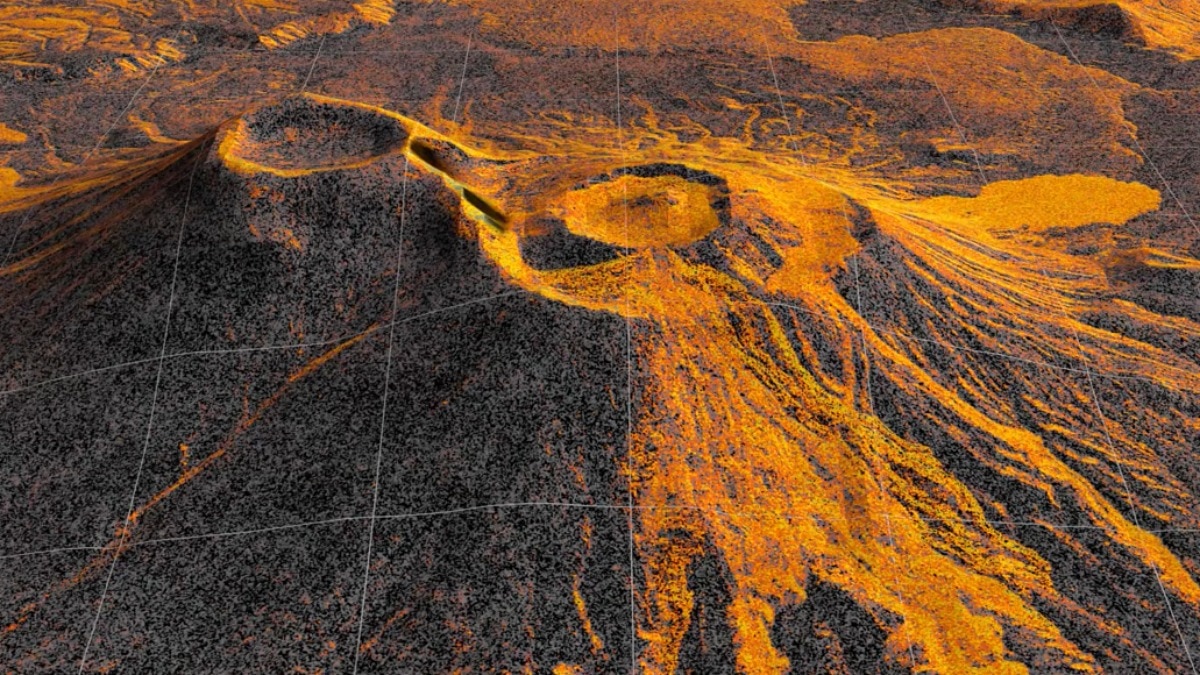
The Nasa-ISRO Nisar satellite has captured detailed radar views of Russia's Krasheninnikov volcano as lava spread across Kamchatka. The observations highlight how repeated all-weather scans can help monitor eruptions in remote hazard zones.The Nasa-ISRO Synthetic Aperture Radar (Nisar) satellite observed the Krasheninnikov volcano. (Photo: Nasa)New Delhi,Sep 25, 2026 11:14 ISTIndia-US Earth-observation mission Nisar has captured a rare, detailed view of an erupting volcano on Russia’s Kamchatka Peninsula, tracking the movement of molten lava as it spread across the landscape.The Nasa-ISRO Synthetic Aperture Radar (Nisar) satellite observed the Krasheninnikov volcano, which erupted for the first time in nearly 500 years after a powerful earthquake struck the region in July 2025.A magnitude 8.8 earthquake hit the Pacific Ocean near Kamchatka on July 30, 2025. Days later, Krasheninnikov, which had remained dormant since around 1550, began erupting.From about 747 kilometres above Earth, Nisar captured its first image of the volcano on December 25, 2025, while the satellite was completing its post-launch checks and becoming operational. Since then, the satellite has repeatedly observed the same region from two different orbital directions. For the first time in nearly five centuries, Krasheninnikov erupted.The @NASA/@ISRO NISAR satellite captured lava filling its caldera and overflowing into a wider crater, showing how NISAR can repeatedly monitor volcanoes and other natural hazards in sharp detail. pic.twitter.com/458fdJOFyQ— NASA Earth (@NASAEarth) September 24, 2026 Researchers combined 17 Nisar images collected through mid-August into a time-lapse showing how the eruption evolved. The sequence reveals lava first filling a smaller inner caldera before spilling into a larger crater and eventually spreading outward in a broad, fan-shaped flow.The observations demonstrate how satellites could provide detailed and repeated monitoring of volcanic activity, particularly in remote areas where ground-based instruments are difficult to deploy. “The consistency is crucial. Twice every 12 days, acquiring in this high-resolution mode and in two observation directions, this shows the promise of Nisar to closely monitor natural hazards,” Matthew Pritchard, a Nisar science team member and geophysicist at Cornell University, said.SEEING VOLCANOES THROUGH MICROWAVESNisar uses synthetic aperture radar, or SAR, to observe Earth. Instead of relying on sunlight like optical cameras, the satellite sends thousands of microwave pulses towards the surface and measures the signals reflected back.By combining these radar observations, scientists can create highly detailed images of the terrain. Each pixel in the Krasheninnikov observations represents an area of roughly 10 metres by 10 metres.The lava appears brighter in the radar images because its surface reflects microwaves differently from the surrounding snow-covered or bare terrain.The sequence shows the main lava field expanding eastward, while another flow can be seen moving northwest. Scientists believe the latter flow formed before Nisar began observing the volcano.The mission is particularly significant because Nisar provides frequent radar observations of volcanoes regardless of daylight or cloud cover. Its coverage extends across virtually all of the world's roughly 1,300 active volcanoes above sea level.Nisar is the first free-flying space mission equipped with two radar systems: an L-band instrument and an S-band instrument. Their different wavelengths allow scientists to study different features of Earth's surface and vegetation.For volcano monitoring, the repeated high-resolution observations could help scientists track lava flows and other changes in hazardous regions, offering a valuable new space-based tool for understanding eruptions and potentially supporting disaster response.- Ends
Nisar captures rare view inside volcano that erupted after 500 years
Full Article
Original Source
Read the full article at Indiatoday →KhanList aggregates and links to publicly available news content. We do not host full articles from third-party sources. Always verify important information with original sources.