
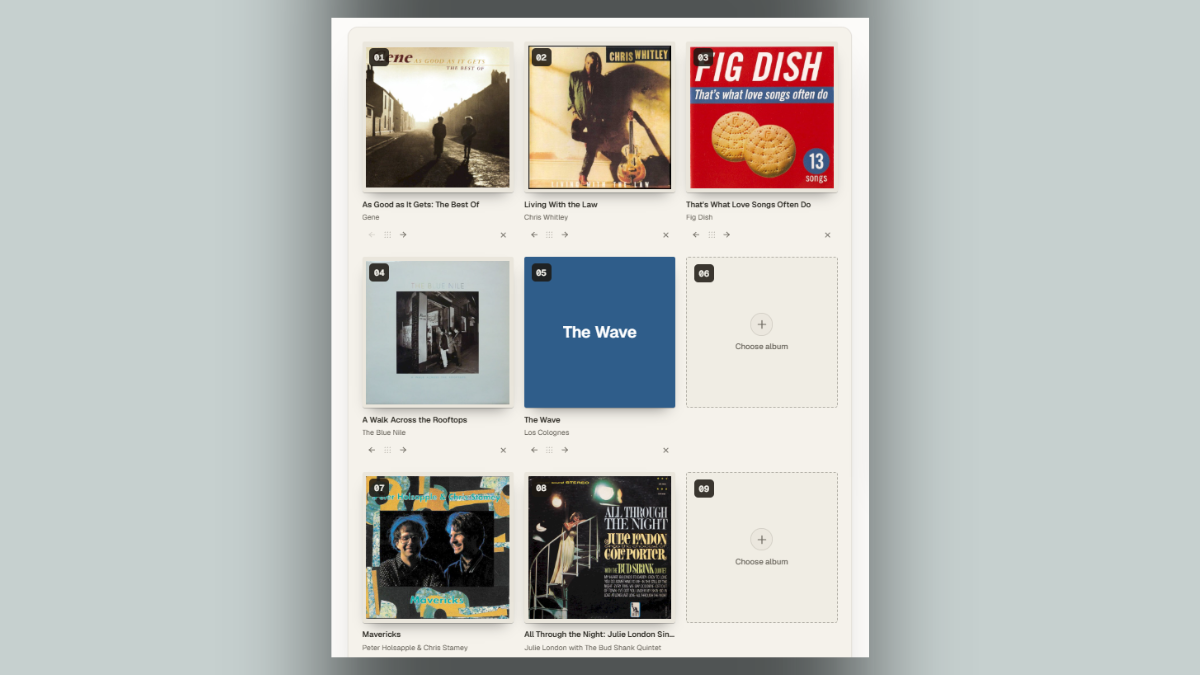
Unless you’ve been living under a rock – or have a healthy life devoid of social media – for the last week or so a lot of people are doing the “nine albums that made me” trend. Basically, there’s a website, my9albums.org, that allows you to input your nine favorite albums and produces a snazzy graphic you can post on Insta or X. While I could have hopped on the (literal, of sorts) bandwagon here, I saw a lot of people with similar taste already posting. I saw someone joke that they could almost tell someone’s birthdate down to the month and year based on this; yes, I’m a 50-year-old white guy music snob so, yes, I concede some of my indie rock faves are predictable. However, I’ve always had adventurous music taste and I thought I’d do something different. I’m going to list nine records I really like that I don’t think most people have heard. I’m sure there are fellow music nerds on here that know these records, but I think we can all agree even if you’ve heard them they are all underappreciated. Also, you’ll see from the photo above, I wasn’t able to complete the graphic on the “nine albums” site. There were two blank spots where the “nine albums” site didn’t have the records listed and another where the “nine albums” site only had the name and not the album art, so there’s definitely obscure-ish stuff here. Stylistically, this is a very diverse group of records – there should be a little something for everyone here. Record One: Gene – As Good As It Gets (2001) At least in America, I don’t think most music fans have a sense of the breadth and depth of the music explosion that came with Britpop. They know Oasis and Blur, might have heard the phrase “shoegaze” at some point, and that’s about it. Which explains why it’s a crime that a band as singularly good as Gene could basically get lost in the din of 90s British bands. As Good As It Gets is technically a greatest hits collection, but it’s an exceptionally cohesive track listing. If you get your hands on a copy of the physical CD (I had to special order it back in the day), Irvine Welsh – the author of Trainspotting – writes the liner notes. Recommended If You Like (RIYL): The Smiths Sample Track: It isn’t their biggest song, but I really dig, “Where Are They Now?” Record Two: Chris Whitley – Living With The Law (1991) Chris Whitley was a brilliant songwriter and performer who died tragically young; he was also an extremely unique and talented guitar player – you don’t see many guys in rock slinging a dobro. Living With The Law was his most successful and probably accessible record, though on any given day I might prefer his more rocking follow-up record, Din of Ecstasy, which has some wild guitar playing on it. Living With The Law is a more subdued record, but no less affecting. It’s a very specific vibe – if you ever find yourself on a desolate road west of the Rockies with many miles ahead of you, this is the record you didn’t know you desperately needed. RIYL: Daniel Lanois, Robbie Robertson’s solo records, John Doe Sample Track: “Big Sky Country” was the big hit off this record and it’s great, but this killer Letterman performance of “Kick the Stones” from 35 years ago really gives you a sense of what a unique and charismatic performer he was. Record Three: Fig Dish – That’s What Love Songs Often Do (1995) I guess you could also say that much like Britpop, the grunge/alternative explosion of the early-to-mid 90s also buried some great bands. In fact, the first song on That’s What Love Songs Often Do is called “Bury Me,” though I doubt that was meant as a commentary on their budding career. Almost no one outside of Chicago heard much of Fig Dish, despite glowing reviews – the Chicago Tribune called TWLSOD “a minor revelation” – and guest vocals on two tracks from Nina Gordon, whose band Veruca Salt was plastered all over MTV at the time. Anyway, if I had to describe the record – imagine there’s a perfect happy medium between Nirvana and Weezer. A band more upbeat and melodic than Nirvana, without any of their dirgey “I Hate Myself and Want to Die” nonsense. At the same time, they stop well short of the cloying neuroses and bubble gum songwriting that defined Weezer as time wore on. Yet, the Fig Dish record is still catchy as all get out and musically adventurous, with lots of unexpected time changes and loud/quiet dynamics. It helps that That’s What Love Songs Often Do was produced by ace Lou Giordano, who’s worked with everyone from Hüsker Dü to the Goo Goo Dolls. Crank it up, this record hits. Fig Dish broke up when their sophomore effort in 1997 was also a commercial disappointment – but they were remembered fondly enough they reformed and put out a pretty decent album in 2024. They’ve been gigging off and on since. RIYL: Nirvana, Weezer, Cheap Trick Sample Track: It’s an album full of bangers, but “Seeds” was the single. Record Four: The Blue Nile – A Walk Across Rooftops (1984) Of all the bands on this list, The Blue Nile are probably the best known, though any familiarity with them probably depends on your interest and/or proximity to the U.K. music scene, where they are successful enough to appear on national shows such as Later with Jools Holland. In any event, for those of us across the pond they’re elusive. I scoured the country for maybe 15 years before I found the vinyl from A Walk Across Rooftops at a record store in Columbus. Another reason they might remain unknown is that the Scottish band has only put out four records in 45 years, and their last full-length LP came out in 2004. However, their sporadic output only seems to add to the legend. Other musicians speak of the band reverentially; being a Blue Nile fan is something of a secret handshake that lets people know you have good taste. Or at least people desperate to convince you they have good taste – the opening lyrics to Taylor Swift’s 2024 song “Guilty As Sin?” references the band and one of their better known songs: “Drowning in The Blue Nile / He sent me ‘Downtown Lights’ / I hadn’t heard it in a while.” The song is presumed to be about Taylor’s ex, Matty Healy of the band The 1975. But for what it’s worth, another one of her famous exes, John Mayer, is also quite public about his love for The Blue Nile. Like I said, musicians really like The Blue Nile. RIYL: Roxy Music, Bryan Ferry, Leonard Cohen, Talk Talk Sample Track: The somber, intellectual funk of “Tinseltown in the Rain” is a car crash of music styles that shouldn’t cohabitate, but succeeds spectacularly. Record Five: Los Colognes – The Wave (2017) I really don’t know much about this band except to say that I discovered them entirely accidentally on the singer’s YouTube channel, which only has a few videos about music gear and doesn’t do much to promote the band. I had to order this record directly from the band’s website, because I don’t think it had distribution. Los Colognes is based in Nashville, but they are definitely not country. In fact, one of the things I really love about The Wave is that, while there are a lot of 80s retro attempts, this record does a remarkable job capturing a very specific 80s vibe – think of the very slickly produced records from the older rockers of that decade. There’s a lot of gated reverb and Linn Drums, and if that means nothing to you, believe me you’ll know it when you hear it. (I would note that John Mayer put out Sob Rock a few years later, a record capitalizing on the exact same niche 80s aesthetic right on down to the album cover.) But it’s not just about the sound; this record is just jam-packed with earworms. I’ve gifted this record to people and every time I play it in front of someone new, they never fail to ask what it is. It’s impossible not to like. RIYL: Dire Straits, The Cars, Phil Collins, Journeyman-era Clapton, Don Henley’s solo records, Springsteen’s Tunnel of Love record. Sample Track: “Molly B Good” is instantly memorable. Record Six: Echo and the Bunnymen – Reverberation (1990) Yes, I know what you’re thinking. Echo and the Bunnymen? How is one of the biggest staples of 80s soundtracks, with ubiquitous hits such as “The Killing Moon,” “Lips Like Sugar,” and “Bring on the Dancing Horses,” on a list of albums you haven’t heard? Well, because 1) purists don’t really consider this an Echo and the Bunnymen record and 2) I am justifiably confident you haven’t heard it. I don’t know what exactly was going on at the end of the 80s, but all was not well with the band. (I started guitarist Will Sergeant’s autobiography earlier this year and haven’t finished it.) I will say when I saw Echo and the Bunnymen a few years back, singer Ian McCulloch was basically unable to sing. Poor performances from McCulloch, and attendant rumors of alcoholism and addiction, have dogged him for years. Anyway, McCulloch put out a solo record that received a lukewarm reception in 1989, and in 1990 the band put out a record without Ian McCulloch. McCulloch’s voice is obviously incredibly recognizable and the band plugging on without him was not received well. Sergeant and McCulloch eventually reteamed for the (also underrated!) side project Electrafixion in 1994 and we had another Bunnymen record surface in 1997. And the band has been consistently putting out records ever since, including one that came out last month. It’s finally become available on streaming services but, near as I can tell, the band has been trying to forget the McCulloch-less Reverberation ever existed – this is one of the records where 9albums didn’t have the cover. Which is a shame, because taken on its own terms it’s a pretty great record. I can’t claim anything on the record reaches the heights of the aforementioned Bunnymen hits you know and love, but it is hook-laden and might be the band’s most consistent record. (That is, if you consider it the same band.) The singer they recruited for the record, Noel Burke of the Belfast band St. Vitus Dance, was definitely a talent who slotted right into the band’s post-punk psychedelia. If Sergeant and company had just decided to release the record under a different name, I suspect people would recognize this as a pretty dang good record instead of a fan-alienating mistake. RIYL: Echo and the Bunnymen (obviously) Sample Track: The album’s consistency is its key attribute, but “Senseless” is a personal favorite. Record Seven: Peter Holsapple & Chris Stamey – Mavericks (1991) Holsapple and Stamey hail from beloved 80s college rock band The dB’s, who like a lot of R.E.M.-adjacent bands of that era were more influential than successful. But they were beloved for a reason – a lot of bands of that era adopted the Byrds-meets-Big Star power pop jangle aesthetic; The dB’s had incredible songs underneath the familiar sound. Anyway, Holsapple and Stamey reteamed as a duo and released a record, Mavericks, in 1991 just as their old pals in R.E.M. were finally conquering the music world. Suffice to say, Mavericks did not set the world on fire but Holsapple and Stamey produced a remarkable record. It’s less rocking than The dB’s, but is a mature record of unparalleled songwriting. It’s just incredible. The pair have since put out two more worthy follow-ups – but the next one didn’t come out until 2021. RIYL: Already mentioned R.E.M., The Byrds, and Big Star, but XTC and Neil Finn/Crowded House are obvious touchstones. Sample Track: “Angel” gives you a pretty good sense of the exquisite craft on display here. Record Eight: Julie London with The Bud Shank Quartet – All Through the Night: Julie London Sings Cole Porter I was driving home after dropping my wife off at the airport at some ungodly morning hour, flipping through the satellite radio channels just trying to stay awake and I landed on London’s rendition of “At Long Last Love.” I was amazed how I could be so riveted by such a smoky ballad at 5:30 am. Within a day or so, I’d ordered the vintage vinyl and it has been in the pantheon of Great Dinner Party Albums ever since. I’ve always regarded London as one of the more underrated jazz chanteuses, but her performances here and the arrangements are superb. The band cooks – among others, jazz guitar legend Joe Pass plays on the record. RIYL: Blossom Dearie, Sarah Vaughan, Peggy Lee, Chet Baker Sample Track: I already mentioned “At Long Last Love,” but you can’t go wrong here. Record Nine: No Los Angeles – El Prado (2014) What’s in a name? Well, if you’re in a band these days, it turns out a lot. Case in point: Some friends of mine were in a fantastic, tragically overlooked band called The Standard. (Another act I could easily add to this list.) Their name wasn’t really an issue when they formed in the late 90s, but as the influence of the internet grew, trying to Google a name as generic as “The Standard” became a major marketing handicap. (For what it’s worth, The Standard’s singer Tim Putnam eventually got damn good at marketing. In 2007, he founded Partisan Records, which is now the home of major indie acts such as Fontaines D.C. and PJ Harvey.) Anyway, by the time 2014 rolled around the band No really, really should have known better. No was the moniker they were going under when I first heard of them, but in addition to being Google-screwed, perhaps there were legal issues because they changed their name, and fast. By the time I tracked down vinyl a couple of months later, the band was going under the name “Black English.” And worse, the name of the album had been “El Prado,” but in order to make the name change they had lazily slapped a sticker on the record cover where the album title had been, thus changing the record title and the band’s name. So instead of “El Prado” by the band No, the album was “No” by Black English. If I hadn’t seen the record cover online previously and recognized it, I probably never would have found it randomly in the “B” section of the record store – and I had been looking for it. Anyway, I looked up the band on Spotify when I was writing this and had trouble finding them yet again, because at some point in the last couple of years they changed the band’s name again to “No Los Angeles.” So if you’re wondering why this album didn’t take off, I suspect making the band’s name like a box of chocolates really, really didn’t help. Anyway, that’s too bad because this is a remarkably hooky, anthemic indie rock record. RIYL: The singer’s baritone draws obvious comparisons to The National, but the band’s sound is a little more driving in a way that evokes The Killers at times. Sample Track: Check out “Leave The Door Wide Open,” which has a fun Magritte-inspired video. Mark Hemingway is the Book Editor at The Federalist, and was formerly a senior writer at The Weekly Standard. Follow him on Twitter at @heminator 9albumsmusicnine albums that made meunderrated music
Nine Great Albums You (Probably) Haven’t Heard
Full Article
Original Source
Read the full article at Thefederalist →KhanList aggregates and links to publicly available news content. We do not host full articles from third-party sources. Always verify important information with original sources.