
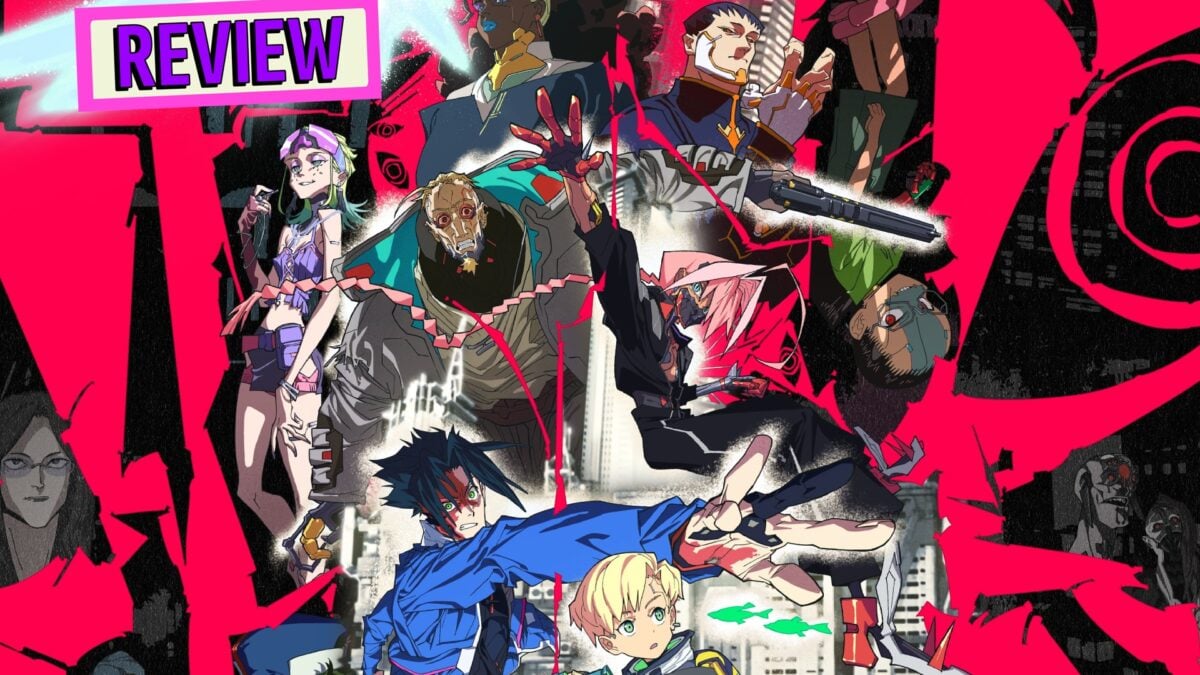
When the world first set eyes on video game developer CD Projekt RED and renowned anime Studio Trigger‘s Netflix series, Cyberpunk: Edgerunners, expectations weren’t particularly high. If anything, folks envisioned a serviceable anime tie-in, swallowed by a series in dire need of good PR. No one could’ve predicted the ten-episode show would exceed every expectation, becoming 2023’s anime of the year and reinvigorating interest in a troubled game long before it finally got fixed. Now, expectations are at an all-time high for the once-standalone series and its new crew of chooms to either capture lightning in a bottle twice or hoist itself by its own petard with Cyberpunk: Edgerunners 2. Although the show falls just short of the dizzying highs of David Martinez’s far more distilled tragedy, Cyberpunk: Edgerunners 2‘s second look at Night City tells a far more expansive story, widening the aperture of its dystopian world. Across its ten episodes, Cyberpunk: Edgerunners 2 sets Night City ablaze once more, weaving a transportive tale that feels wildly more ambitious, consequential, and warmly aspirational than its predecessor. Cyberpunk: Edgerunners 2, written by returning scribe Bartosz Sztybor and directed by Kai Ikarashi, wastes no time in its ads telling fans its former hero, David Martinez, is cadaveriffic. He ain’t coming back. Instead, the creatives introduce an even more interesting wrinkle for their second go around in Night City: what if the tale followed four heroes who, as protagonists in their own stories, also act as antagonists from the other’s perspective? Enter: Roman Carax (EN: Valeria Rodriguez JP: Momoka Terasawa), a young cinephile documenting LiveLeak-esque footage from his 35mm camera for eddies; D (EN: Nazeeh Tarsha, JP: Kouki Uchiyama), a nomad with a mysterious past on a warpath; Weak Kingsley (EN: Clancy Brown, JP: Kentaro Tone) a washed-up cyberpunk legend looking for a new sense of purpose; and Talia (EN: Kimoy Lee, JP: Akari Kitou), a woman who’s more chrome than flesh, running around with the wrong crowd. Coming to Edgerunners 2, its odds were a bit stacked against it. I’ve always thought the first season was one of Trigger’s best because it felt like they reined themselves in from their usual bombast—the kind that inevitably sends their defiant heroes screaming past the atmosphere into space. Edgerunners told a compelling story I always wanted from the games. So the moment Stybor compared season one to a Michael Bay spectacle and season two to a Martin Scorsese joint at the Edgerunners 2 Anime Expo premiere, I was fully on board with whatever it planned to deliver. Sure, both shows share a minimalistic, stylized opening title sequence no one in their right mind would skip (season two swaps The Cure’s “10:15 Saturday Night” for Franz Ferdinand’s “This Fffire” from season one), but that’s the last similarity the series share. © TRIGGER/CD Projekt RED/Netflix © TRIGGER/CD Projekt RED/Netflix © TRIGGER/CD Projekt RED/Netflix © TRIGGER/CD Projekt RED/Netflix © TRIGGER/CD Projekt RED/Netflix © TRIGGER/CD Projekt RED/Netflix © TRIGGER/CD Projekt RED/Netflix © TRIGGER/CD Projekt RED/Netflix For starters, calling the quartet a crew like David’s chooms is a misnomer. For most of the show, they split into duos, crisscrossing and clashing throughout Edgerunners 2’s ten‑episode run as each chases their own shifting goalposts. Matters get even more complicated when a mysterious digital construct is dropped between them like a loaded gun. Tucked inside the shard is a grant that bestows immense power, monkey’s‑paw style. In typical Edgerunners fashion, the anime is teeming with brutal carnage, slick action sequences, and writing that hopes to hit as hard as its cybernetic heroes. After the credits roll on both the English and Japanese dubs, Edgerunners 2 doesn’t reach quite as many noteworthy highs as its predecessor. It’s a tough curve to grade on. But as far as a video game adaptation sequel, it does manage to pull off a genre convention in a mostly satisfying way. In video games, there’s a term called a vertical slice. A vertical slice is a small, fully polished playable chunk that lets gamers experience all its key components: gameplay, art, animation, etc. It’s essentially a proof-of-quality diamond test, demonstrating a game can deliver what it promised in its buzzword-laden promotional material. While Cyberpunk: Edgerunners sings as a film-noir romanticization of what it means to be an “edgerunner” through the naive eyes of its protagonist, Cyberpunk: Edgerunners 2 shifts into an entirely different tempo. It’s abundantly clear that Edgerunners 2‘s story is a love letter to touchstones like Pulp Fiction, Léon: The Professional, and City of God. Likewise, Trigger does Trigger things while also occasionally dipping its toes into the futuristic aesthetics and stylizations of genre classics like Blade Runner and Akira. Rather than settle for a cosplaying pastiche of their narrative beats, Frankenstein-ing reference fodder from what worked for each influence, Edgerunners 2 takes their pathos to weave a story that’s expansive, subversive, and, for the most part, moving by being a vertical slice of everything both the anime and the games have to offer. In so doing, the anime bites off a bit more than it can chew. Narratively, Edgerunners 2 sits at the intersection of its first season and its video game counterpart. As a sequel to its first season and a prequel to the game, its narrative can be seen as the tissue stitching their major plotlines together. That said, the show never feels so tightly woven that it can’t stand on its own. The familiar Cyberpunk hallmarks are all here: corporate secrets never meant to see daylight, shootouts with rival gangs, and plenty of familial angst. However, instead of chasing the catharsis of a pie‑in‑the‑sky dream, Edgerunners 2 interrogates whether the obsession to make ends meet—at any cost—is worth it. Each protagonist feels like CD Projekt Red and Trigger rotate saves between each player character backstory from Cyberpunk 2077. While the game’s corpo, nomad, and street kid backstories start differently, they invariably follow the same storyline with small touches of narrative differences. It’s a pretty big weak point of the game. Only here, the quartet authentically corrupt each other’s saves by intersecting their stories to see how caustic their heroes’ journeys would look when put in conflict with one another. It’s a neat concept in theory, bolstered by the fact that Roman, Talia, Weak, and especially D have a long road ahead of them in answering that question of how much they’re willing to risk to succeed in a world where Night City always wins. Fascinatingly, the show’s path to answering this question extends beyond an internal quandary, spilling out into Night City’s denizens, who take on more agency in the story than in its first seasons, and arguably in the games themselves. Be they malestrom gonks, politicing corpo elites, double-crossing gangsters, or everyday citizens trying to make ends meet, everyone in Night City reacts to and rebuffs its ensemble. At times, that beast grows into a larger force than its four protagonists, turning them into bystanders as Night City engulfs itself in an all-encompassing fit of rage and righteous vengeance. To the show’s credit, the vocal performances across the board do a phenomenal job of guiding their characters through every pothole from point A to point B in Edgerunners 2. While he takes a backseat to the rest of the cast, Brown’s performance as Weak makes him an early favorite of the season. As the show’s emotional anchor, every scene with Weak present serves as the tide that lifts all ships for every actor sharing a scene with him. Visually, Edgerunners 2 is absolutely stunning. Every frame of the show’s animation feels rougher, rawer, and unruly, matching its story’s mix of cinematic prestige and “I shouldn’t be looking at this” snuff-film presence. No two scenes look alike; colors will drop out of an action sequence, leaving character sketched in eclectic outlines. Likewise, grainy footage vignettes from Roman’s camcorder capture both the horrors and fleeting moments of joy in Night City. © Studio Trigger/CD Projekt RED/Netflix © TRIGGER/CD Projekt RED/Netflix © TRIGGER/CD Projekt RED/Netflix © TRIGGER/CD Projekt RED/Netflix That said, the show occasionally feels stretched thin, spinning as many narrative plates as it does. Unlike the first season’s dive into David’s would‑be hero’s journey, Edgerunners 2 swings its lens toward Night City’s citizens as active participants in the moving and shaking left behind by its protagonists and the megacorps lording over them. One caveat to keeping all those intersecting storylines moving is its occasional over-reliance on montages and time jumps. Stylish as hell, sure, but they sometimes make the pacing—and the season’s escalation in the back half—feel unruly and unfocused. That’s not to say the characters’ endings come out of nowhere; it’s more that the show barely gives its teeth enough time to bite, or for viewers to understand the characters’ motivations and decisions once everything goes disastrously sideways. The invitingly hopeful note Edgerunners 2 ends on worked for me, even if it comes together in a slightly contrived, puzzle‑piece‑jammed‑into‑place way. Much of that strain comes from the glaring sense that its crew never really functions as an ensemble the way the first season’s cast did. The quartet’s storylines, while brushing against one another, barely intersect in a way that feels wholly memorable. They connect with one another just long enough to keep the plot moving, but never mesh in a way that justifies four protagonists whose collective arc lands far softer than the single, tightly focused journey that anchored season one. More often than not, they feel like characters who’d be better served headlining their own series rather than sharing space in one that never figures out how to make them cohere. The result is a maximalist show with one too many ideas running loose across four characters whose stories aren’t that interesting when you put them together outside their occasional roles as allies and annoyances. As both a sequel and a video game adaptation, CD Projekt RED and Trigger’s follow-up is far from derivative or a cynical cash grab coasting on its name recognition. Nevertheless, the huge narrative swing of Cyberpunk: Edgerunners 2 ultimately falls palpably short of its predecessor’s highs. If the emotional damage from Cyberpunk: Edgerunners’ first season left a scar, Cyberpunk: Edgerunners 2 will only leave a bruise you don’t remember getting once the credits roll. All ten episodes of Cyberpunk: Edgerunners 2 premiere on Netflix on October 20. Want more io9 news? Check out the best movies and TV shows to stream this month and all the upcoming sci-fi, fantasy, and horror books that should be on your radar.
Night City Doesn’t Burn Quite as Brightly the Second Time in ‘Cyberpunk: Edgerunners 2’
Full Article
Original Source
Read the full article at Gizmodo →KhanList aggregates and links to publicly available news content. We do not host full articles from third-party sources. Always verify important information with original sources.