
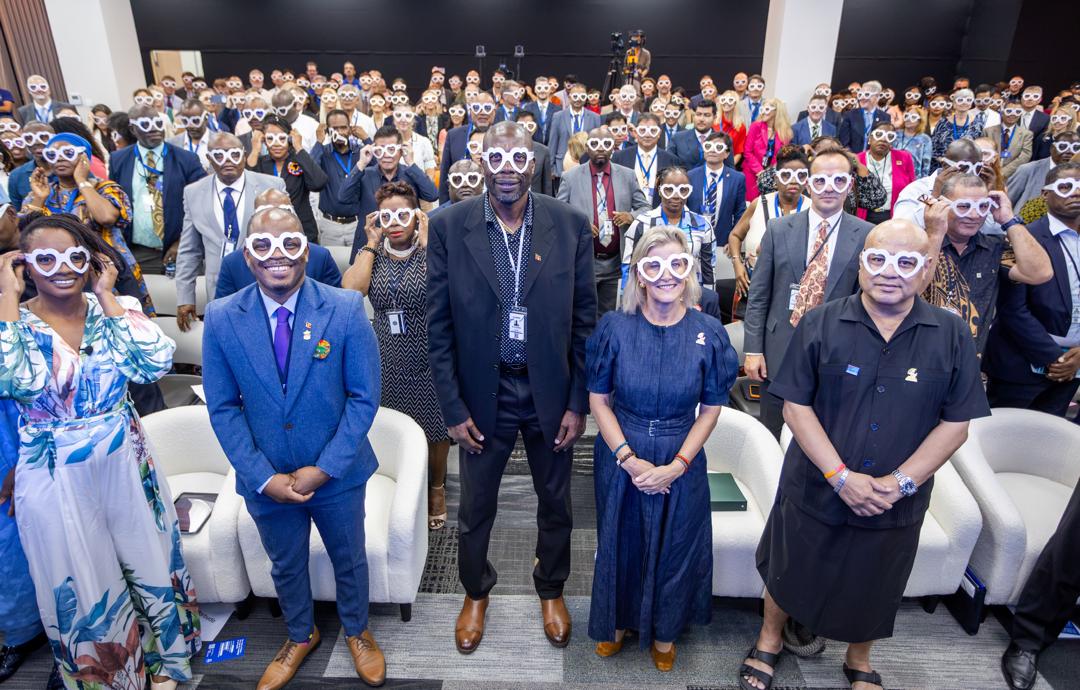
Nigeria to Expand Eye Care to 25m People, Accelerate Universal Health Coverage Delegates at the Global Summit on Eye Health wearing the signature-heart-shaped glasses synonymous with the Internal Agency for Prevention of Blindness (IAPB) #LoveYourEyes Campaign held on Tuesday at St. John's, Antigua and Barbuda. The Federal Government of Nigeria, alongside its partners, has announced a major commitment to strengthening eye health services and advancing progress towards Universal Health Coverage (UHC). By 2030 the initiative aims to reach more than 25 million vulnerable Nigerians through expanded access to equitable, high-quality eye care, enabling more people to fully participate in education, work and community life. The commitment was announced on Tuesday at the Global Summit for Eye Health, hosted by the Government of Antigua and Barbuda, co-hosted by the Governments of Bangladesh, Guyana, Ireland and Nigeria, in technical collaboration with the World Health Organisation. It was convened by the International Agency for the Prevention of Blindness (IAPB). According to a statement from the summit, Nigeria is advancing efforts to reduce avoidable vision loss by integrating Primary Eye Care (PEC) into Primary Health Care (PHC), building the capacity of frontline health workers, and expanding access to essential services for women, older people and underserved communities including those in rural and hard to reach areas, where access to eyecare services can be limited. Under the commitment, Nigeria will fully integrate Primary Eye Care into Primary Health Care services nationwide, train 10,000 primary health care workers in eye care, distribute 5 million pairs of ready-made reading spectacles, provide 25,000 fully subsidised cataract surgeries, increase the active eye care workforce by 20%, and Increase Nigeria’s Effective Cataract Surgical Coverage (eCSC) by 30 percentage points by 2030. Senator George Akume, Secretary to the Government of the Federation (SGF), addressing delegates during the inaugural Global Summit on Eye Health, held on Tuesday at St John’s, Antigua and Barbuda. The commitment, jointly submitted by multiple partners including Sightsavers and Christian Blind Mission, builds on Nigeria’s existing eye health strategy and recognises that avoidable vision loss remains a significant health, social and economic challenge. In 2020, an estimated 24 million Nigerians were living with vision loss, while approximately 1.3 million people were blind. According to the “Value of Vision: The case for investing in eye health report on Vision Atlas”, investing in eye health in Nigeria could deliver US$2.45 billion in economic benefits by 2030 from an investment of US$110 million, while improving educational outcomes, productivity, road safety and mental health. The analysis estimates that such investments could avert 13,590 cases of depression, prevent 56 traffic deaths, avoid 1,479 traffic injuries, and generate the equivalent of 70,641 additional years of learning, the summit stated. Speaking at the summit, George Akume, Secretary to the Government of the Federation, said: “For too long eye health has been treated as a footnote in the global development conversation. We must alter that paradigm because vision care is an economic accelerator… We cannot eradicate poverty, we cannot ensure inclusive education, and we cannot foster sustainable economic growth if a billion people are left in the dark, and the Value of Vision report shows what a modest investment can do. $71 billion over five years spent on six critical priorities would unlock $199 billion in economic benefits by 2030.”An example of this collaborative approach is the Focus on Clear Vision project, supported by Sightsavers, government and other partners in Kebbi, Jigawa and Bauchi states. The initiative is helping school-aged children access essential eye care through vision screening and the provision of spectacles to those who need them. To date, the project has screened more than 1.5 million children and teachers and distributed over 33,000 pairs of glasses. Also speaking on the project, Abimbola Ogundirahun, Country Manager, Vision Spring, said it is supporting the Federal Ministry of Health’s Jigi Bola initiative, which aims to integrate access to reading glasses into primary healthcare. Through training, technical assistance and the supply of affordable, fit-for-purpose eyeglasses, VisionSpring is helping strengthen the capacity of frontline health workers to deliver vision services. Peter Holland, CEO, IAPB, said: “The Global Summit for Eye Health marks a defining moment for global eye health. Never before have so many governments, organisations, and private sector leaders come together around a shared commitment to expand access to sight-saving care. The package of commitments announced this week will improve the lives of hundreds of millions of people and help them go to school, stay in work, care for their families, and participate fully in society. It demonstrates growing recognition that investing in eye health is an investment in human potential, economic growth, and sustainable development.”
Nigeria to Expand Eye Care to 25m People, Accelerate Universal Health Coverage
Full Article
Original Source
Read the full article at Thisdaylive →KhanList aggregates and links to publicly available news content. We do not host full articles from third-party sources. Always verify important information with original sources.