
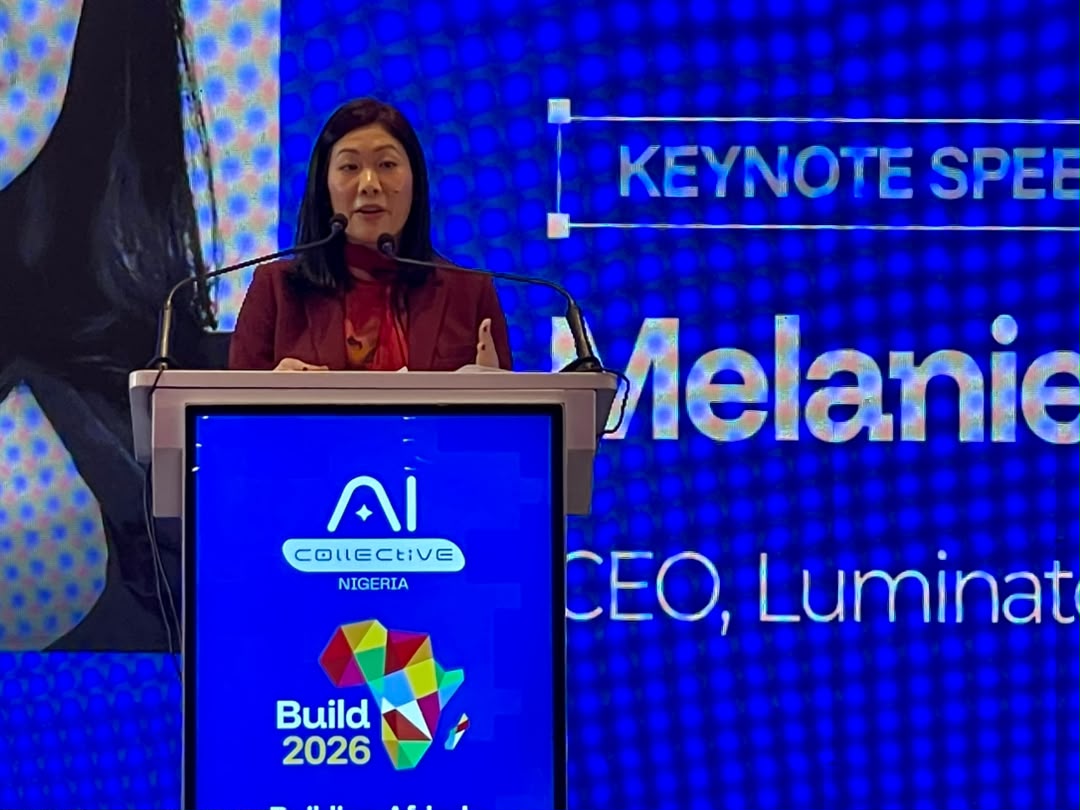
Nigeria Shows Global Tech Giants Are Not Beyond Reach, Says Luminate CEO The Chief Executive Officer of Luminate, Melanie Hui, has praised Nigeria as a leading example of how African countries can shape the global artificial intelligence economy rather than simply consume it. She pointed to the country’s regulators, workers and innovators as proof that the continent is already setting its own terms. Hui gave the keynote address at the Build 2026 Conference in Abuja on Wednesday. The audience included the Honourable Minister of Communication, Innovation and Digital Economy, heads of government parastatals, members of the diplomatic community and members of the Nigeria AI Collective. She said research Luminate commissioned this year on the continent’s AI landscape “found not only patterns of extraction and inequality. It found imagination and leadership.” “Here, there are important reasons for optimism,” she said. Hui cited the action Nigeria’s competition authority took against Meta over data exploitation and discriminatory practices. She said this showed that “global tech companies are not beyond the reach of national institutions.” She also praised app-based drivers in Nigeria for securing government recognition for Africa’s first e-hailing trade union. She said innovators across Nigeria are “using locally built, practical technology to serve the underserved: from bringing reliable banking for rural communities to tackling massive crop losses.” Her examples from elsewhere on the continent were litigation in Kenya establishing that global technology companies can be brought before Kenyan courts civil society coalitions in South Africa challenging bulk surveillance at the Constitutional Court AI-assisted learning materials in local languages helping children in Mali drones extending healthcare to remote islands in Uganda “They are not merely enduring technology,” she said of Africa’s technologists, teachers, climate advocates, feminists, trade unions, youth movements and public interest lawyers. “They are shaping and reshaping it.” “These examples matter because ownership is also about power: the power to negotiate, regulate, organise and secure remedy,” she added. Hui’s speech was titled “Africa in the Global AI Order: Towards Equitable Ownership and Shared Prosperity.” She made clear that Luminate stands behind Africa’s ambition to be a full participant in the AI economy. “My African friends tell me they will not be confined to the role of consumer, supplier of raw data, source of critical minerals or provider of low-paid labour in somebody else’s AI economy,” she said. “And Luminate will stand with them in securing a better digital age.” She said equitable ownership “means moving beyond participation alone.” It means having “meaningful influence over the infrastructure, the institutions, the partnerships, the choices that will determine Africa’s digital future.” She also said Africa’s young and growing population, along with its markets, languages and cultures, “will be enormously valuable to the development of future AI systems.” Hui rejected the argument, made by some in the tech industry, that regulation holds innovation back. She offered a more hopeful view of how growth and fairness can go together. “Those of us who promote tech justice must not lend credence to some in the tech industry who would paint regulation as a brake on progress. I disagree,” she said. “Safeguards are the allies of progress. Inclusion is the engine of meaningful scale. Sovereignty means being stronger together.” “Prosperity is not shared automatically,” she added. “It is shared because workers have bargaining power. Because markets can compete. Because regulators and courts have resources and authority. Because people can seek remedy when they are harmed.” To show what successful AI deployment needs, Hui described how India’s Ministry of Agriculture and Farmers’ Welfare used AI to predict the start of the monsoon for 40 million farmers. She credited African expert Rose Mutiso with the insight that AI “was the last piece of this breakthrough, not the first.”
Nigeria Shows Global Tech Giants Are Not Beyond Reach, Says Luminate CEO
Full Article
Original Source
Read the full article at Thisdaylive →KhanList aggregates and links to publicly available news content. We do not host full articles from third-party sources. Always verify important information with original sources.