
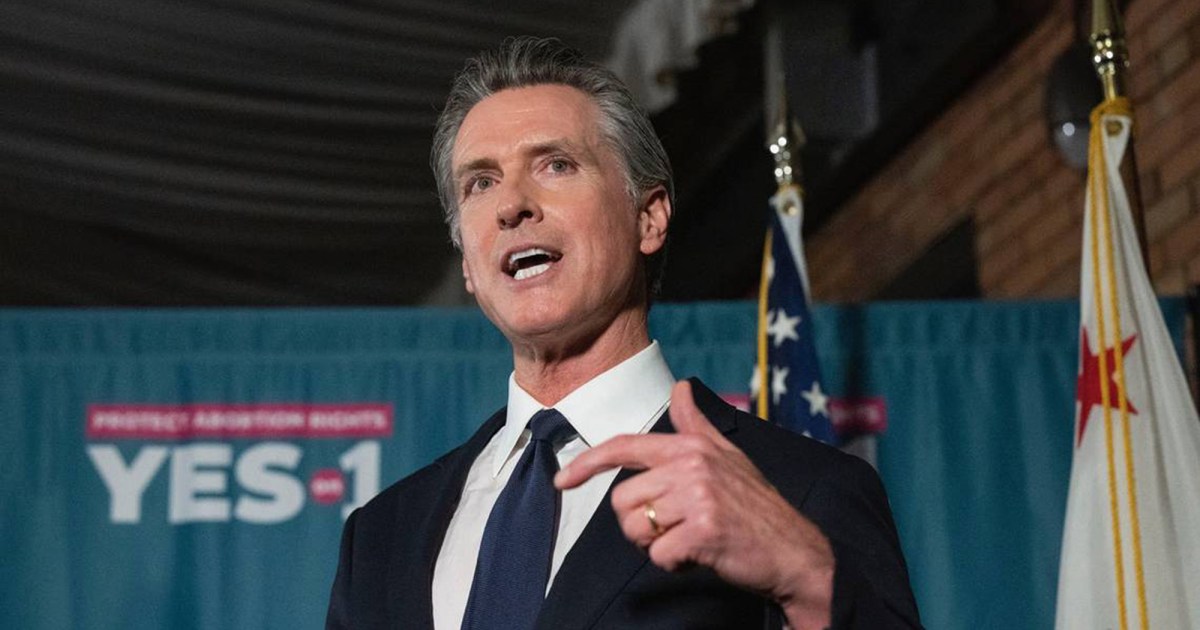
Gov. Gavin Newsom at a November 2022 watch party for Proposition 1, which enshrined reproductive freedom in California's constitution.Hector Amezcua/TNS/ZUMA Get your news from a source that’s not owned and controlled by oligarchs. Sign up for the free Mother Jones Daily. When Louisiana authorities tried to extradite a California doctor last winter for sending abortion pills to women in their state, Gov. Gavin Newsom pushed back—hard. “We will not allow extremist politicians from other states to reach into California and try to punish doctors based on allegations that they provided reproductive health care services,” Newsom declared. “Not today. Not ever.” Yet nine months after that ringing defense of abortion providers and reproductive freedom, Newsom has blocked Democratic efforts to enshrine the same anti-extradition policy into state law. The soon-to-be-ex-governor has vetoed a bill that would have prohibited future governors from handing over abortion providers, helpers, and patients to red states for criminal prosecution. The bill also barred extraditions involving transgender care. Newsom’s decision was “incredibly disappointing” and “certainly not what we were expecting,” says Pavitra Abraham, director of state campaigns for Reproductive Freedom for All. The veto of AB 2164—also known as the Care Without Fear Act—has alarmed reproductive rights advocates around the country because of California’s critical role in preserving abortion access since the Dobbs decision overturned Roe v. Wade in 2022. The state is home to telemedicine providers, mail-order pharmacies, research organizations, and other groups that have helped keep abortion pills flowing even to the most conservative parts of the US. Much of that abortion infrastructure is built on so-called shield laws that protect reproductive care across state lines. California has some of the most robust shield laws in the US, protecting providers, helpers and patients from out-of-state legal action over abortion and gender-affirming care. Newsom signed California’s first shield laws in 2022 and has consistently backed legislation to strengthen those safeguards. But he has resisted efforts to codify one key protection: a ban on extraditions in criminal cases, like the one Louisiana authorities sought earlier this year. Instead, Newsom argues that decisions on extradition should remain an “executive function”—a prerogative of the governor rather than the legislature, preferably addressed by executive order rather than written into state law. That distinction doesn’t matter much as long as California has a chief executive who supports reproductive rights. But it could be disastrous if a Republican won the governorship. “Legislatively enacted laws are just on firmer footing when there are political changes at the executive level,” says Amanda Barrow, senior staff attorney at the UCLA Law Center on Reproductive Health, Law, and Policy. An executive order of the type Newsom has used to fight extraditions “could be revoked by a governor who is anti-abortion or anti–gender-affirming care.” So, with Newsom winding up his second term as governor and widely expected to run for the Democratic presidential nomination in 2028, California reproductive advocates made a ban on extradition one of their top legislative priorities for 2026. Eighteen other Democratic-run states have enacted laws prohibiting extradition of abortion providers and patients. “California cannot call itself a safe haven for reproductive freedom while leaving abortion providers just one election away from extradition.” AB 2164 would have gone even further than most of those statutes, extending California’s shield-law protections to providers and helpers based in other blue states where abortion and gender-affirming care are legal. Supporters seemed confident that Newsom would sign the bill into law. After all, this is the same governor who, when faced with President Donald Trump’s extraordinary effort to gerrymander red-state congressional seats to rig the midterm elections, responded with his own redistricting plan, in the form of last year’s Proposition 50. Four years ago, he signed a law making California the first sanctuary state for trans minors seeking medical care. But instead, Newsom vetoed the bill, announcing the move in a Sunday legislative update. In his statement explaining his decision, Newsom pointed to his strong record on reproductive health issues, including privacy. But he said he was “troubled by the precedent that would be set if an outgoing administration agreed with the Legislature to erode the executive authority of an incoming Governor based on their shared policy preferences, regardless of how righteous and well-intentioned those actions may be.” That stance “is cold comfort to Californians living and working in the real world post-Dobbs,” Lizzy Hinkley, legal director of Abortion Coalition for Telemedicine, the bill’s lead sponsor, responded in a statement. “A high-brow, academic justification for refusing to codify legal protections only reveals an ignorance for the lived reality of patients and providers—and does nothing to help them.” Newsom’s veto—which some social media commenters criticized as pandering to conservatives ahead of a presidential run—also seems to reflect the widespread assumption that Democrat Xavier Becerra is a shoo-in to defeat Republican Steve Hilton in November’s gubernatorial election. Becerra—a former California attorney general and President Biden’s secretary of Health and Human Services in the aftermath of the Dobbs decision—has been a staunch defender of reproductive and trans care, while Hilton has said he would have extradited California abortion doctor Rémy Coeytaux to Louisiana as requested in January. Hilton later walked back that position. Texas and Louisiana attorneys general have also targeted telehealth abortion providers in New York and Delaware. But Becerra’s widening lead in the polls doesn’t mean a ban on extraditions isn’t needed, the bill’s supporters counter. “That mentality of people saying, ‘It’s going to be fine, a Democrat’s going to win, it’s California, blah blah blah’—it’s just really dangerous,” Abraham says. “California cannot call itself a safe haven for reproductive freedom,” she adds, “while leaving abortion providers just one election away from extradition.” Newsom still has not acted on several other important reproductive-related bills this session, including AB 2540, which would make medication abortion available to community college students in the state, and AB 1973, which would expand the ability of non-physicians to provide abortion care.
Newsom Vetoes Bill That Would Ban Extraditions for Abortion and Gender-Affirming Care
Full Article
Original Source
Read the full article at Motherjones →KhanList aggregates and links to publicly available news content. We do not host full articles from third-party sources. Always verify important information with original sources.