
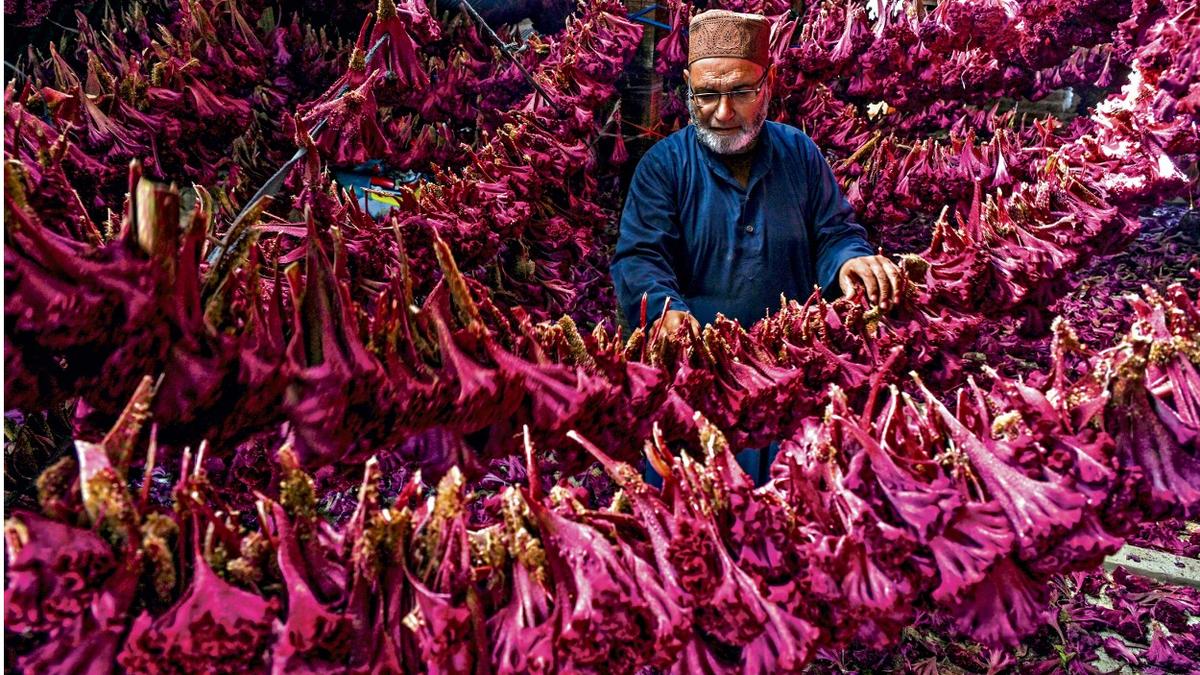
The cockscomb flower (Celosia cristata) is recognisable by its distinctive, velvety, fan-shaped crest that resembles a rooster’s comb. Rich crimson pigment is concentrated in the dense and highly textured folds of the blossom and these petals are harvested and dried to give traditional Kashmiri dishes their signature ruby-red colour.Cultivated in the fertile valleys of Kashmir, these blossoms are carefully handpicked at peak bloom, sun-dried to preserve their intense natural pigments, and stored for year-round culinary use. The dried flowers are locally known as mawal.Mawal holds a sacred status in the wazwan — the famous multi-course royal feast prepared by master chefs known as wazas. It imparts a subtle, earthy undertone that seamlessly complements heavy spices without overpowering them. Mawal is usually sold in the traditional markets of Srinagar. To release the signature crimson colour, the dried flower petals or mawal powder is steeped in hot water. The resulting rich, ruby extract is then strained directly into simmering gravies.Mawal is indispensable in classics like rogan josh (meat curry), adding colour and flavour to the famed gravy alongside mild Kashmiri red chillies. It is also added to dishes like rista (spiced meatball curry), mirchi korma (chillies curry), and vegetarian specialities like dum aloo (potato curry).Mawal reflects Kashmir’s deep-rooted heritage of using local flora for natural, organic cooking. In traditional medicine, it is valued for its soothing and cooling properties, making rich, meat-heavy wazwan courses easier to digest.As an irreplaceable element of Kashmir’s gastronomic identity, mawal helps elevate every feast into a visually stunning and authentic experience.Photo: Imran Nissar Preparations under way: Bashir Ahmad, a farmer, arranges freshly harvested cockscomb flowers inside his house in Srinagar for drying.Photo: Imran Nissar Pretty blossoms: Farmers harvest cockscomb flowers on the outskirts of Srinagar.Photo: Imran Nissar A blooming affair: A butterfly feeds on nectar from a cockscomb flower.Photo: Imran Nissar Nature’s pigment: Cockscomb flowers are harvested at full bloom for their red pigmentPhoto: Imran Nissar Slick cut: Flowers being harvested for their petals. Once dehydrated, the red blooms are stored and later ground into a powder or used to extract the natural colouring for Kashmiri dishesPhoto: Imran Nissar Bed of petals: The dried petals are used in traditional cuisinePhoto: Imran Nissar Floral stock: Workers sift through the petals to get them ready for the marketPhoto: Imran Nissar Intense colour: Sun-drying cockscomb flowers helps preserve their natural pigment.Photo: Imran Nissar Finishing touch: A farmer shows the dry petals, which become a prized ingredient for rich gravies and sumptuous dishes.Photo: Imran Nissar Before the feast: A chef presses the essence of powdered cockscomb flower into a dish for wazwan, Kashmir’s traditional multi-course banquet.Photo: Imran Nissar Colouring tradition: Powdered mawalis ready to offer a rich colour to traditional cuisinePhoto: Imran Nissar Vibrant hues: Awaza, a traditional Kashmiri master chef, adds the essence of mawalto a dish during the preparation of wazwan. The flower lends its distinctive crimson hue to dishes such as rogan josh and rista Published - November 01, 2026 07:59 am IST
News In Frames: Velvety crimson is Kashmir’s treasure
Full Article
Original Source
Read the full article at Thehindu →KhanList aggregates and links to publicly available news content. We do not host full articles from third-party sources. Always verify important information with original sources.