
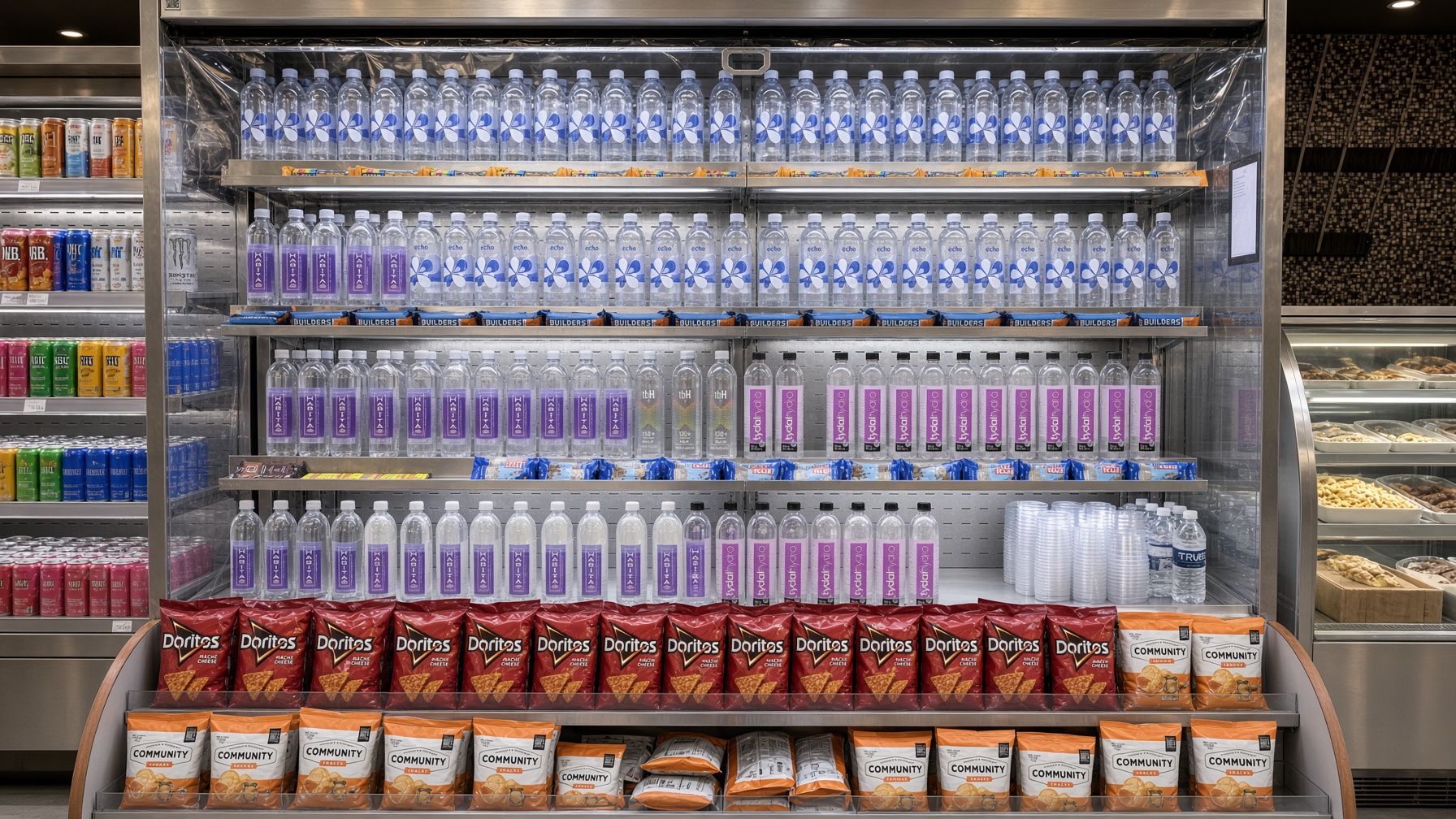
A passenger at Newark airport found a refrigerator full of bottled water with names like Echo, Habitas, tbH and Tydal Hydro. He wanted to know why he’d never encountered these brands anywhere else. There’s a simple answer: the concessions company owns the brands. They were developed for the airport. That makes it harder to check whether you’re getting the “street pricing” that airports promise. You might have some idea what Poland Spring costs outside the terminal, but what’s the going rate for Habitas? What kind of mob situation is happening with the bottled water at EWR? These brands don’t exist anywhere else on the face of the earth — @joncoffey October 18, 2026 A designer’s portfolio identifies airport concessionaire OTG Management as the client for a 2023 water branding project. The CIBO airport concessions shops commissioned separate identities for alkaline and spring waters to replace familiar national brands. Those designs match the bottles in the photo. I looked for the trademarks and OTG applied for the name BOUGIE BRANDS. Applications for tbH, Habitas and Tydal Hydro waters name Bougie Brands, LLC. Now, the small bottles at bottom right are True Clear, which is a Staples brand so it’s actually sold outside airports. I can’t read a water price in this photo so the reply in the twitter thread “And they’re probably $13” is not the actual price but it almost seems plausible. My favorite explanation was, “They are rare, that’s why they are so expensive.” A New Label Doesn’t Eliminate The Street Pricing Rule Many airports limit what concessionaires can charge relative to comparable businesses outside the terminal. The details vary by airport. The Port Authority of New York and New Jersey’s current manual allows street price plus up to 15%, along with a separately authorized employee benefit and retention surcharge of up to 3%. A $10 street item can be sold at $11.85++. Controlling the water brands offers better margins and makes it harder for customers to recognize the markup. But the airport regulation expressly covers the same or similar items. It provides for comparisons with other retailers when the concessionaire doesn’t have an off-airport business. So they’re not just supposed to charge whatever they want even for white label water. There’s also supposed to be a cheaper option available. The Port Authority’s Value for Money guidance calls for a 16–20 ounce spring water bottle at $2 or less where bottled water is sold, or another affordable water option approved by the agency. The program also requires customers to be able to identify its value offerings. It’s not clear in the photo what the value brand is here. New York Has Promised To Fix Airport Prices Before I’ve been writing about OTG’s version of airport retail since CBGB became a Newark airport restaurant. A legendary punk club’s name, licensed for a place where you ordered using an iPad. Now there’s a collection of water brands developed for the airport shops, too. In 2021, there was the $27.85 Sam Adams at LaGuardia, plus a 10% COVID recovery fee. OTG called the price a ‘mistake.’ A subsequent investigation found 25 customers had paid $23–$27 for a seasonal beer. The Port Authority promised proactive enforcement. In 2023, a passenger reported paying $7.66 for a one liter Smartwater at JFK. The payment tablet asked for a tip, too. Airports have even encouraged surcharges as a way around their own price caps. Philadelphia authorized a separate 3% surcharge while retaining its street pricing limit. New York’s rules now permit surcharges to circumvent their own street pricing rules as well. Calling part of the price an employee benefit charge doesn’t make it any less part of the price. (Nor does the money actually mean they’re spending more on employee benefits, which are a cost of running the business.) The surcharge goes to the business. Airport operating costs are higher. Employees face badging requirements, inconvenient parking and security checks so it takes higher wages to recruit them. Deliveries through security are harder. Rents can be extraordinary, and airports often take a percentage of sales on top. Several differently named stores may be run by the same concessions company, so walking to the next shop doesn’t mean they’re competitors. The airport has helped create those costs and restrictions, and it shares in the revenue. Passengers aren’t the airport’s customers, they’re the mark. TSA Makes Avoiding Costly Water Harder The TSA’s War on Water liquid restrictions give the shops an advantage. You can buy an inexpensive bottle on the way to the airport, but generally can’t bring that full bottle through the checkpoint. We certainly don’t need the restrictions with new, slower screening machines. And it eliminates competition for monopoly retailers airside inside the terminal. You can bring an empty bottle through security and refill it. But it’s often unclear how often those refill station spouts are sanitized, particularly when people press the mouths of their bottles against them. They should display cleaning and filter change records, not how many plastic bottles have been saved. And if you do buy a bottle, there’s the checkout. Newark self-checkout terminals absurdly ask for tips. At Austin, I even encountered one that wouldn’t accept $0.00. The tip should default to zero for self-serve. Topics on this page
Newark Airport Shops Invented Their Own Water Brands—Exclusive Bottles, Captive Customers
Full Article
Original Source
Read the full article at Viewfromthewing →KhanList aggregates and links to publicly available news content. We do not host full articles from third-party sources. Always verify important information with original sources.