
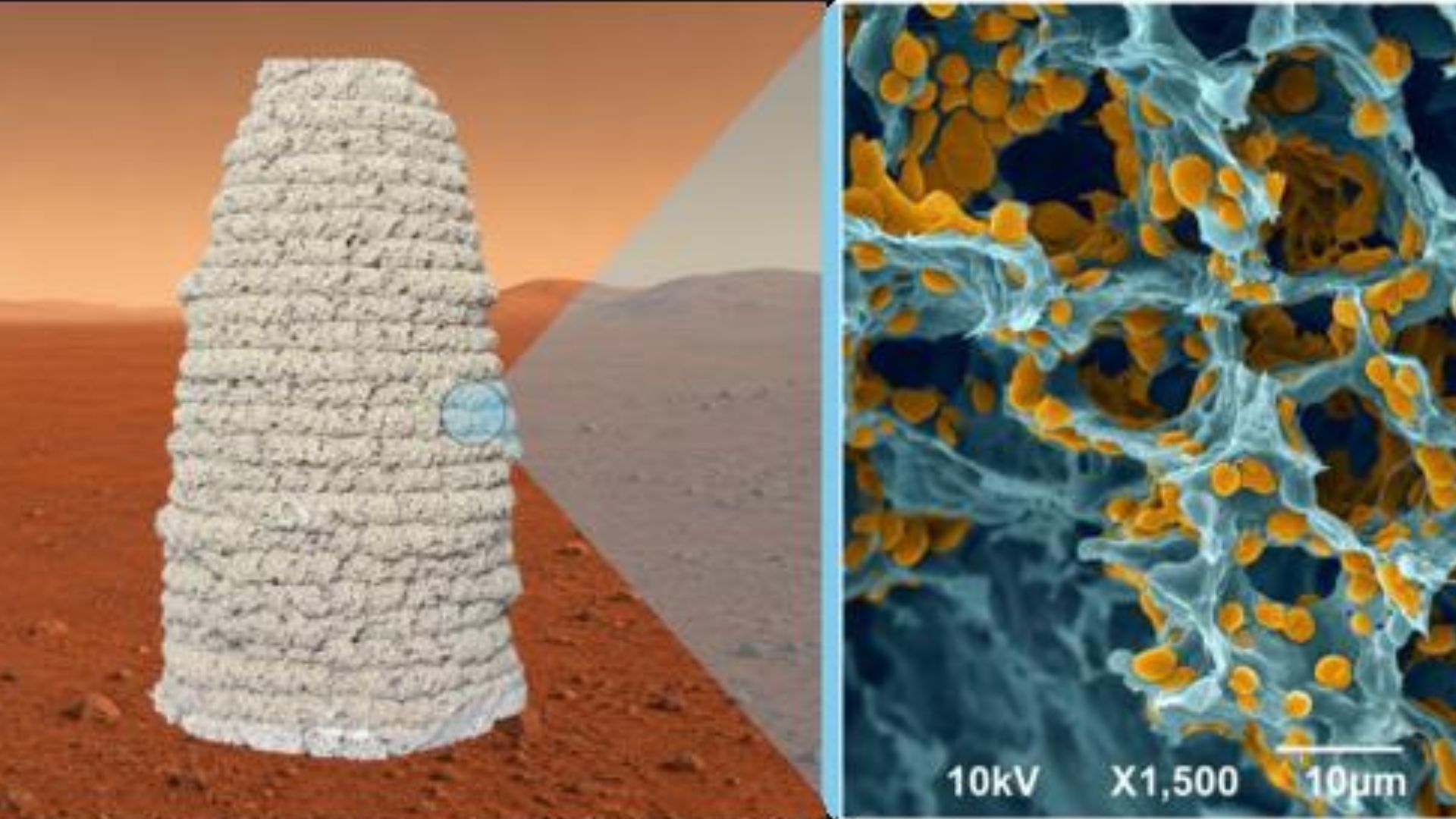
If humans ever build a home on Mars, yeast might be the most important item on the packing list. That is the takeaway from a new study in which researchers revealed a new bio-recipe for 3D printing habitats on the Red Planet. Researchers at The Hong Kong University of Science and Technology have developed a printable, bio-based building material designed for construction on Mars. Bio-baking recipe for Martian homes Building a home on Mars is famously difficult. The atmosphere is a near-vacuum, radiation is lethal, and temperatures plunge to soul-crushing lows. Shipping heavy construction materials like steel or concrete across millions of miles of deep space is financially absurd. Most past proposals suggested melting Martian soil into bricks using extreme heat. But that requires massive energy — something early settlers will severely lack. Now, civil engineer Jishen Qiu and his team wondered if engineers could exploit Mars’s hostile climate, rather than fighting the planet’s extremely low temperature. “My inspiration came from freeze-dried fruits that become harder,” said the senior author Qiu. Mars acts like a “natural freeze-dryer”. The combination of subzero temperatures and negligible atmospheric pressure causes ice to sublimate directly into vapor without ever melting. Qiu created a printable material using sand held together by a biological glue of gelatin and engineered yeast. The team coated the yeast in sticky proteins inspired by ocean mussels. Gelatin holds the mixture together and feeds the growing cells, while sand supplies structural mass. When printed under simulated Martian conditions, the cold vacuum instantly freeze-dries the wet compound. Ice turns straight to vapor and forms a lightweight, porous foam. The team currently produces small test domes roughly the size of a wine cork. Despite their miniature size, these structures match the strength of low-grade concrete. Tests showed the bio-material achieves a compressive strength of 10 to 12 megapascals. “So this is actually strong enough to build a one- or two-story building on Earth whose gravity is three times that of Mars,” said Qiu. “So, you can probably easily build a multistory building on Mars with the material.” More research required Most space construction ideas use melting local rock into bricks, which consumes massive amounts of energy. This biological method overcomes high-heat processing and creates an eco-friendly system. When a building is no longer needed, settlers can break it down, harvest the living yeast cells, and regrow them inside bioreactors. Challenges remain, of course. Scientists would still need to prove the yeast can survive real Martian radiation and atmospheric stress. Early projects will also require shipping hundreds of tons of raw materials from Earth before local production fully takes off. Yet, the fundamental science works. “I always ask myself: Is there any physical law or fundamental mechanism that prevents us from doing this?” said Qiu. “I can’t see any at this point in time. We are confident in scaling it up. It would surprise me if materials for future Martian engineering will not be as diverse as those used in Earth engineering—and biology will certainly contribute.” Biology, it seems, might just be the blueprint for surviving off-world. While yeast is a single-celled fungus, its filamentous fungal cousins (mushrooms) are central to NASA Ames Research Center’s Mycotecture Off-Planet project. Scientists grow fungal root networks (mycelium) around Martian soil simulants and organic waste. When baked and sealed, these grown structures form lightweight, fire-resistant, and radiation-shielding building blocks.The findings were published in the journal Chem Circularity on September 10. Get the latest in engineering, tech, space & science - delivered daily to your inbox.Mrigakshi is a science journalist who enjoys writing about space exploration, biology, and technological innovations. Her work has been featured in well-known publications including Nature India, Supercluster, The Weather Channel and Astronomy magazine. If you have pitches in mind, please do not hesitate to email her.
New yeast-based biomaterial uses Mars’s cold environment to freeze-dry printed habitats
Full Article
Original Source
Read the full article at Interestingengineering →KhanList aggregates and links to publicly available news content. We do not host full articles from third-party sources. Always verify important information with original sources.