
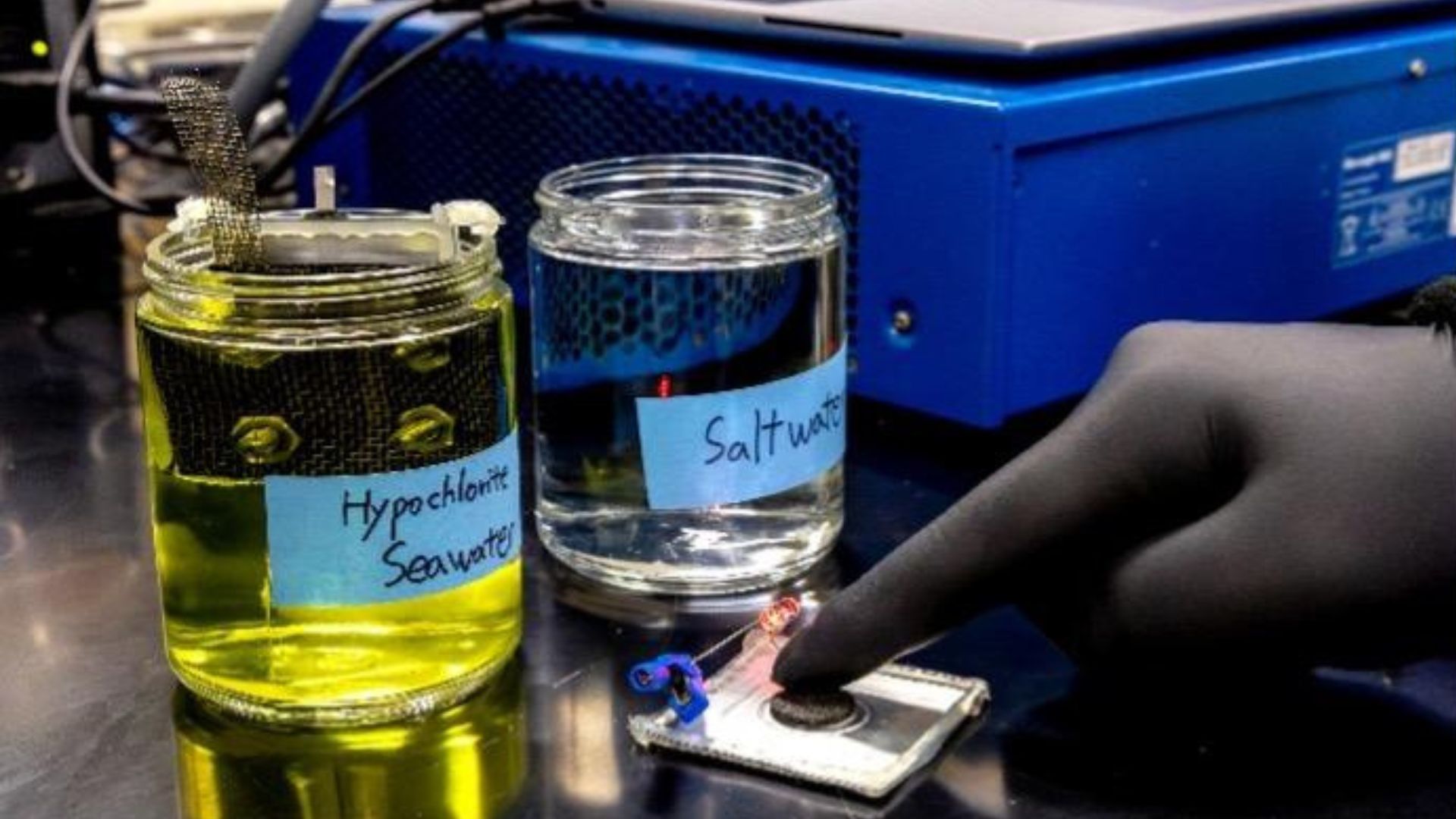
Researchers at the Department of Energy’s Oak Ridge National Laboratory (ORNL) turned an “unwanted” side reaction into the primary driver for saltwater batteries. The team created a safer, cheaper, and higher-performing battery for large-scale grid storage after deciding to embrace a sodium hypochlorite (bleach) side reaction instead of suppressing it. The innovation promises to strengthen the U.S. electric grid by helping utilities manage peak demand, cut energy costs, and maintain reliable power during blackouts. Saltwater spark for grid resilience A saltwater battery uses a liquid salt-water solution as its electrolyte to transfer sodium ions between electrodes and conduct electricity. These batteries hold the potential to replace lithium-ion components with a safe, abundant, and self-cooling liquid electrolyte that avoids critical material issues. However, relying on a slow oxygen reaction that requires shifting between liquid and gas states adds system complexity, depends on expensive catalysts, and ultimately restricts power output. While working to fix that oxygen process, ORNL postdoctoral researcher Wooseok Go noticed a side reaction occurring beforehand. It produced sodium hypochlorite — plain bleach. Usual battery chemistry treats these rogue side reactions as pests to be suppressed at all costs. Go saw an opportunity. “Why don’t we just make the side reaction the dominant reaction, because it shows higher voltage than the oxygen reaction?” Go asked. Adding just 5 percent more bleach into the system completely transformed the outcome. The side reaction took center stage. As the entire chlorine-bleach cycle happens purely in liquid form, the phase-change challenge vanished. The need for pricey catalysts disappeared instantly as internal resistance dropped. It depends on a reversible hypochlorite/chloride redox reaction that continuously toggles between chloride and hypochlorite ions during charge and discharge cycles. Operating entirely within the liquid phase, this chlorine process delivers faster electrochemical kinetics and operates at a higher electrical potential than slow oxygen reactions. Moving to this liquid-only chlorine reaction eliminated gas conversion steps, cut internal resistance, removed catalyst requirements, and more than doubled the battery’s peak power to rival lithium-ion performance. This shift yields a highly efficient, stable energy source that delivers rapid power during outages and offers ideal, salt-water-compatible storage for nautical applications. Safer alternative to lithium-ion Although heavier and bulkier than lithium-ion cells, salt-water batteries are well-suited for stationary grid storage where physical size is not a limiting factor. These are impractical for smartphones or electric vehicles, but could excel in large-scale applications where low cost, safety, and long operational lifespans outweigh weight considerations. The discovery could reshape how power grids handle extreme demand spikes and blackouts. While giant banks of lithium-ion batteries require energy-intensive liquid cooling systems to prevent catastrophic fires, salt water provides built-in temperature regulation. According to lead researcher Ruhul Amin, accessing this new chemistry is like swapping a family sedan for a sports car. When the grid needs power instantly, the battery responds without flinching. Industry partner Coulomb Technology is already moving to bring the innovation to market. The Tennessee-based startup aims to deploy the technology to back up massive data centers and support utility grids over extended periods. The technology may even hit the high seas, powering ocean-bound cargo ships surrounded by the saltwater that makes the battery tick. Now, researchers are exploring alternative anode metals to streamline manufacturing and enhance safety. The goal is to refine the electrodes to suppress the original, inefficient oxygen reaction further. Get the latest in engineering, tech, space & science - delivered daily to your inbox.Mrigakshi is a science journalist who enjoys writing about space exploration, biology, and technological innovations. Her work has been featured in well-known publications including Nature India, Supercluster, The Weather Channel and Astronomy magazine. If you have pitches in mind, please do not hesitate to email her.
New salt-water battery uses bleach side reaction to rival lithium-ion power
Full Article
Original Source
Read the full article at Interestingengineering →KhanList aggregates and links to publicly available news content. We do not host full articles from third-party sources. Always verify important information with original sources.