
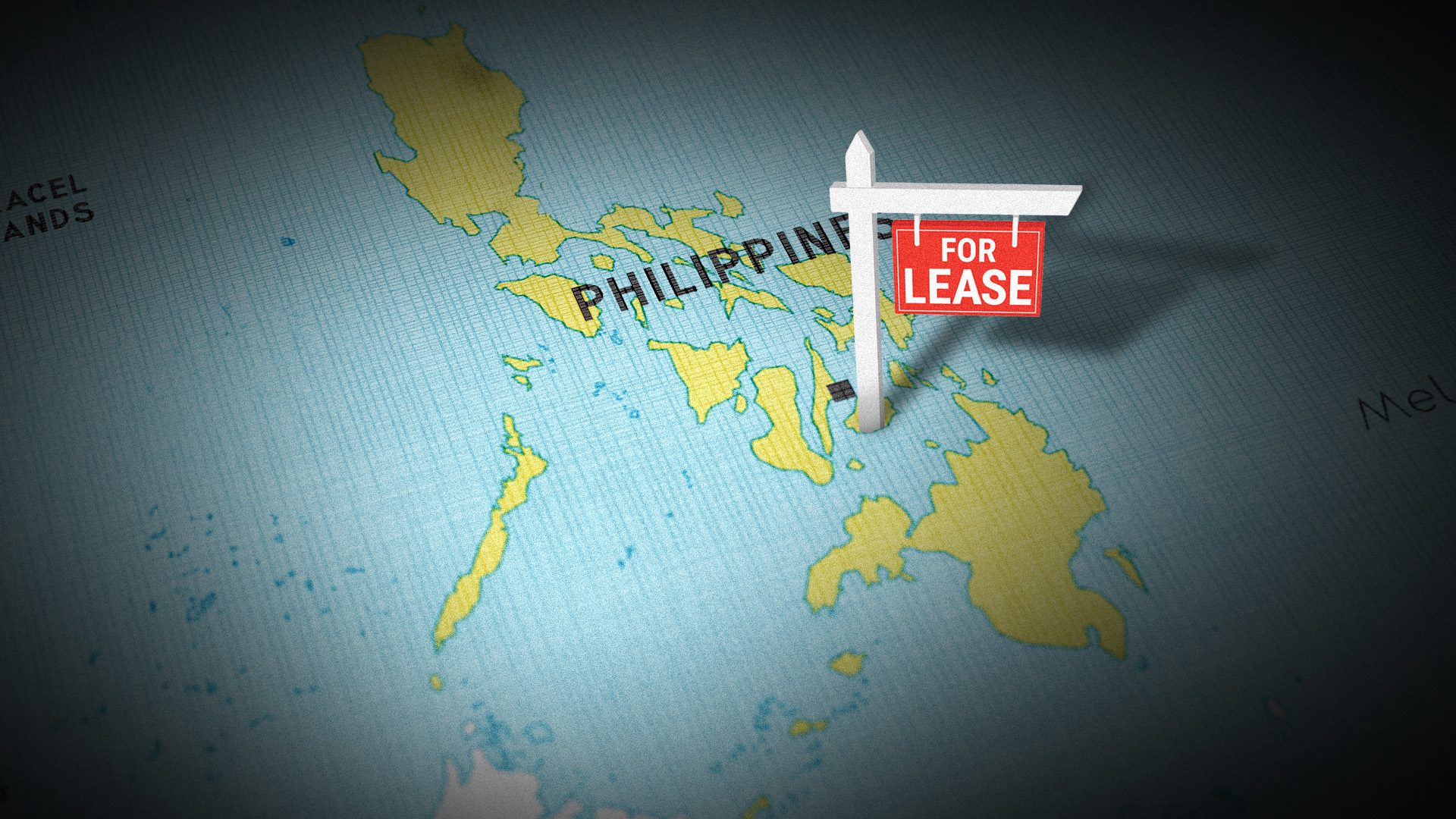
The Philippine peso recently reached a record low of ₱64.17 against the US dollar. While currency depreciation alone does not indicate economic weakness, it raises a key question: how can the Philippines strengthen investor confidence and attract long-term capital for economic transformation? During a visit to the Philippines, my father made an unusual suggestion: why not lease one island to another country for 100 years? Under this proposal, the partner country would help establish a distinct legal and institutional framework while the Philippines retains sovereignty, national defense, and responsibility for essential public services. After a century, the Philippines would inherit a thriving economic center with modern infrastructure and competitive institutions. An idea with an unexpected precedent In January 2016, then-presidential candidate Rodrigo Duterte proposed leasing islands to multinational companies with autonomy to develop infrastructure and operating rules. However, my father’s proposal differs: rather than relying on private corporations, it involves a government-to-government institutional partnership. The historical comparison is Hong Kong. In 1898, China leased the New Territories to Britain for 99 years. Decades later, Hong Kong helped channel international capital, expertise, and commerce into Shenzhen and the Pearl River Delta, illustrating how a jurisdiction with distinct institutions can stimulate development far beyond its borders. Not another economic zone The Philippines already offers investment incentives and special economic zones, but these remain subject to the national administrative framework. What if one island operated under a distinct system of civil and commercial laws, an independent judiciary, taxation, and regulatory institutions? The goal would be to offer investors predictable rules, enforceable contracts, and credible institutions. Like Hong Kong, it could feature separate residency arrangements while preserving Philippine citizenship. Importantly, the foreign partner would not operate the entire government. The Philippines would continue providing healthcare, education, policing, municipal services, and defense. The partner would supply the institutional architecture: judicial expertise, regulatory standards, and independent oversight. Such an arrangement would require constitutional changes, particularly to establish an independent judiciary and a distinct immigration system. The experiment would concern institutions, not merely financial incentives. Why would Singapore be interested? Singapore’s domestic market is small, land and labor are constrained, and its companies need international expansion. Initiatives like the Johor-Singapore Special Economic Zone demonstrate its strategy of pairing financial and technological strengths with regional land and workforce capacity. A Philippine island could offer another variation of that strategy. Singaporean businesses could establish manufacturing facilities, logistics hubs, and research campuses operating under familiar standards. Headquarters and advanced research would remain in Singapore, while land-intensive operations locate on the island. Unlike conventional industrial parks, the arrangement would feature a separate judicial and regulatory framework supported by Singaporean institutions. Private investors could finance much of the infrastructure, limiting Singaporean taxpayer exposure while Singapore contributes institutional expertise rather than assuming territorial administration. Singapore has not expressed interest in such an arrangement, and its potential participation would require further examination. South Korea offers another possibility Alternatively, South Korea brings strengths in advanced manufacturing, engineering, and digital governance. The partner could be any country with strong institutions, proven administrative capabilities, and no territorial ambitions. An economic engine for surrounding provinces Imagine an underdeveloped island transformed into an international commercial center with modern ports, industrial parks, and universities. The benefits would extend to surrounding provinces supplying agriculture, labor, and materials, stimulating investment across the region. Any location would require an independent feasibility study and a credible process for securing the informed consent of affected communities. Protecting sovereignty — and the foreign partner To protect Philippine sovereignty, foreign military bases and territorial claims would be prohibited. The Philippines would retain national defense and natural resource rights, while existing residents’ citizenship, property rights, and political representation would be protected. Equally important, foreign partners would need assurances against unilateral termination by future Philippine administrations. A constitutionally authorized bilateral treaty, international arbitration, compensation provisions, and political-risk insurance could reduce these risks, although no legal safeguard could entirely eliminate them. Could one island change expectations? Beyond economics, experiencing predictable permits, efficient dispute resolution, and transparent rules could raise public expectations for governance across the Philippines, encouraging broader national reforms. The island’s greatest legacy might be changing what Filipinos expect from the government. Beyond defending the peso The Philippines has pursued growth through incentives and economic zones for decades. The next experiment should focus on institutional credibility. By starting with just one island, the Philippines could create a model that delivers capital, infrastructure, and institutional learning for generations to come. After 100 years, the Philippines could inherit not only a thriving economic center but also institutions and practices worth adopting elsewhere. Speaking in Parliament in 1977 about Singapore’s need to develop its own institutional approach, then-Prime Minister Lee Kuan Yew expressed a philosophy that remains relevant far beyond its original context: “We have got to find our own style. We have got to be bold enough to experiment.” – Rappler.com Dr. Jaemin Park is an adjunct professor at the University of the Philippines College of Public Health and works across Southeast Asia on healthcare financing, medical innovation, and public sector reform.
[New Rx] What if the Philippines leased an island for 100 years?
Full Article
Original Source
Read the full article at Rappler →KhanList aggregates and links to publicly available news content. We do not host full articles from third-party sources. Always verify important information with original sources.