
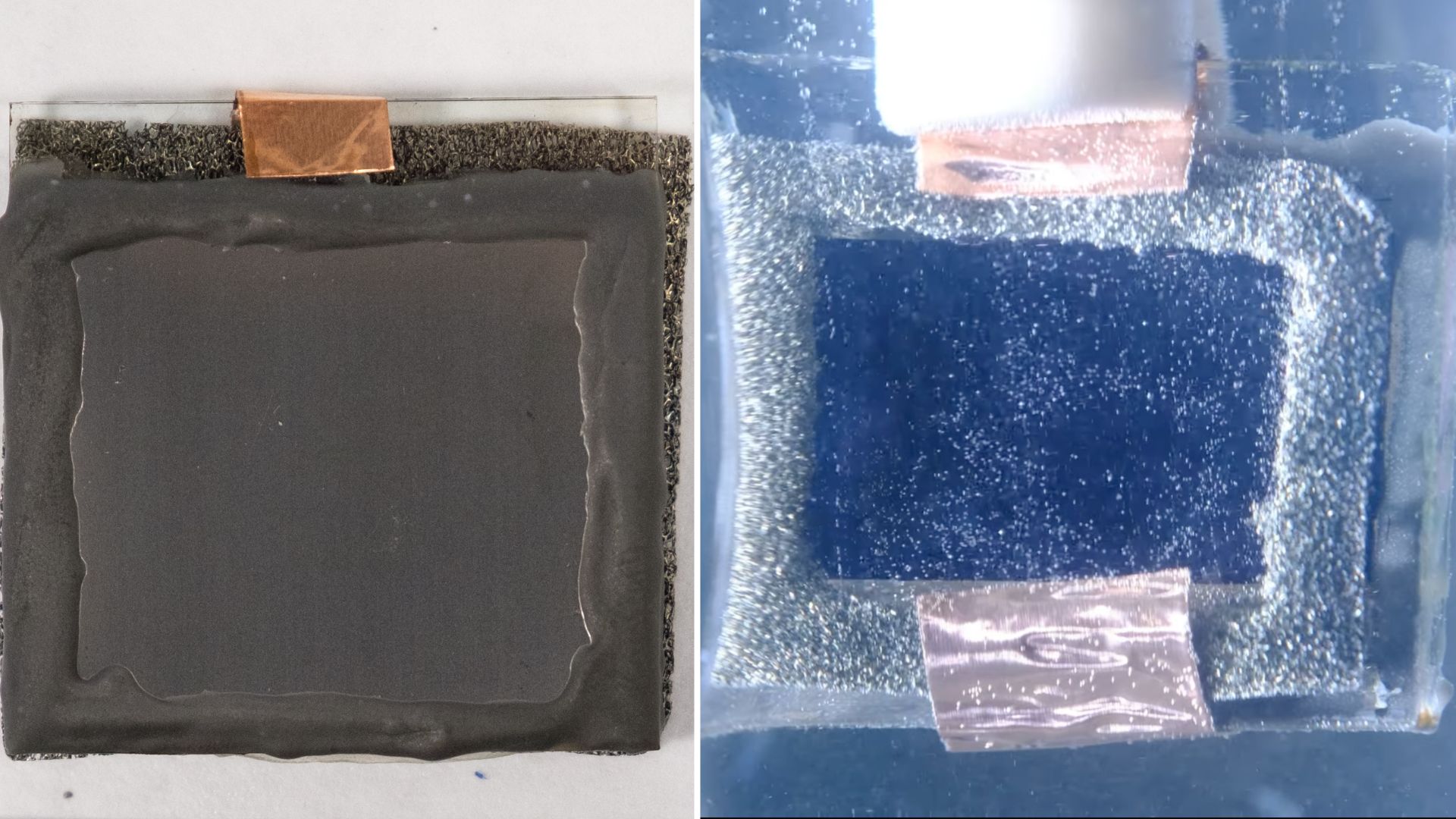
Scientists at Nanyang Technological University (NTU) Singapore have developed a solar-powered device that produces hydrogen from seawater while breaking down hydrazine, a highly toxic industrial pollutant. The researchers describe the system as a dual-purpose approach that combines clean fuel production with wastewater treatment. The work uses sunlight to generate the electricity needed to drive the chemical reactions. Inspired by the way leaves capture sunlight, the device operates without an external power supply. Catalyst changes the electrolysis reaction Green hydrogen is commonly produced through electrolysis, where electricity drives water molecules to split into hydrogen and oxygen. The electrons reach the cathode, or negative electrode, where they help form hydrogen gas. Using seawater could make the process more sustainable by avoiding the freshwater and additional treatment needed to remove salt. However, seawater contains chloride ions that can interfere with electrolysis. The process can also produce corrosive and toxic chlorine compounds that damage electrodes. The NTU team, led by Professor Lydia Wong from the School of Materials Science and Engineering, addressed these problems by changing the reaction at the anode. The positive electrode contains a catalyst made with iron, cobalt, and chromium that breaks hydrazine down into hydrogen and nitrogen. Because this reaction requires less energy than producing oxygen during conventional water electrolysis, the system can produce hydrogen with lower energy requirements. The anode also removes hydrazine from the water while generating additional hydrogen. Perovskite electrode harvests sunlight The researchers built the cathode using lead halide-based perovskites, semiconductor materials capable of absorbing sunlight and converting it into electricity. A conductive epoxy resin containing silver and copper particles, along with titanium foil, was used to protect the cathode from degradation. Tests with simulated and real seawater showed that the device could generate a stable electric current under illumination. It achieved a photocurrent density of 25 mA cm⁻², measuring the current produced across the illuminated electrode area. The system continued operating for more than 72 hours under illumination equivalent to clear-day sunlight at Earth’s surface. It produced hydrogen at a rate of 466 μmol cm⁻² h⁻¹, which the researchers said was comparable with other solar-powered systems. Toxic hydrazine reduced to trace levels The device also demonstrated its wastewater treatment capability. It degraded hydrazine directly in the water without requiring the pollutant to be separated first. Within 30 hours, the system reduced hydrazine from 0.5 M, equivalent to about 1.6 percent by weight, to 0.5 parts per billion. That final concentration was more than 20 times below the U.S. Environmental Protection Agency’s permissible limit of 10 ppb. “This dual-function device represents a major leap forward for environmental technology. By efficiently harvesting solar energy to break down a toxic industrial pollutant while simultaneously harvesting clean fuel, we are solving both an energy problem and a pollution problem,” said Wong in the press release. “The breakthrough here lies not simply in producing solar hydrogen but in demonstrating a practical route toward multifunctional photoelectrochemical systems. Such dual-purpose approaches are likely to play an increasingly important role in the future deployment of solar fuels technologies, where economic value and environmental impact must go hand in hand,” added James Durrant, professor of photochemistry and sustainable energy in the Department of Chemistry at the University of Oxford, who was not involved in the research. The team is now developing catalysts that could target other pollutants and convert waste materials into useful products, including fuels and industrial chemicals. The study was published in the journal Nature Communications. Get the latest in engineering, tech, space & science - delivered daily to your inbox.A versatile writer, Sujita has worked with Mashable Middle East and News Daily 24. When she isn't writing, you can find her glued to the latest web series and movies.
New leaf-inspired device makes hydrogen from seawater, cleans toxic waste too
Full Article
Original Source
Read the full article at Interestingengineering →KhanList aggregates and links to publicly available news content. We do not host full articles from third-party sources. Always verify important information with original sources.