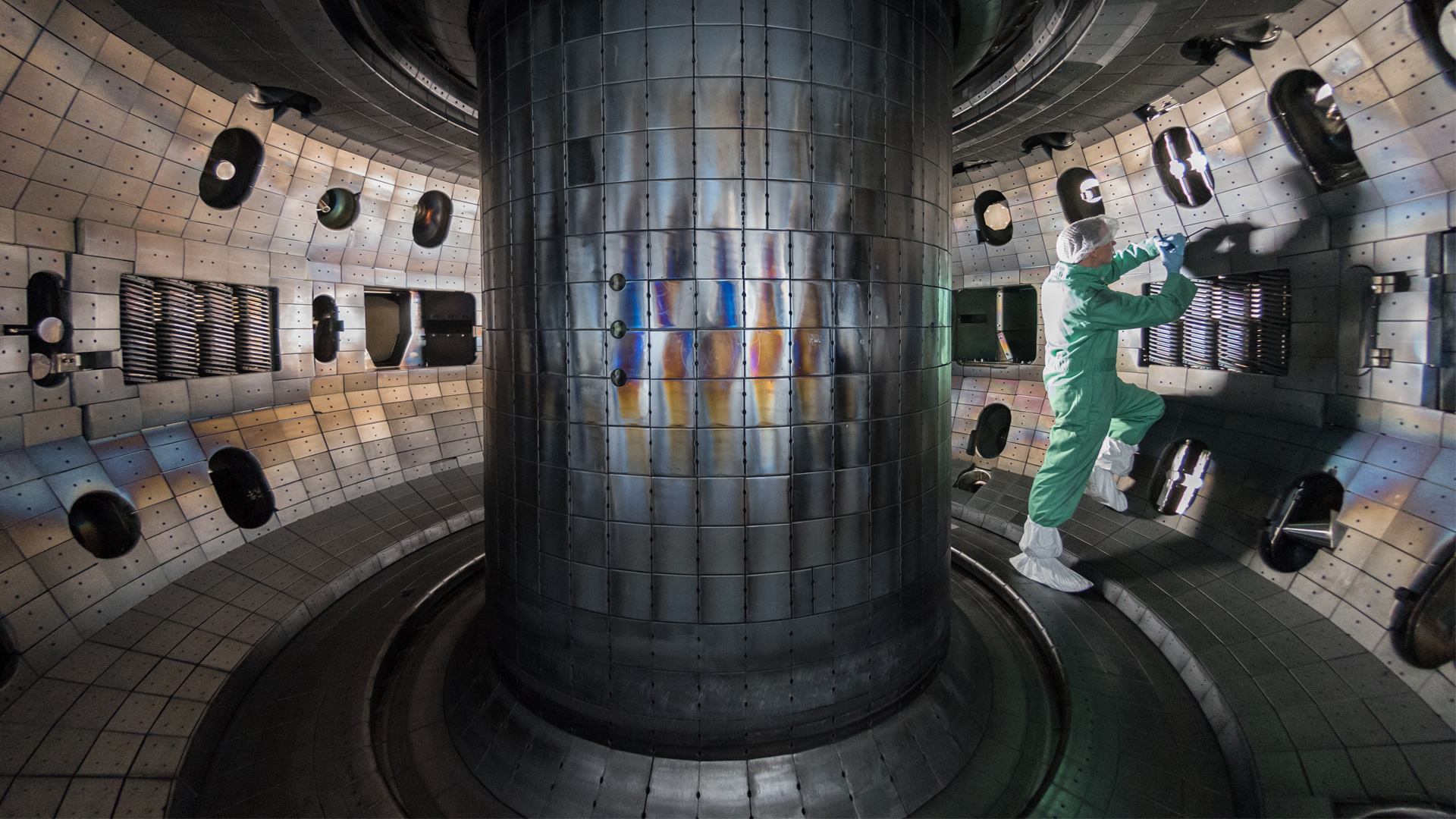
Inside a fusion machine, the plasma can reach temperatures hotter than the Sun’s core while powerful magnetic fields squeeze it into a tiny, unstable space. These extreme conditions are necessary for fusion, but they can also make the machine itself move in subtle ways. At the DIII-D National Fusion Facility in San Diego, even tiny shifts in the large magnets surrounding the plasma can affect an experiment. Now, researchers have developed a machine-learning system that can learn from those changes as they happen and predict how the machine’s hardware will behave during its next experiment. When tested, this approach reduced prediction errors by 80 percent compared with a conventional static machine-learning model, bringing AI closer to becoming an operational tool for fusion research, much like recent efforts to use AI for real-time plasma control. “The technique that we have developed would help fusion researchers find issues before they actually happen on the physical machine,” Kishan Rajput, one of the researchers and a data scientist at Jefferson Lab, said. A fusion machine that never behaves the same way DIII-D is a tokamak, a donut-shaped device that uses powerful magnetic fields to confine superhot plasma. Its D-shaped cross-section is surrounded by a ring of large magnets called toroidal field (TF) coils. Those coils are built and secured with tight engineering tolerances, but they are not completely motionless. As plasma stability changes from one experiment, or ‘shot,’ to another, the coils can shift slightly. “You want to predict the movement of these coils during experiments to get a sense of how stable a particular shot would be and whether a problem may arise,” Rajput added. The problem is that the data describing this movement also changes over time. This creates a headache for conventional machine learning. A model trained on yesterday’s data effectively assumes that tomorrow’s data will behave in much the same way. However, “there’s a lot of drift in the TF coil data shot to shot because the behavior of the plasma is always changing. So if you only train a model on historical data and try to use it without any updates, it would likely not be reliable,” Rajput explained. The DIII-D team wanted something more flexible. A virtual version of the TF coil system that could keep updating itself between shots and forecast what would happen during the next one. Teaching AI to keep learning In their latest study, Rajput and his colleagues propose an approach that uses deep neural networks trained through online learning. Instead of training a model once and leaving it unchanged, online learning continually feeds new information into the system so it can adjust as conditions evolve. The researchers then took this idea further. Rather than relying on a single model, they created an online ensemble containing several models trained using different historical time horizons. This matters because changes in the fusion machine can happen at different speeds. One model can respond better to sudden changes, while another can capture slower, gradual shifts. Models covering intermediate time periods fill the gaps between them. However, there was another problem. During the prediction itself, the system does not yet know whether its forecast is correct. The researchers addressed this by giving every prediction an uncertainty estimate—essentially, a measure of how confident the model is. The ensemble then gives more influence to models producing narrower, more reliable uncertainty ranges. The result is a system that does not simply say what it thinks will happen; it also gives operators an indication of how much they should trust that prediction. The results were substantial. Online learning cut prediction error by 80 percent compared with static machine-learning models. The uncertainty-guided ensemble then reduced error by approximately another 10 percent compared with standard single-model online learning, while also providing uncertainty estimates that could support operational decisions. From digital twin to fusion control room The researchers describe the system as a digital twin of DIII-D’s toroidal-field coil system—a virtual replica that can be supplied with information and used to anticipate how the physical machine may respond. We created “a virtual replica, more or less. You can feed all sorts of different parameters to this virtual replica that you may want to run on the physical machine,” Rajput said. This could become particularly useful at DIII-D, where shots occur roughly every 10 minutes. This short gap between experiments gives operators little time to investigate unexpected hardware behavior. Predicting coil movement before the next shot could allow them to modify plasma parameters or carry out maintenance before a small problem becomes a larger one. DIII-D has also been central to other research aimed at controlling dangerous behavior inside fusion plasmas. The researchers want to run the system on years of data, allowing it to encounter rarer events and improving its uncertainty estimates. They also want to understand how the models themselves evolve as the machine changes. “People want to know what’s going on inside an AI model as opposed to it being a so-called ‘black box. That’s a top priority because it builds trust,” Rajput added. For now, the framework is considered ready for deployment on DIII-D and could potentially be adapted to other fusion machines. If that happens, AI may take on a role beyond analysing fusion experiments after they occur. It could become part of the machinery used to decide, in real time, whether the next experiment is ready to begin. This comes as researchers increasingly explore AI for fusion, including efforts to accelerate complex fusion simulations and improve plasma control in tokamaks. The study is published in the journal Machine Learning with Applications. Get the latest in engineering, tech, space & science - delivered daily to your inbox.Rupendra Brahambhatt is an experienced writer, researcher, journalist, and filmmaker. With a B.Sc (Hons.) in Science and PGJMC in Mass Communications, he has been actively working with some of the most innovative brands, news agencies, digital magazines, documentary filmmakers, and nonprofits from different parts of the globe. As an author, he works with a vision to bring forward the right information and encourage a constructive mindset among the masses.
New framework cuts errors by 80%, helps scientists predict fusion machine’s hardware changes
Full Article
Original Source
Read the full article at Interestingengineering →KhanList aggregates and links to publicly available news content. We do not host full articles from third-party sources. Always verify important information with original sources.