
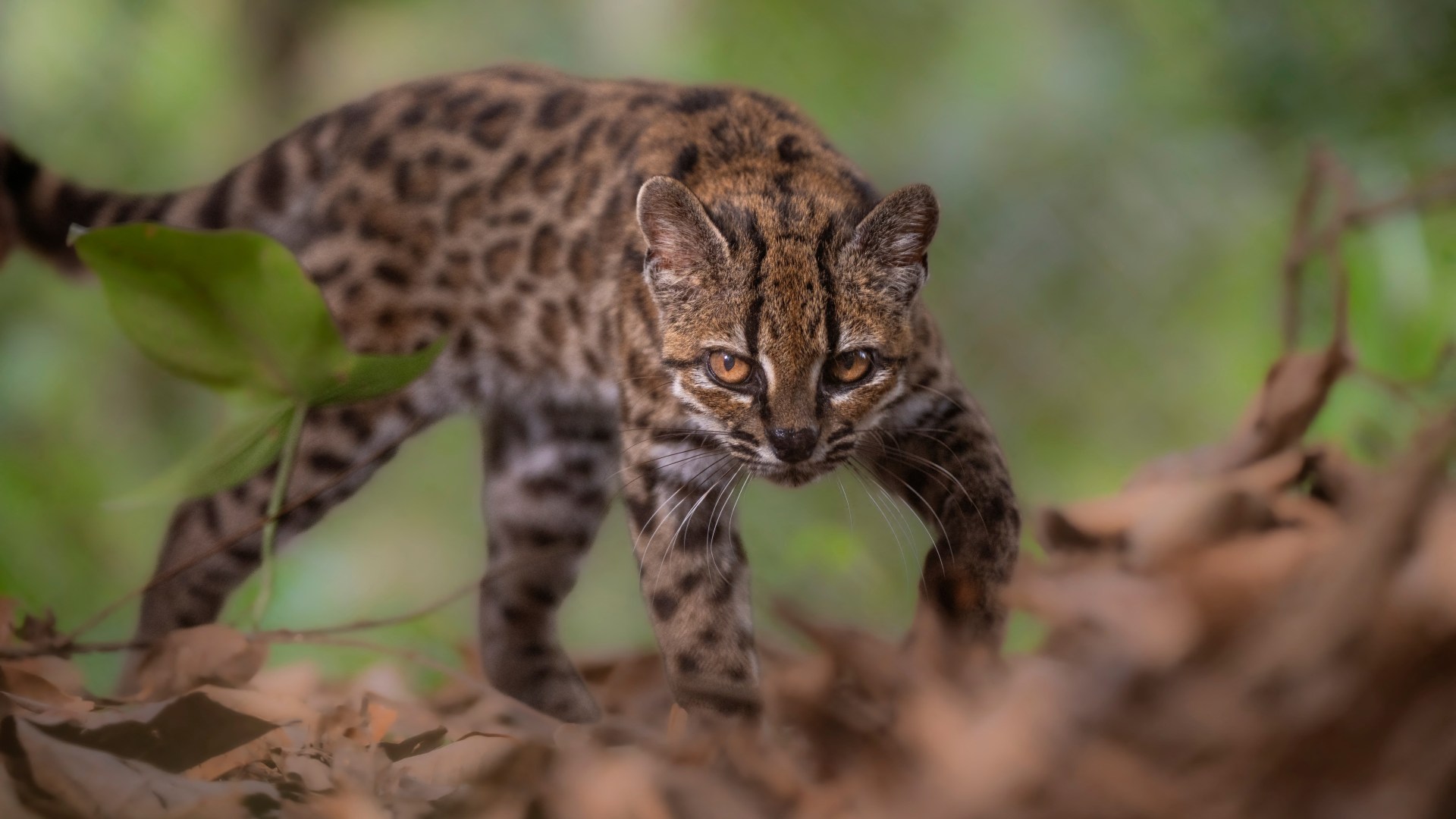
A TINY spotted cat hiding in Bolivia’s misty forests has been unmasked as a completely new species for the first time in 100 years. The elusive feline is smaller than the average house cat but had been hiding in plain sight among near-identical South American tiger cats. A tiny spotted cat has been unmasked as a new species for the first time in 100 years Credit: Reuters The mysterious creature belongs to an entirely separate species – dubbed Leopardus tilcayo Credit: Reuters Now bombshell DNA analysis has revealed the mysterious creature belongs to an entirely separate species – dubbed Leopardus tilcayo. The remarkable find marks the first time a new living feline species has been formally named and described in more than a century . Sign up for The Sun newsletter Thank you! Scientists cracked the mystery after studying a 10-year-old male nicknamed Tigrino, who now lives at Bolivia’s Senda Verde wildlife sanctuary. The extraordinary animal had originally been plucked from the forest by a local resident who mistook it for an ordinary domestic kitten. But as Tigrino grew, his wild behaviour made it increasingly clear he was no household moggy. Bolivian scientist Dr Paola Nogales-Ascarrunz later spotted the unusual cat while volunteering at the sanctuary and realised something did not add up. She had also heard tantalising reports of similar mystery felines prowling the dense Yungas forests – but scientists had never properly investigated them. Researchers then launched a genetic deep dive using DNA from living animals and precious museum specimens to unravel the cats’ tangled family tree. Most read in The Sun Their study of DNA from 38 cats across several South American countries, including eight museum specimens, delivered a stunning result. The team concluded tiger cats actually comprise five genetically distinct species rather than the three previously thought – with the Bolivian tilcayo among them. Genetic evidence suggests its lineage broke away from other tiger cats around 1.4million years ago. “It’s an amazing result that we have a new species for the world, which is the Leopardus tilcayo,” said Dr Nogales-Ascarrunz, of Universidad Mayor de San Andres in La Paz. “It’s amazing that there are still new species waiting to be discovered: we don’t have to go to a volcano, an island, or deep into the sea.” The pint-sized predator measures just 18 inches – 46cm – long and tips the scales at around 3lb, or 1.4kg. ]The pint-sized predator measures just 18 inches – 46cm – long and tips the scales at around 3lb, or 1.4kg Credit: Reuters The extraordinary animal had originally been plucked from the forest by a local resident who mistook it for an ordinary domestic kitten Credit: Alamy Its striking coat is light brown and splashed with irregular rosette-shaped markings that helped it blend in with its spotted relatives. But those similarities also helped keep its true identity hidden from science. Tiger cats are notoriously tricky “cryptic species”, with different species looking so alike that even experts can struggle to separate them by sight. Eduardo Eizirik, a conservation geneticist at the Pontifical Catholic University of Rio Grande do Sul in Brazil, said: “There’s so few records or pictures, no individual in a museum, so it was hiding because nobody was looking.” Scientists currently have information from just two living tilcayos and a handful of camera-trap sightings, leaving much of the secretive creature’s life shrouded in mystery. Rodent remains found in scat offer a clue to what the tiny hunter eats, while camera traps suggest it may stalk the forests mainly after dark. Study co-lead author Jonas Lescroart, an evolutionary biologist at the University of Antwerp, said: “We never expected this Bolivian tiger cat to be a separate species, and no one had ever proposed it as a different animal, subspecies or otherwise.” The genetic detective work also uncovered a new tiger cat subspecies in Peru’s Yungas region. Scientists named it Leopardus tigrinus antisuyo after Antisuyu, the sprawling region of the Inca empire that once covered its habitat. But the dramatic discovery has also sounded an alarm over the future of the newly identified cat. Tiger cats already face a brutal squeeze from deforestation, disappearing habitat and illegal hunting. The tilcayo’s home in Bolivia’s lush Yungas – mountainous cloud forests frequently cloaked in mist – is also under mounting pressure from agriculture, fires, mining and forest destruction. Existing conservation assessments did not recognise the tilcayo as its own species, meaning scientists still do not know precisely how threatened it may be. Researchers have now handed their findings to the International Union for Conservation of Nature, which is expected to consider the five separate lineages during its next review. Dr Caroline Sartor, of the University of Oxford’s Wildlife Conservation Research Unit, said the breakthrough could prove crucial because scientists cannot protect an animal without first knowing what it is and where it survives. “These are animals similar in size to a domestic cat, so you might think we would know them all by now, but this discovery shows how much biodiversity is still to be uncovered in some of the less-studied regions of the world,” she said. The revelation could even force scientists to redraw the wider feline family tree. There are officially 41 recognised species in the Felidae family, which stretches from tiny wild cats to enormous tigers, but the new research could push that tally to at least 44. Andrew Kitchener, a mammal expert at National Museums Scotland who was not involved in the research, described South America’s lookalike tiger cats as a “taxonomic nightmare”. “These cats are confusing because they look so similar and there are few specimens in museums, so even now we are still learning how to tell them apart as genetics reveal more species,” he said. And scientists fear other unknown creatures could vanish before humans even realise they exist. Eizirik warned: “There are many undiscovered species out there in the world, and they are at risk of disappearing before we even discover them.” Comment now
New cat species discovered for first time in 100 years as tiny wild Tilcayo seen prowling in Bolivian forest
Full Article
Original Source
Read the full article at Thesun →KhanList aggregates and links to publicly available news content. We do not host full articles from third-party sources. Always verify important information with original sources.