
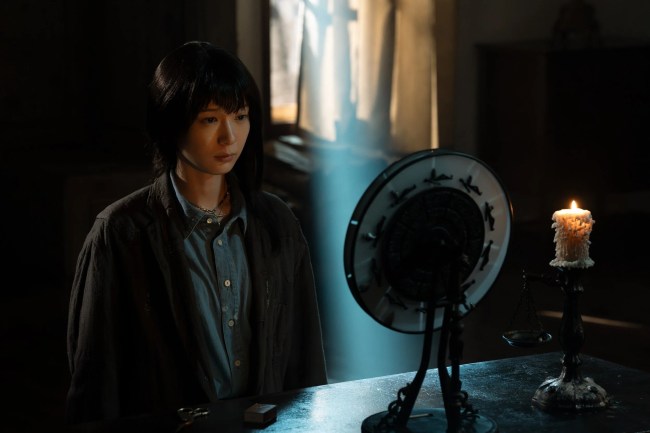
A slow-burn ghost story that seems to be playing into convention even as it sneakily plants the seeds to turn the genre on its head, Dave Boyle’s clever and involving “Never After Dark” starts with a rather familiar premise: A medium is hired to expunge a dark spirit from a big house in the middle of nowhere. In this case, the “middle of nowhere” is a massive house in the forests of Hokkaido (a real property in Kiyosato that feels like it was designed as a fan tribute to the Overlook Hotel), and the medium is a jaded young thirtysomething who’s more afraid of the living than she is of the dead. But, in the first of the movie’s curious wrinkles, there’s an unusual reason why Airi — played by “Shōgun” highlight Moeka Hoshi, who delivers a fun and forceful performance that’s always teetering right on the edge of control — is so comfortable with the deceased: She’s intimately haunted by a (sweet and encouraging) ghost of her own, that of her teenaged big sister, Miku (Kurumi Inagaki), who’s still and forever the same age that she was when she died. That introductory detail proves to be an important clue as to how this movie will play with time, as Boyle’s spare and patient script gradually begins to conflate the thin line between this world and the next with the line between the present and the past — to blur one of those boundaries is also to blur the other. That confusion is somewhat implicit in all ghost stories, but “Never After Dark” seizes upon it in fascinatingly direct ways as Airi struggles to exorcize her latest target, and its “been there, done that” things going bump in the night first half gives way to a second one in which the film’s ronin ghostbuster is forced to mix things up and banish a living person to the other side of the veil instead of banishing a dead person’s ghost from this one. Now you might be thinking: “Isn’t ‘banish a living person to the other side of the veil’ just medium-speak for committing murder?” And… well, yes. But it’s a testament to the detail of Boyle’s film — which is modestly scaled but immersively self-contained — that “Never After Dark” is able to redefine the rules of this mortal coil on its own terms. That starts with the mechanics of Airi’s practice, which are as familiar in function as they are novel in form, and, typical of the “Man from Reno” filmmaker’s work, blend Eastern and Western tropes into the stuff of a singular genre exercise. Much like the mediums in a million other ghost stories, Airi lights a candle and closes her eyes as she gets down to business. What sets her method apart is that she opens a portal into the spirit world with a spinning zoetrope-like contraption that flattens time into a perfect circle and allows her to stop outside of her unconscious body so that Airi can literally see herself kneeling on the floor of the mansion’s enormous living room as she explores the rest of the house in search of the dead. How else would Boyle set up the harrowing — and very clever — sequence in which Airi has to wake herself up before an evil force traps her in the spirit world forever? It doesn’t take her very long to happen upon the ghost who homeowner Teiko (Tae Kimura) and her peevish son Gunji (producer Kento Kaku) have hired her to expel, a pale-faced demon with a bloody gaping wound where his mouth should be (the demon is played by “Chime” star Mutsuo Yoshioka, whose twisty-faced blankness is used to similarly marvelous effect here). Curiously, the “Gaping Mouth Man” — as he’s referred to in the credits — doesn’t appear to be interested in harming Airi. He’s too busy shuffling down the hallways and scratching at a cabinet in the back of a second floor bedroom, which makes it all too easy for the medium to brush off her ghost sister’s warnings of grave danger. Despite a constant patina of tension and a small, well-curated selection of jolts, “Never After Dark” can’t really afford to fray your nerves with loud noises and the like — Airi isn’t the least bit frightened of ghosts (she almost seems to be comforted by them), and Boyle is determined to align us with her experience. For a time, the movie appears to be getting less scary on purpose as it goes along and Airi settles into her latest gig. There’s plenty of time to kill every night, as the veil between worlds is too thin for her to work after sunset. Airi idles away the hours by chatting with her sister (who only appears in mirrors and reflections), getting beer drunk as she dances around the house, and even ranking Kraftwerk albums when Gunji shows up to spy on her progress. After a while, it almost starts to feel like Airi is just scamming her clients for a free place to stay, and that she only insists her seances have to be conducted without any witnesses in order to guarantee she won’t have to deal with other people. Miku is the only company she needs, and the sisters are still so close that it’s easy to forget one of them has been dead for a decade or two. Miku at least seems to recognize that might not be so healthy, but Airi is unconvinced. “Never After Dark” doesn’t bend over backwards to teach its protagonist a lesson (Boyle takes an extremely soft and elusively ambiguous approach to the kind of “you have to let go” moralizing that has always haunted ghost stories like this one), but the risk of confusing the past with the present soon becomes all too clear as the movie settles into its more traditionally horror-coded later chapters. While Boyle’s character work isn’t as well-defined as the performances he gets from his cast, and the measured pacing of the movie’s first half — similar in gait and spirit to something like Ti West’s “House of the Devil” — doesn’t quite reward Airi with the level of emotional depth that’s demanded by the film’s uncertain final moments, there’s a real thrill to be found in how “Never After Dark” taps into the temporal dimensions of its timeless genre, its blithe spirit gradually stiffening into the stuff of a Kiyoshi Kurosawa chiller as it confronts the dangers of a broken clock. Every time we see Airi take her zoetrope for another spin, its static images blurring into the illusion of motion, we’re reminded that the movies have always been the perfect medium through which to appreciate a medium like her. Grade: B Magnolia Pictures will release “Never After Dark” in theaters on Friday, September 25.
‘Never After Dark’ Review: A Japanese Medium Is Forced to Confront a Living Threat in This Clever Ghost Story
Full Article
Original Source
Read the full article at Indiewire →KhanList aggregates and links to publicly available news content. We do not host full articles from third-party sources. Always verify important information with original sources.