
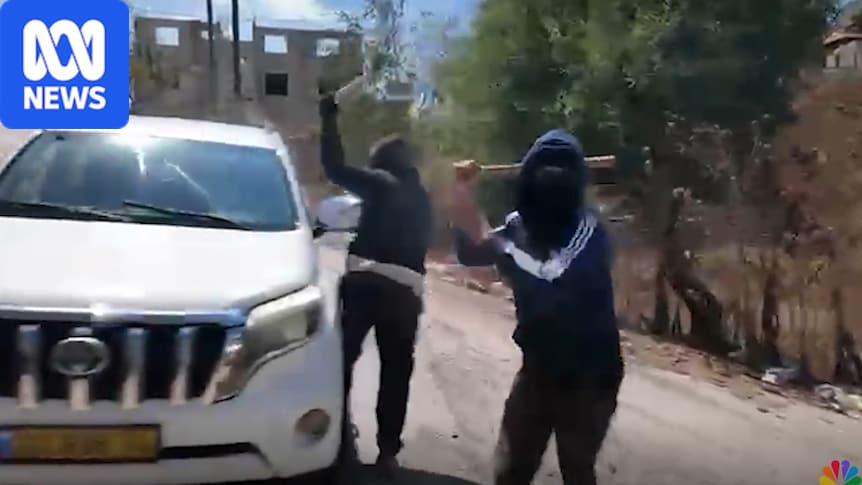
Over the weekend Israeli settlers once again tore through West Bank towns and villages attacking Palestinians and even foreign media crews.Masked settlers set upon the American network NBC on Saturday in the town of Jalud, which has spent months under siege by young men from nearby Israeli settlements and outposts.It prompted another round of condemnation from senior Israeli officials, including Prime Minister Benjamin Netanyahu himself.He labelled them a "handful of rioters who are violating the law, causing a grave injustice to the law-abiding Jewish community, interfering with the [Israel Defense Forces (IDF)] in carrying out its missions, and harming Israel's standing in the world".The rhetoric is familiar. These are a few bad eggs who are using violence to enforce their belief the West Bank is their God-given land, and, officials say, do not represent the wider settler community who share that creed.Add to that the argument that this is bad publicity.If the issue is indeed what officials call a small number of offenders, and quite separate from the issue that all Israeli settlement in the occupied Palestinian territories is considered illegal under international law, the situation poses an obvious question which no Israeli official seems able or willing to answer.Why can't one of the most powerful militaries in the world stop it from happening?The answer, as it often does, comes down to politics.Two West Bank crackdowns, two different outcomesIn mid-August, the IDF launched a military operation to quell settler attacks in Qusra, roughly 50 kilometres north of Jerusalem and less than 5 kilometres from Jalud.Settlers, many of whom appeared to be young men or teenagers, had besieged homes of the edge of town, cutting power and water supplies as they tried to force the residents to leave.One of the properties was owned by a Palestinian-American businessman who demanded intervention from the US Embassy. His highly publicised position likely a factor in the United States ambassador to Israel Mike Huckabee branding the attackers "Israeli terrorists".A fortnight on, and the situation persists. Despite the area declared a military zone, settlers continue to harass and attack Palestinians.When the operation began one person had been detained. The ABC asked the IDF and Israeli police for an update on whether more arrests had been made. The IDF said it was a police matter, and a police source told the ABC no-one had been arrested.Compare that to the response to a deadly shooting in the village of Tell, south of Nablus, a few weeks earlier.On a Friday in late July, some Israeli settlers were on what they described as a "hike" from a nearby settlement, without seeking the approval of the IDF, when they came into contact with a group Palestinians on the edge of the village.The Israelis said the Palestinians attacked them, while the Palestinians said the Israelis were the aggressors.Video from the scene shows one of the Palestinian men grabbing a settler's gun and opening fire, then later shows Israeli soldiers opening fire on the group as the melee continued.Two settlers and four Palestinians were killed.What followed was not only a wave of settler violence, with buildings and cars firebombed and people attacked, but a massive security crackdown by Israeli forces.Between Friday, when the initial shooting occurred, and Sunday evening Israeli police arrested more than 130 people, all Palestinians.And that is just one example of the tough approach Israeli forces take against Palestinians, with arrests happening across the West Bank each and every day.'Acts' vs 'terrorism': Politics surrounds violenceThe issue of Israeli settlements in the West Bank is deeply political.All settlements in the occupied Palestinian territories are considered illegal under international law, but the Israeli government denies their illegality, and even supports them.None of the major Israeli-led parties vying for votes and attention ahead of the October 27 election want to show weakness on the issue, insisting they support communities in "Judea and Samaria", the biblical names for the region.Two masked settlers attack a Palestinian woman and NBC News crew in the West Bank on Saturday. (Supplied: NBC News)The language politicians use to describe settler violence is also very different to what they use to describe Palestinian violence in the West Bank, which is often quickly labelled as "terrorism".Take, for example, the prime minister's international spokesperson Doron Spielman's description of the weekend settler violence as "acts … committed by a small group of rioters, many from broken homes"."They do not represent the law-abiding Jewish community in Judea and Samaria; on the contrary, they cause that community a grave injustice," he said.With Qusra in the spotlight, Israel's Defense Minister Israel Katz said the IDF would draft a plan to hand over security control for civilian matters in the West Bank to Israeli police.Some in the Israeli media characterised that as an attempt to distance his ministry, and the military, from the growing mess which it was faced with clearing up.Concerns were also raised about the legality of such a move, with reporting suggesting the military would likely tell Katz that shifting security responsibility from the military to the police would require formal annexation of territory.Commentators also insisted it played into the hands of Israel's right wing national security minister, Itamar Ben-Gvir, who has control over the police.UN reports surge in attacksBen-Gvir himself is a settler and is subject to international sanctions, including from Australia, for his policies and rhetoric towards Palestinians.Along with far-right Finance Minister Bezalel Smotrich, he has frequently called to expand settlements.Despite critics of Israel's occupation of the West Bank saying its conduct amounts to de facto annexation, a formal declaration or change in its legal status has not occurred.US President Donald Trump, perhaps the only world leader Netanyahu listens to, has previously said he would not allow it.This is why the response to settler violence has, thus far, been muted. The people holding the levers of power in the government to act are not interested in dealing with it.Analysts also say that within the IDF there is a lack of will to act against the settlers, either due to general apathy about the situation they're causing, a fear that soldiers don't have the political backing to tackle them, or the reality that more and more settlers are now in the ranks of the Israeli military itself.The United Nations has reported a sharp rise in Palestinians attacked by Israeli settlers, from an average of one Palestinian injured every three days in 2020 to more than three per day in 2026.Since the start of the year, 23 Palestinians have been killed and more than 1,040 injured in settler attacks in the West Bank, the organisation's latest figures said.In a 24-hour period from Friday morning to Saturday morning, activists recorded at least 13 different incidents of settler attacks ranging from using live fire against Palestinians, stealing livestock, cutting down fruit trees and setting fire to farmland.Warnings about settler violence go unheededOne Israeli politician, Gilad Kariv of the Democrats, labelled the prime minister's latest condemnation as "meaningless" and "nothing more than a fraudulent exercise"."These rioters are his direct emissaries, Katz's, Smotrich's and Ben-Gvir's," Kariv said."This is why there have been no arrests and no indictments in recent weeks against the invaders. This is why they are granted de facto immunity by the IDF and the police."Netanyahu's goal is to cause an explosion in the territories ahead of the elections. Once again, a bunch of lunatics are betting on the lives of Israelis and Palestinians for the sake of political survival."In late April the former chief of Israeli spy agency Mossad, Tamir Pardo, toured some of the West Bank villages and towns being targeted by settlers. He told the country's Channel 13 what he saw made him "ashamed to be a Jew".He warned it was fuelling such anger among Palestinians that it was "planting the seeds of the next October 7" attack against Israel.Both the IDF and the domestic intelligence agency Shin Bet, Israeli media has reported, have warned the situation in the West Bank is getting out of control.For a country that prides itself on being able to target what it claims are threats against Israel in places like Gaza and Lebanon, cleaning up what it describes as its own backyard seems much more difficult; or, more specifically, of much less interest.
Netanyahu's rhetoric on settler violence doesn't match Israeli government action
Full Article
Original Source
Read the full article at Abc →KhanList aggregates and links to publicly available news content. We do not host full articles from third-party sources. Always verify important information with original sources.