
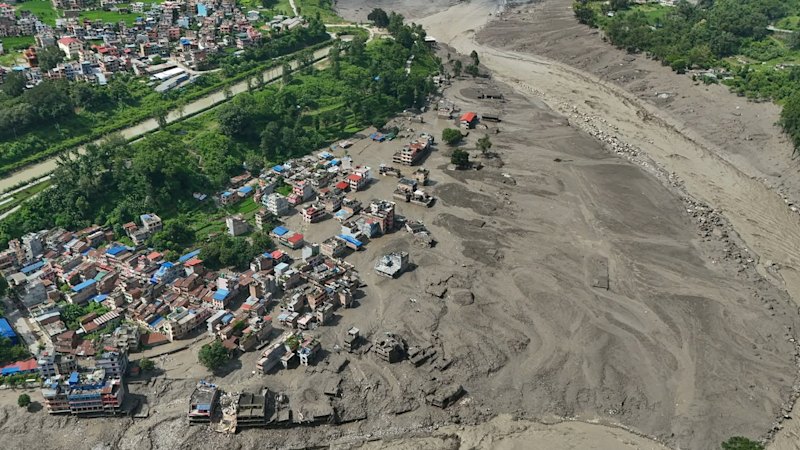
Paul DyerUpdated August 27, 2026 — 5:46am,first published 5:06amKey PostsWhat you need to knowBy Thank you for joining our coverage of the deadly flash floods in Nepal and Tibet. Here’s what you need to know:Warning: This story contains graphic content.Thirty-four Australians are among hundreds of people reported missing after an avalanche of ice and rock triggered massive flash floods that swept through parts of Nepal and China on Wednesday.Nepal police said 157 bodies had so far been recovered. Neighbouring China has reported at least three people killed and 265 missing in a border community in Tibet.More than 400 tourists are unaccounted for, according to officials in Nepal, including from Australia, India, the US, UK and Canada.It is suspected that an earthquake struck the region and triggered the lower part of a glacier to collapse on the Lhende Khola river in Nepal, causing the floods.A wall of water destroys a building at Rasuwa Gadi port.X/@thenepalitruthRescuers carry a victim of flash flooding to safety along the Trishuli River in Nepal’s Nuwakot district.AP Photo/Niranjan ShresthaLatest Posts5.46amEarly reports suggest earthquake triggered glacier collapse that caused flash floodingBy Liz LeeInitial reports from Nepali officials suggested an earthquake in the area could have caused the lower part of a glacier to collapse and trigger the floods. Security footage captured on the Chinese side of the Nepal-Tibet border showed many people fleeing before a torrent of rock, mud and water destroyed buildings and vehicles and took many lives.Damaged houses and vehicles are seen in the aftermath of flash floods along the Trishuli River in Nepal’s Nuwakot district.AP Photo/Niranjan ShresthaThe German Research Centre for Geosciences said there was a 4.4-magnitude quake approximately seven minutes before the time shown on the security footage time-stamp.An initial study of Planet Labs satellite imagery indicated that a landslide of ice and rock triggered a debris-laden flood in the Lhende River, about 20 kiometres northeast of the Nepal-China Rasuwagadhi border crossing, Nepal’s National Disaster Risk Reduction and Management Authority said on X.Reuters5.39am‘She’s gone’: Survivor tells of losing his wife in ‘huge gush of mud’By “It was a huge gush of mud coming straight towards us. As it got closer, it kept rising higher and higher,” Keshav Prasad Baral, a 68-year-old survivor, who was being treated at a small hospital.“When I saw it enter our home, I tried to grab my wife’s hand and take her to the terrace. But she was swept away by the mud.“Four or five hours later, a helicopter came to rescue me. My wife is still somewhere beneath the mud. She’s gone.”Reuters5.28amWhere the flash flooding hitBy The deadly flash flooding occurred in a border area of Nepal and China.The Himalayan region, which spans several countries including India, is especially vulnerable to heavy rains, floods and landslides because of warming due to human-caused climate change. Research shows that extreme weather events, including heat waves, rains and melting glaciers, have become more frequent.5.05amLabourer saved by mango tree in deadly torrentBy Nepali labourer Bibek Kumal was digging a toilet pit outside a newly built house on Wednesday when a wall of water, mud and rock came roaring down, sweeping him and everything near him away.Kumal, 24, was working in Bidur, downstream from the worst-hit Rasuwa district, near Nepal’s Himalayan border with China’s Tibet, when he heard a hissing sound. His four co-workers, standing above the five-foot (1.5 metre) deep pit, shouted at him to get out and run.By the time he scrambled out of the pit, his co-workers had already fled.“I started running. Then a wall of water came thundering down as if it was an earthquake,” Kumal said from his bed at Kathmandu’s National Trauma Centre, his brother Dinesh sitting beside him.The torrent swept him downstream amid mud and debris, but “luckily I was stuck up in a mango tree”, he said. “Had there been no mango tree, I would have been washed away to death.”Reuters5.04amIn pictures: Deadly floods hit Nepal-Tibet borderBy CCTV footage shows the moment the Chinese and Tibetan side of the Rasuwagadhi border crossing, known as Gyirong Port, is enveloped by the mudslide.Social mediaThe Trishuli River after flash floods in Nepal’s Nuwakot district.AP Photo/Niranjan ShresthaA boy looks at the devastation along the Trishuli River in Nepal’s Nuwakot district.AP Photo/Niranjan ShresthaRescuers in Nuwakot use an earthmover to carry a survivor.AP Photo/Niranjan ShresthaRescuers use earthmovers to reach submerged houses.AP Photo/Niranjan ShresthaA muddy river bank with debris is seen near Gyirong Port in southwestern Tibet.Anonymous/Xinhua via APWhat you need to knowBy Thank you for joining our coverage of the deadly flash floods in Nepal and Tibet. Here’s what you need to know:Warning: This story contains graphic content.Thirty-four Australians are among hundreds of people reported missing after an avalanche of ice and rock triggered massive flash floods that swept through parts of Nepal and China on Wednesday.Nepal police said 157 bodies had so far been recovered. Neighbouring China has reported at least three people killed and 265 missing in a border community in Tibet.More than 400 tourists are unaccounted for, according to officials in Nepal, including from Australia, India, the US, UK and Canada.It is suspected that an earthquake struck the region and triggered the lower part of a glacier to collapse on the Lhende Khola river in Nepal, causing the floods.A wall of water destroys a building at Rasuwa Gadi port.X/@thenepalitruthRescuers carry a victim of flash flooding to safety along the Trishuli River in Nepal’s Nuwakot district.AP Photo/Niranjan Shrestha1 of 1
Nepal floods live updates: At least 160 dead, dozens of Australians among hundreds missing
Full Article
Original Source
Read the full article at Smh →KhanList aggregates and links to publicly available news content. We do not host full articles from third-party sources. Always verify important information with original sources.