
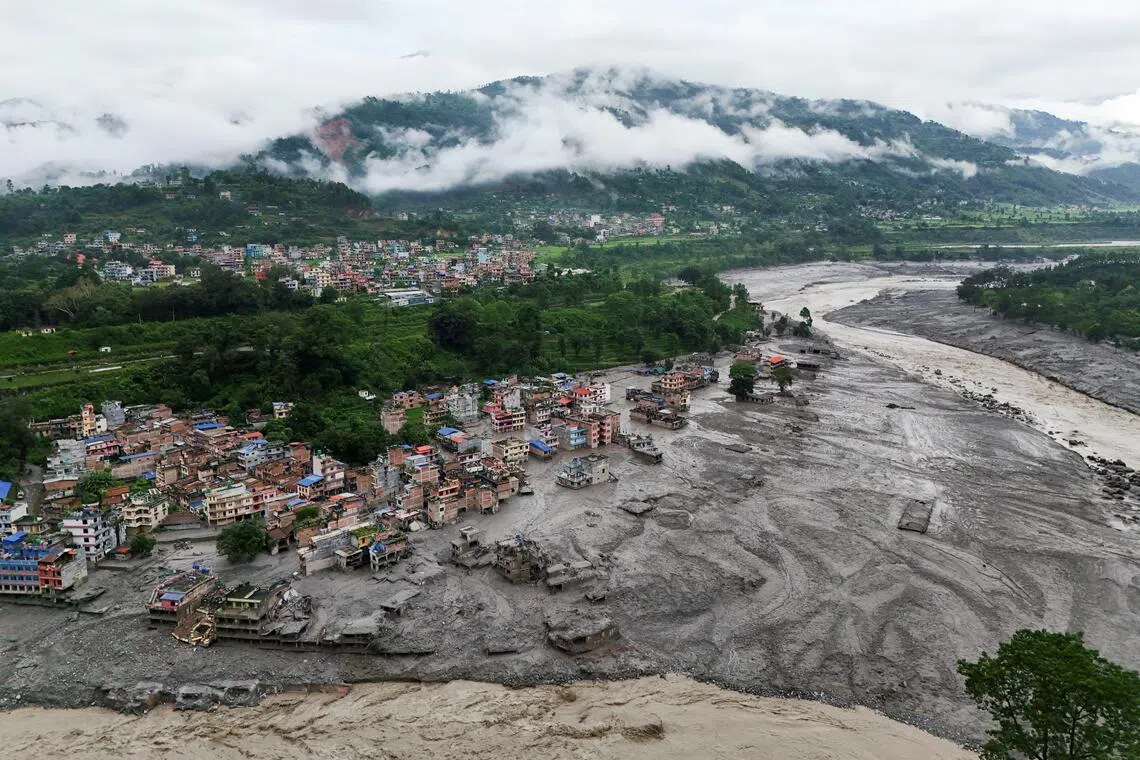
KATHMANDU – Victims of Nepal’s catastrophic floods had barely a few minutes’ warning before the waters came rushing through, highlighting gaps in high-altitude weather monitoring and data sharing with neighbouring China.“People even didn’t get five minutes of lead time,” Dharam Raj Uprety, chief executive of Nepal’s National Disaster Risk Reduction and Management Authority, told Bloomberg News in an interview.“We don’t have weather stations in high mountain areas” because of the “lack of trans-boundary data seeding mechanisms,” or limited sharing of weather and climate data across national borders. That is one of our “biggest challenges,” he said. The devastating floods last week that killed at least 800 people and have left more than 3000 missing have exposed a dangerous blind spot in the Himalayas, Upreti said, as warming temperatures destabilise glaciers and mountain slopes faster than authorities can build systems to monitor them. Better forecasting and earlier warnings will not only help save lives, but also go some way towards protecting critical infrastructure and limiting disruption to tourism, a vital source of jobs and foreign exchange for the Himalayan economy.China’s President Xi Jinping has called for faster surveys of glaciers and glacial lakes across the Tibetan Plateau to prevent further disasters, according to the official Xinhua News Agency.The Communist Party on Aug 28 also ordered stronger monitoring and early-warning systems to improve authorities’ ability to identify linked disaster risks.The Nepal catastrophe was triggered on Aug 26 by a glacial collapse that sent ice, mud, rocks and fast-moving water surging through a valley in Nepal, wiping out entire settlements in their path.Videos showed people attempting to flee as walls of water and debris swallowed buildings, tore down bridges and power lines, and washed away trees, boulders and vehicles.The cost of the damage may reach at least US$5 billion (S$6.37 billion) and reconstruction is likely to be similar to the seven-to-eight year-long process of rebuilding after Nepal’s 2015 earthquake, according to Binod Chaudhary, the country’s only billionaire and chairman of the Chaudhary Group conglomerate.While Nepal has monitoring infrastructure farther downstream, Uprety said that large stretches of the high mountains remain poorly observed. Installing and maintaining weather stations at extreme altitude is expensive and difficult, leaving authorities with limited ability to detect rapidly changing temperatures, permafrost conditions or newly emerging glacial hazards.Satellite analysis indicates that bedrock beneath a glacier collapsed, triggering the cascading disaster.Scientists caution that it is too early to attribute the specific collapse directly to climate change, though warming can weaken permafrost that helps bind high-altitude slopes together.Improving early-warning systems is now a priority, Uprety said.His team at the NDRRMA – the main body that is coordinating Nepal’s response to the disaster – had drafted a roadmap that is expected to be endorsed soon, with a focus on giving communities more time to prepare for disasters, he said.“Unless we stop making boundary for climate information,” disasters originating in remote mountain areas will remain difficult to anticipate, he said. BLOOMBERG
Nepal floods expose gaps in warning systems, China data sharing
Full Article
Original Source
Read the full article at Straitstimes →KhanList aggregates and links to publicly available news content. We do not host full articles from third-party sources. Always verify important information with original sources.