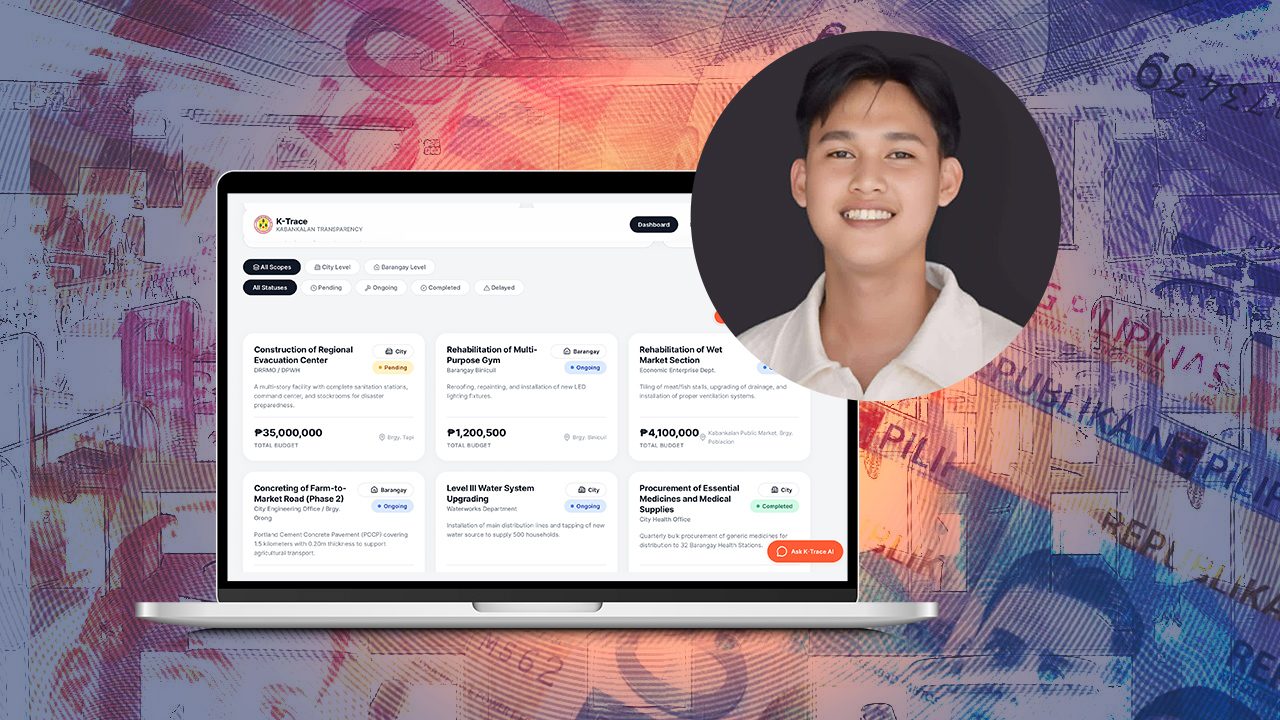
FOR TRANSPARENCY. Japheth Gonzales, a young educator from Kabankalan City and creator of K-Tracer, promotes transparency in government spending. Photo courtesy of Japheth Gonzales ‘I also want to prove that it’s not only big cities that can develop innovative applications. People who grew up here in Kabankalan can do it too,’ says Negrense web developer Japheth Gonzales NEGROS OCCIDENTAL, Philippines — At a time when the Philippines is grappling with controversies over failed government projects and corruption in trillions of pesos in flood control spending, a young Negrense web developer is pushing for greater transparency through a digital platform that allows ordinary citizens to track where every taxpayer’s peso goes. In just eight hours over a weekend during the third week of July, Japheth Gonzales, a 25-year-old instructor at Southland College and a resident of Barangay 1 in Kabankalan City, turned a moment of boredom and inspiration from the public’s increasing demand for greater transparency in government spending into an innovative response. K-TRACER. The transparency portal that features government projects allows users to view their corresponding budgets and track the status of the projects. Drawing on years of expertise in artificial intelligence (AI) — a field he began studying in 2021 — Gonzales developed a prototype transparency portal he called K-Tracer. “It’s not about politics. It’s about transparency and accountability. As taxpayers, we have the right to know where our money goes and whether projects are actually being implemented,” Gonzales told Rappler in a mix of Hiligaynon. The developer clarified that the current prototype uses dummy data for demonstration purposes. Even so, the platform showcases how users can monitor government projects, view their corresponding budgets, and track whether projects are ongoing, delayed, pending, or completed. “It can help reduce doubts and misunderstandings because people can directly see how government funds are being used and where taxpayers’ money goes. It also gives people easier access to information. They can see which projects are being implemented by the government and where the budget is allocated,” Gonzales said. “For every project, the application can display detailed information such as the budget, project items, suppliers, engineers involved, and other relevant data. It also has an AI feature that helps people quickly verify whether the government has officially approved a project,” he added. The dashboard also includes a price comparison feature that shows each item’s prevailing market price alongside its awarded bid price, enabling users to identify any price variance. Immutable data To ensure records remain secure, he envisions integrating blockchain technology should any government unit adopt the platform. He said that local government units (LGUs) do not need to seek approval from an outside organization to use blockchain, describing it as part of the software infrastructure that can be built into the system. “Once it’s integrated, every time an authorized LGU employee enters a new project or budget, the portal can automatically encrypt and record that information on the blockchain,” he said. “The staff won’t need to do anything differently because the system handles everything in the background.” According to Gonzales, blockchain technology would make project records traceable and significantly reduce the risk of unauthorized editing or deletion, strengthening public trust in government data. Kabankalons can deliver The developer also hopes the invention would send a message that great innovation can also come from communities outside major cities. “I also want to prove that it’s not only big cities that can develop innovative applications. People who grew up here in Kabankalan can do it too. I also hope the government will continue supporting students because many of them have the potential to contribute to technology, especially those studying computer science, computer engineering, and related fields,” Gonzales said. “That’s one of the reasons I became a teacher — to help students develop their skills, learn new technologies, and think beyond Kabankalan toward the international level,” he added. “I want students to realize that they don’t have to leave Kabankalan to achieve great things. They can study here, learn from their teachers and mentors, and still create technologies that can make a difference.” – Rappler.com A version of this story was first published in Brigada News. How does this make you feel? Loading
Negrense web developer proposes AI-powered transparency portal for gov’t projects
Full Article
Original Source
Read the full article at Rappler →KhanList aggregates and links to publicly available news content. We do not host full articles from third-party sources. Always verify important information with original sources.