
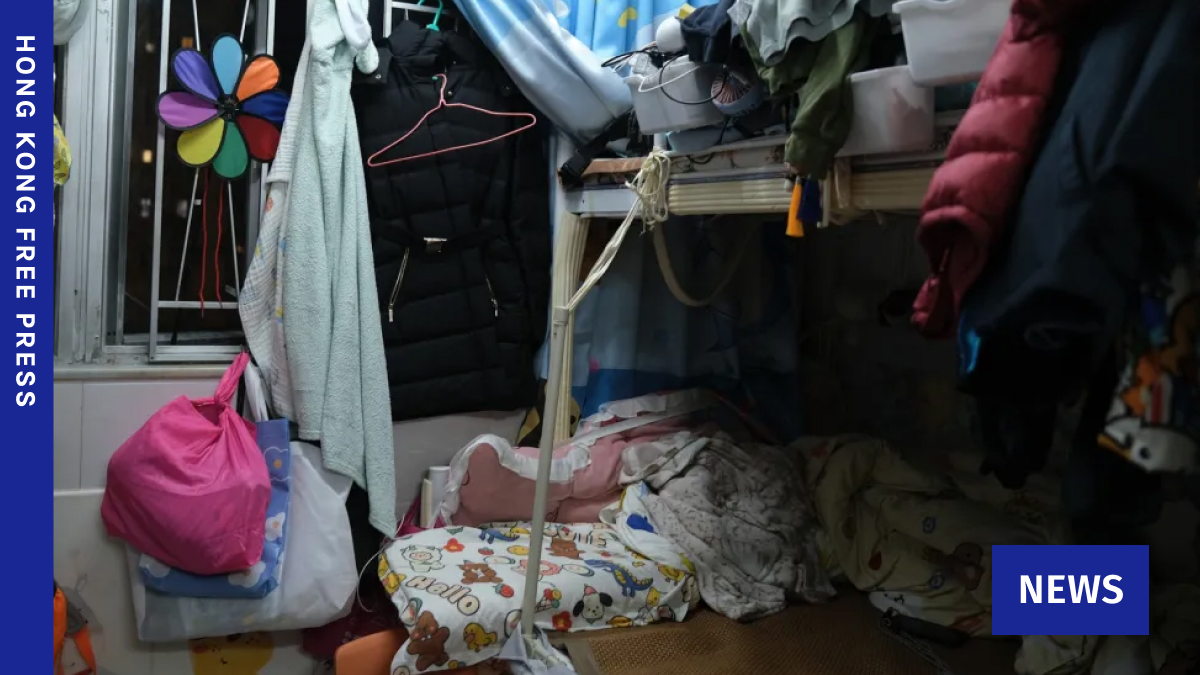
Nearly 40 per cent of Hong Kong’s elderly live in districts with medium to high or high-extreme heat risk, a new study has found. A subdivided unit in Kwun Tong, on February 8, 2025. Photo: James Lee/HKFP. NGO Greenpeace said on Thursday that it evaluated extreme heat risks in districts across the city by assessing factors such as day and night temperatures, concentrations of senior citizens, and income levels. Kwun Tong, Kwai Tsing, Tuen Mun, and Wong Tai Sin comprised the highest-risk areas, the NGO said. All four contain many old buildings as well as a high number of low-income elderly residents, some of whom live alone, the NGO said. The four districts only have one heat shelter each and these are located far from the areas where many elderly live. They also a lack outdoor green space, Greenpeace added. NGO Greenpeace’s heat map showing heat risks to the elderly across Hong Kong. Photo: Greenpeace. According to the group’s heat map, neighbourhoods with more greenery and country parks generally pose the lowest risk. On Hong Kong Island, Shek O, The Peak, and Pok Fu Lam were logged as low risk, while parts of Aberdeen and Eastern District were higher-risk. More extreme weather Hong Kong’s summer again set record high temperatures this year, with the mercury reaching 39.8 degrees Celsius in Sheung Shui in August. The official temperature at the Hong Kong Observatory also set a historical high that day. In June, the Observatory warned of more extreme weather in the coming year due to climate change and forecasts of a “super-strong El Niño event.” Ren Chao, a climate change expert at the University of Hong Kong’s architecture department who worked with Greenpeace, said the Hong Kong Observatory has predicted that the number of “hot nights” a year could reach 80 or more by 2040. The Observatory defines hot nights as ones when the minimum temperature reaches 28 degrees Celsius or above. Last year, there were 54 hot nights. A woman walks under an umbrella in Hong Kong on May 8, 2024. File photo: Kyle Lam/HKFP. “Extreme heat risks vary across Hong Kong depending on neighbourhood planning. The government must act early to identify high-risk areas and deliver immediate interventions,” Ren said in a Chinese-language statement. See also: ‘Covered in bites’: Pests and extreme heat worsen health risks for Hong Kong’s homeless – NGO For example, authorities could consider opening additional heat shelters in new developments like the Northern Metropolis, she said, referring to the major government infrastructure project near the city’s border with mainland China. Greenpeace urged the government to announce measures relating to extreme heat in the Policy Address due to be delivered by the chief executive later this month. The NGO said authorities should coordinate between departments to collect population and climate data that will help identify high-risk areas. The Social Welfare Department should also work with NGOs to visit at-risk elderly people when hot weather warnings are in force, Greenpeace said. Safeguard press freedom; keep HKFP free for all readers by supporting our team Support HKFP | Policies & Ethics | Error/typo? | Contact | Newsletter | Transparency & Annual Report | Apps Make a one-off donation. Hillary Leung is a journalist at Hong Kong Free Press, where she reports on local politics and social issues, and assists with editing. Since joining in late 2021, she has covered the Covid-19 pandemic, political court cases including the 47 democrats national security trial, and challenges faced by minority communities. Born and raised in Hong Kong, Hillary completed her undergraduate degree in journalism and sociology at the University of Hong Kong. She worked at TIME Magazine in 2019, where she wrote about Asia and overnight US news before turning her focus to the protests that began that summer. At Coconuts Hong Kong, she covered general news and wrote features, including about a Black Lives Matter march that drew controversy amid the local pro-democracy movement and two sisters who were born to a domestic worker and lived undocumented for 30 years in Hong Kong. More by Hillary Leung
Nearly 40% of Hong Kong’s elderly face medium to extreme heat risk – Greenpeace
Full Article
Original Source
Read the full article at Hongkongfp →KhanList aggregates and links to publicly available news content. We do not host full articles from third-party sources. Always verify important information with original sources.