
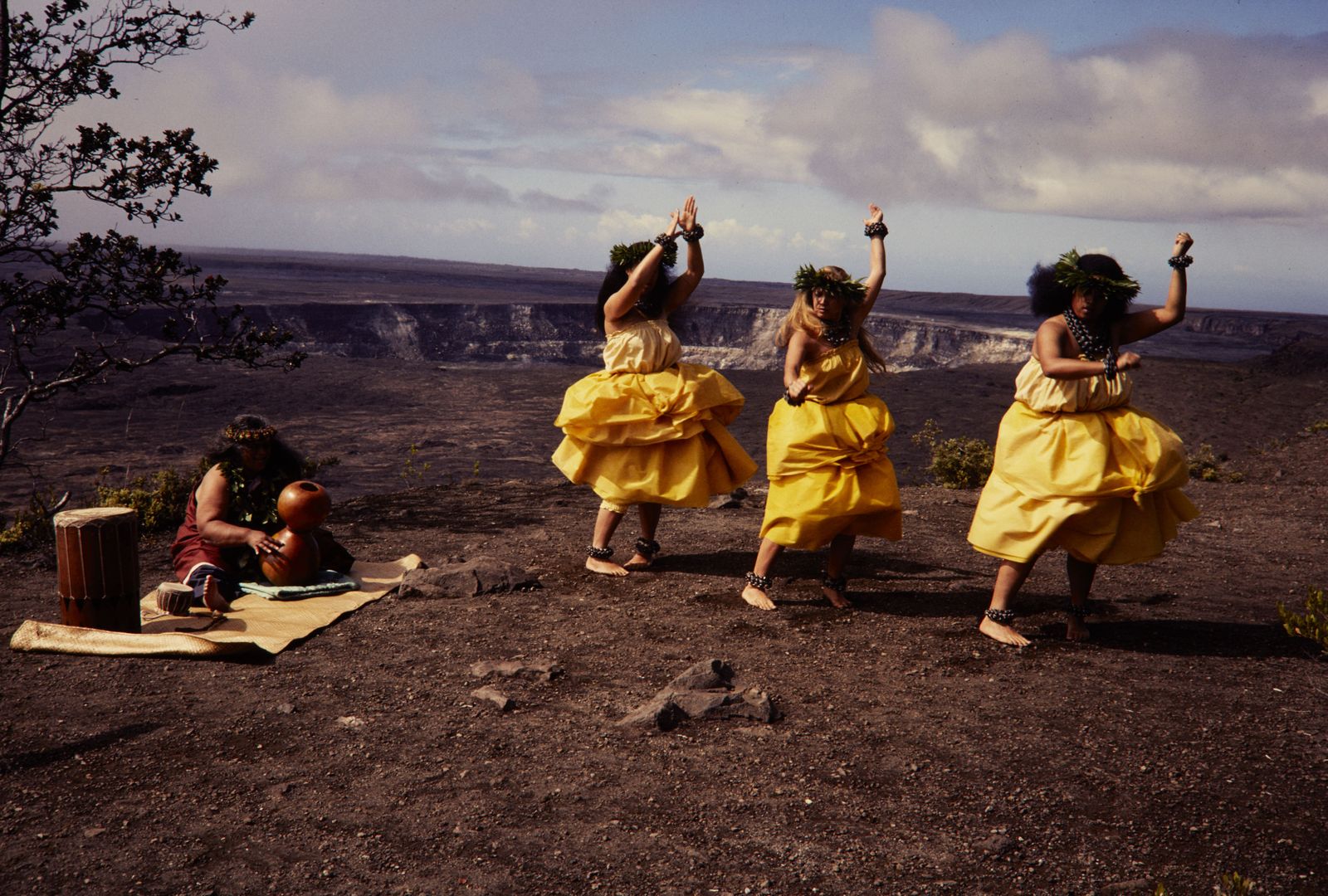
Researchers studied DNA from more than 1,000 modern-day Polynesians and found that Native Hawaiians and Easter Islanders were most closely related. The findings help trace the epic settlement of the Polynesian islands while also revealing genetic vulnerabilities among their communities November 3, 2026 1:56 p.m. Native Hawaiians dancing at Hawai'i Volcanoes National Park. Thomas C. Gray / U.S. National Park Service Almost 1,000 years ago, a group of exceptionally skilled seafarers left Easter Island, also called Rapa Nui, one of the Polynesian islands in the Pacific Ocean. They spent weeks at sea before finally docking their double-hulled catamarans in what’s now Hawaii—around 4,400 miles from their homeland. Researchers reported this surprising new insight into Hawaii’s first settlers on October 8 in the journal Science after analyzing genetic data from more than 1,000 modern-day Polynesians. What’s more, the “ultravoyaging” group’s far-flung journey is just part of a broader settlement process that populated Polynesia—but also brought genetic health hazards that affect people today. Polynesia is a large cultural and geographic region of the east-central Pacific Ocean that includes more than 1,000 islands. The Hawaiian Islands are the only ones located in the Northern Hemisphere, while Easter Island is far off the coast of Chile. Both sit more than 1,800 miles from another inhabited Polynesian island, meaning they’re “the two most remote islands in Polynesia,” study co-author Keolu Fox, an anthropologist at the University of California, San Diego, tells Olin Lagon at Honolulu Civil Beat. “If you had to guess which two islands were least related, you might pick those two,” he says. And yet, Fox and colleagues found just that. In the study, the team analyzed the complete sets of genetic instructions, or genomes, from 1,050 Polynesian individuals, including 317 Native Hawaiians and 12 Easter Islanders. They specifically looked at the length of chromosomal segments shared among people from different islands. Longer shared segments between two people hint at a more recent common ancestor. Based on that information, the team reconstructed thousands of family trees. “In 61 percent of those trees, Hawaii and Rapa Nui were paired together,” Fox tells Reuters’ Will Dunham. “We checked it four different ways because, frankly, we were dumbfounded and couldn’t believe it ourselves at first.” Native Hawaiians shared the second-highest ancestry with individuals from Mangareva, an island around 1,600 miles west of Easter Island. The newly uncovered journey is the most recent addition to researchers’ understanding of the settlement pattern in Polynesia. In 2021, for instance, some of the same researchers reported that people traveled from Samoa through the Cook Islands, then to the Society Islands, followed by Mangareva. They finally reached Easter Island in approximately 1210. The recent study shows that this ultravoyaging culture didn’t stop there. Quick fact: Ultravoyagers The researchers call the ultravoyaging group Holomoana Nui, the Hawaiian phrase for “great ocean voyaging.” Additionally, the genetic evidence bringing together Hawaii, Easter Island and Mangareva aligns with archaeological data, Patrick Kirch, an archaeologist at the University of Hawaii at Mānoa who did not participate in the study, tells Live Science’s Charles Q. Choi. “It gives scientists a lot of confidence when independent lines of evidence from different disciplines give similar results.” What’s more, the study highlights that Polynesia’s settlement process made its populations vulnerable to what’s known as founder effects, which happens when a small group leaves a community to found a new one. The founders of the new community have a shrunken gene pool with limited diversity, which can increase the occurrence of usually rare genetic variants, including those associated with disease. These effects have been well studied in populations including the Amish, Ashkenazi Jews and Finns, leading to the establishment of genetic screenings for certain issues among their groups. The new findings suggest the same needs to be done for Native Hawaiians, who are at the end of a nested series of founder events. “Even compared to Ashkenazi Jews, Polynesians have much stronger bottlenecks, the strongest ever reported. This has real implications for their health,” Cosimo Posth, a population geneticist at the University of Tübingen in Germany who did not participate in the study, tells the Washington Post’s Makana Eyre. For example, three analyzed genetic variants associated with vision or kidney issues, which are exceptionally rare in the global population, were present in 2 to 3 percent of the Eastern Polynesians who participated in the study. That’s enough to justify the establishment of genetic screening recommendations, according to a statement. “This is a population that should be getting research resources and attention from geneticists even more urgently,” says study co-author Alexander Ioannidis, a computational geneticist at Stanford University, in the statement. You Might Also Like Get the latest stories in your inbox every weekday. More about: genealogy Genetics Hawaii Health New Research Pacific Ocean
Native Hawaiians Descend From a Group of 'Ultravoyagers' Who Sailed About 4,400 Miles From Easter Island, Genetic Study Suggests
Full Article
Original Source
Read the full article at Smithsonianmag →KhanList aggregates and links to publicly available news content. We do not host full articles from third-party sources. Always verify important information with original sources.