
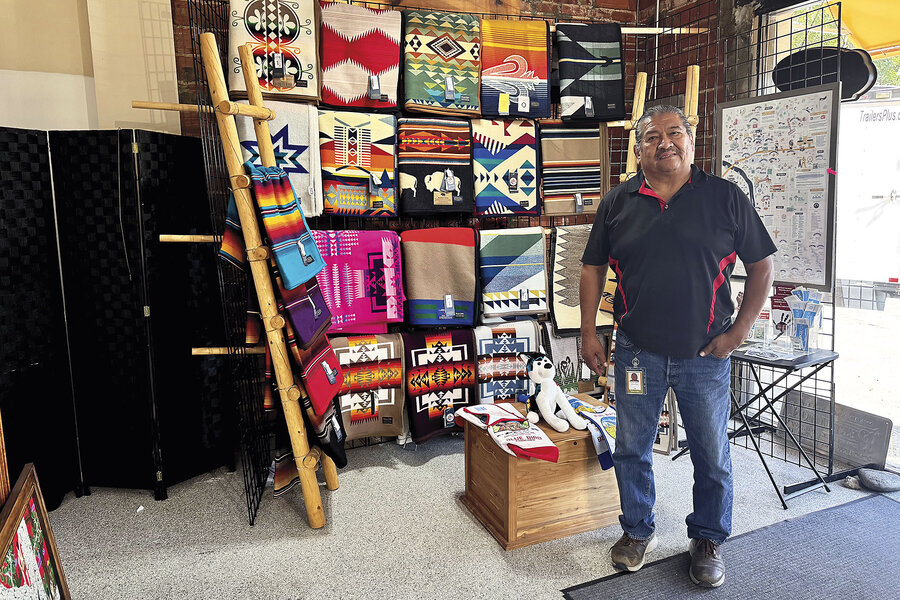
On East 11th Street in Tulsa, Route 66 is hard to miss.Neon signs crowd the old highway through the Meadow Gold District. Murals, giant roadside figures, and the familiar red, white, and blue shield turn the block into a bright distillation of the Mother Road – nostalgic, playful, and designed to be understood through a windshield.Inside Southwest Trading Company, however, David Bible refuses to sell anything bearing the highway’s logo. Why We Wrote This Some Native American communities push back on stereotypes used to market businesses along Route 66. But they also know that the road attracts people who can be customers for their businesses, and who may listen to the true stories of Indigenous people in the American southwest. “We could do the Route 66 emblem and hang some feathers off of it,” he says. People would buy it, too; nearly half the store’s customers are travelers.But the shop, run by Mr. Bible and his daughters, carries no such design. “That’s not who we are.”That small refusal opens onto a larger Indigenous encounter with Route 66. More than half of its 2,400 miles cross Indian Country, often following older Native paths through communities that predated it.For nearly a century, roadside businesses turned Indigenous identity into a reliable commercial trope: a generalized “Indian” assembled from headdresses, tipis, and Hollywood Westerns, detached from the nations whose lands the highway crossed. Now, tribal governments and tourism groups are using the centennial to tell another story: Native nations as founders of towns, owners of land, and as sovereign governments, while directing travelers toward tribal museums and Native-owned businesses.This is reclamation, but also commerce. Mr. Bible sees reason for caution. What connects these approaches is a demand for control over the story, the identity being marketed, and the money travelers bring.“We were here long before”On his father’s side, Mr. Bible is Muscogee, of the Bird Clan, and on his mother’s side Hopi, of the Coyote Clan. As a child in the 1960s and ’70s, he rode Route 66 west nearly every year in his family’s station wagon to visit Hopi relatives in Arizona.Outside were giant chiefs, wigwam motels, and trading posts that made the American Indian one of Route 66’s oldest roadside attractions.Mr. Bible’s family now sells work by Native artists, along with affordable, mass-produced merchandise bearing Native designs. Yet during the highway’s centennial, as neighboring businesses lean harder into its mythology, Mr. Bible holds it at arm’s length. Harry Bruinius/The Christian Science Monitor Southwest Trading Company stands just off Route 66 in the historic Meadow Gold District in Tulsa, Oklahoma, July 27, 2026. Pressed on whether he is merely indifferent, he concedes “a little bit of active hostility,” even though “it would benefit our business,” he adds.Other people and tribal nations are embracing some of this year’s centennial celebrations – but it’s complicated and sometimes ambivalent.“It’s not so much the actual event,” says Gail Chehak, a Klamath citizen and the community relations director of the American Indigenous Tourism Association. Native nations, she says, are using the centennial “to remind people, you know, we were here long before the route, and the route follows a lot of our traditional trails, and that we’re still here.”Many tribe members have “both fond and not-so-fond memories” of the road. It crossed Native land and helped market a generic Hollywood Indian. But it also connected Native communities, carried families along the Powwow Trail, and opened new markets for Native artists, she says.“I think people have decided that [Route 66] is a good way to get their story out,” Ms. Chehak says.Mr. Bible remembers the generic figures from his trips. “They were more caricature statues,” he says. “Big headdress, big nose, big muscles.”His family sometimes laughed, but usually stopped only for gasoline or a restroom. More striking was what motorists could not see: Native lands were rarely marked.“You didn’t know you were going through it unless you had the non-Native stores that were advertising it,” he says.At the First Americans Museum in Oklahoma City, an exhibit maps the highway across Oklahoma’s tribal geography. John Hamilton, an assistant curator who helped install it, is careful about calling that reclamation.“We’re not claiming the road itself,” he says. “We are claiming that it does run through Native land, and this has always been Native land.”Cherokee Nation leaders are more willing to use the language of reclamation. In a tribal video, Principal Chief Chuck Hoskin Jr. called the old roadside experience “a pan-Indian offering.”“The true origins of the Mother Road run far deeper than the pavement laid in the 1920s,” he said. The nation is “proudly reclaiming our vital role in this narrative.”“The vibrant towns that dot this iconic route today – communities like Bonita, Claremore, Catoosa, and Chelsea – did not simply spring from the wilderness alongside the highway. They were founded by Cherokees decades prior,” Chief Hoskin said.His father, former Vinita Mayor Chuck Hoskin Sr., grew up on his grandmother’s Cherokee allotment. As a boy, he’d watch license plates to see all the different states represented. “In my young mind, everyone came through Vinita, Oklahoma,” the former mayor recalled.Later he rode the entire highway twice by motorcycle. Chicago marks its beginning; near Santa Monica, California, a sign declares the “End of the Trail.”“This was the end of our trail,” Mr. Hoskin Sr. said of Oklahoma, alluding to the infamous “trail of tears.” “This was the end of our forced movement.”Two sides of commerceMs. Chehak says that tribes “definitely are taking advantage of the route and the business that it brings.”But the association will not advertise a destination until the tribe or business approves its description – a small reversal of the old roadside economy, in which outsiders invented Native identities for signs and souvenirs.Mr. Bible experienced that economy from both sides. His family sold beadwork through Lyon’s Indian Store, a non-Native-owned Tulsa business. Decades later, he and his daughter opened Southwest Trading Company nearby.His surname bears the history of the attempts to assimilate Native peoples into American ways of life. His mother was placed with a Mormon foster family in 1952 under the church’s student placement program; his father, from Broken Arrow, also went through boarding school, joined the Marines, and met his mother in San Diego. His parents “just didn’t talk about it,” he says.Mr. Bible, raised Mormon, later rose into church leadership, but left over teachings about Native people and the ways his children were treated as they grew up. Still, he emphasizes, there was opportunity alongside assimilation, generosity alongside injury.His store occupies similar unsettled ground. The family does not want to become another Native American attraction. Yet travelers enter because they are following Route 66. They ask about the artists and the southwest focus of the store’s offerings.The store is in the final year of its lease. The Meadow Gold District has revived, rents have risen, and the family might have to move their business.Mr. Bible believes customers will find them, should that happen. Then he acknowledges the loss. “We really enjoy the area and the people we meet,” he says. “But we’ll lose that Route 66.”The road does not define him. But it has become part of the place from which he tells his own story.
Native Americans, once caricatured, now ponder: Reject Route 66, or use it to connect?
Full Article
Original Source
Read the full article at Csmonitor →KhanList aggregates and links to publicly available news content. We do not host full articles from third-party sources. Always verify important information with original sources.