
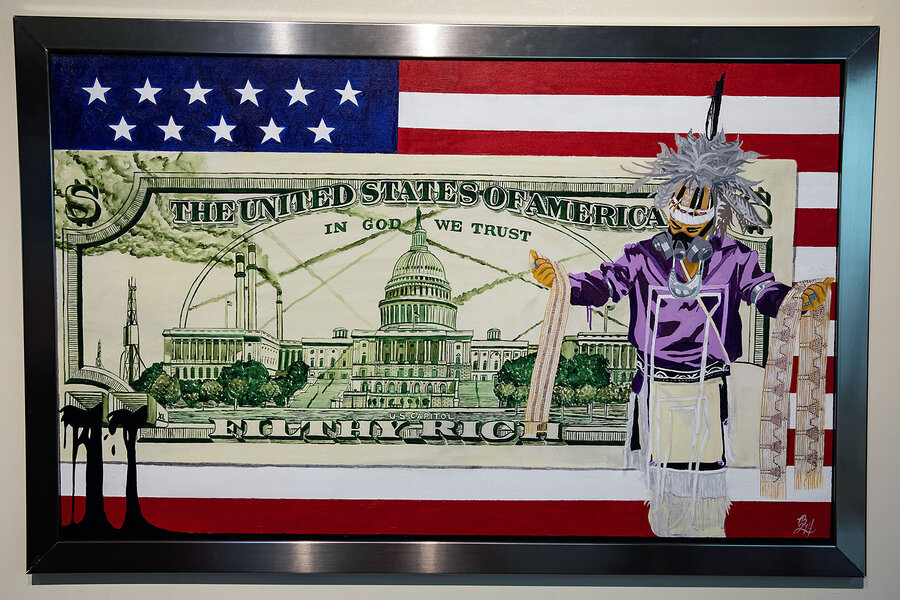
About a 40-minute drive west of Albany, the Iroquois Museum here is hosting an art exhibit that explores the impact of 250 years of American independence on the people who have called this land home for thousands of years.Brandon Lazore, a member of the Onondaga Nation and painter on the Akwesasne Mohawk Reservation, has two works on show that hint at how layered that relationship was as America got its start. He details the profound effect of Native American ideas and practices on the American colonists attempting to form a more perfect union in Philadelphia.“That term – ‘We the People’ – comes from us because we’re governed by the people; they were learning from us,” says Mr. Lazore. One of the most powerful ideas the colonists borrowed from the six-nation confederacy of the Iroquois, he says, was the separation of powers in a federal system: a legislative branch that passes laws, a judicial branch that settles disagreements, and a central authority, or grand council, that provides for common defense. Melanie Stetson Freeman/StaffOnondaga Nation artist Brandon Lazore poses in his studio in Akwesasne, New York, Aug. 11, 2026. As a Native American, Mr. Lazore says America’s 250th anniversary of independence fills him with both pride and sadness. Decades before the colonists rose up, Native American elders viewed the arriving settlers as younger brothers, Mr. Lazore says. Iroquois envoys regularly visited colonists, both to size up their ambitious rivals and to give advice on how to survive on an American continent where Native American culture dominated. In 1744, a senior elder of the Iroquois Confederacy named Canassatego told a gathering of colonial leaders in Lancaster, Pennsylvania, that they needed to unite.In Mr. Lazore’s telling, Canassatego told them: “We want you to form a union like how we have because it’s hard to deal with you all separately. You all want different things.” Taking a handful of arrows, the elder pulled out one and snapped it in two; then he took the remaining arrows and demonstrated how hard it was to break them when they were united. Congress ultimately adopted this image in the Great Seal of the United States in 1782, with a bald eagle grasping 13 arrows in one foot, and an olive branch representing peace in the other.Two hundred fifty years after the Declaration of Independence, many Americans know the relationship between Native Americans and the European settlers of the 13 colonies as a clash of civilizations that led to the displacement of entire peoples and their way of life. But the story is more complex. At the end of the Revolution, Native American nations controlled most of what would become the United States. While the new country’s first decade set the stage for violent conflict, there was a time when the societies were learning from each other, shaping each other, and negotiating as near equals.Looking deeper at places such as Rome, New York; the Akwesasne Mohawk Reservation; Cincinnati; and Lewistown, Pennsylvania, can reveal stories that help us better understand the complicated and sometimes surprising relationships between American settlers and Native American nations, and how those interactions give insight into how America became what it is. Colin G. Calloway, a Dartmouth history professor and author of “The Indian World of George Washington,” says that the Congress of the Confederation – the precursor to the U.S. Congress – set the stage for westward expansion, before George Washington took office as president, by passing the Northwest Ordinance of 1787. It set a new government model for the Northwest Territories, the Ohio Valley and lands east of the Mississippi River, and offered a clear path for settlers to create new states on an equal footing with the original 13 colonies.This put Washington in conflict with every Native American nation on the western frontier, at a time when the new nation was still recovering from its war for independence. Melanie Stetson Freeman/Staff"Symbols of the Confederacy," an exhibit at the Iroquois Museum in Howes Cave, New York, chronicles the centuries-old union of six Native American nations. “Congress had made conflicting commitments: We’re going to expand west and build the nation on Indian land. And by the way, we’re going to deal fairly and honestly with Indian nations,” says Dr. Calloway.“The question for Washington, and I believe he was sincere in this to an extent, is how can we do this as fairly and honorably as we can, and I think that kind of sets up a core dilemma for American Indian policy from that day, perhaps to this day.”Lewistown, Pennsylvania: A woman who pioneeredIn retrospect, America’s westward expansion seems like it was inevitable, but the Revolutionary period was a time when Manifest Destiny was anything but.In the mid-1700s, the colonies of Pennsylvania, New York, and Virginia were every bit as much the Wild West as the Dakotas would be a century later. During the French and Indian War, during which Britain took on French armies and their Native American allies, New York and Pennsylvania were the sites of scorched-earth campaigns that would displace both settlers and Native American communities, sometimes permanently.But the people who lived in these conflict zones often returned. In 1754, Pennsylvania adventurer Arthur Buchanan bought 200 acres in an Indian village from a Lenape chief. With his wife, Dorcas, he established a trading post and tavern at the convergence of Kishacoquillas Creek and the Juniata River. Melanie Stetson Freeman/StaffA fabric collage by Native American poet and artist Alex Jacobs, entitled “Homeland Father at the River,” is on display at a cultural center and museum in Akwesasne, New York, Aug. 10, 2026. Months after setting up shop, the Buchanans were forced to flee to the fortified town of Carlisle when tribes cast their lot with either the French or the British. Dorcas, an Irish immigrant, drew upon decades of frontier experience as a very personal war broke out. One contemporary tale has Dorcas facing down a raiding party that demanded she hand over the goods at the trading post. “She asserted her own authority,” says Forest Fisher, president of the Mifflin County Historical Society in Lewistown. “‘This is my space and you jolly well better just turn around and go.’ She had that reputation, and that carried weight.”For years, Dorcas Buchanan was referred to in local histories as “the first European woman settler.” When Arthur died in 1760, his property was deeded to Dorcas, and it was her persistence in returning to the trading post that encouraged other settlers to return as well. Ultimately, the land was sold, subdivided into lots, and became the town of Lewistown.In preparation for the 250th anniversary, Cate Barron, a retired newspaper executive editor, looked into Dorcas’s story with her sister Jenny Landis, executive director of the Juniata River Valley Visitors Bureau. The two consider Dorcas Buchanan a “founding mother” of Lewistown.Ms. Landis says, “I would not call myself a feminist, but I do believe young women need to know the power that they have inside of themselves. She’s very empowering.”Cincinnati: After the revolution, new perilDuring the Revolutionary War, most Indigenous tribes sided with Britain because the British were preventing the westward movement of American settlers seeking land.In western New York, punishing raids by American Maj. Gen. John Sullivan against towns and villages of the Iroquois Confederacy, also known as the Haudenosaunee, destroyed fields, orchards, granaries, and morale. The Haudenosaunee ultimately sued for peace, signing a treaty at Fort Stanwix in 1784, which ceded lands in New York and Pennsylvania, and opened up the Ohio Valley for settlement. Melanie Stetson Freeman/StaffVisitors at the reconstructed Fort Stanwix National Monument, in Rome, New York, on Aug. 12, 2026. The fort was built in the mid 1700s by the British during the French and Indian Wars to protect a portage known as the Oneida Carry. Settlers came first, in 1788. A year later, a small detachment of soldiers landed downstream and built a stockade named Fort Washington at what would, in 1790, become the city of Cincinnati. For those at the nearby Columbia settlement, five miles upriver from Fort Washington, the only way to survive in these early days was self-defense, says Dinese Young, executive director of the Carnegie Center of Columbia Tusculum.“From lore, we hear that the top of the hill above Columbia was cleared by Native people to keep an eye on settlers,” says Ms. Young. Land disputes led to conflict, she says. By 1789, settlers were paying $30 per scalp of Indigenous warriors. By 1790, 150 residents were armed.While Congress had disbanded most of the army after peace was signed with Britain in 1783, Washington, as president, ordered additional troops to Ohio to protect the new settlements. But he had only one regiment to send.When it arrived, Chief Little Turtle of the Miami was waiting. On Nov. 4, 1791, Little Turtle routed the U.S. force, led by Maj. Gen. Arthur St. Clair, on the upper Wabash River. Native fighters killed more than 900 regulars and militiamen and wounded 276 others. Historian Patrick Feng says this number accounted for nearly half the entire U.S. Army at the time. It remains the Army’s worst defeat at the hands of Native American forces. Melanie Stetson Freeman/StaffBuilt in the 1800s, Victorian homes called "Painted Ladies" dot the historic Columbia Tusculum district of Cincinnati, May 19, 2026. The neighborhood is the oldest in the city, dating back to the Revolutionary era. The defeat shocked the nation and prompted Congress in March 1792 to reorganize the army with new troops and a new commander, Maj. Gen. Anthony Wayne. In 1794, he took this new army to Ohio and defeated Little Turtle, leading to a treaty in which the Miami and allied tribes gave up land claims to the Northwest Territory.For Native Americans and American settlers alike, this battle was a turning point. It set the stage for America’s expansion to the west – and Native American displacement. It also marked a change of philosophy, in which American leaders embraced a strong central authority.“You’ve still got Britain in the north,” says Dr. Calloway. “You’ve got Spain in the south. These still powerful Indian nations are uniting against you, and you cannot even defend your frontiers. For America’s new government, that’s the trigger. If people are going to take us seriously as a nation, a proper army, funded in a proper way, is essential.”Rome, New York: Pride, sadness, and hopeFor Mr. Lazore, the painter, America’s 250th anniversary of independence fills him with both pride and sadness. The pride comes from the undeniable influence that Native American ideas and principles of governance had on the Founding Fathers. The sadness comes from reflecting on how those founders used their newly independent government and military might against Indigenous people. Melanie Stetson Freeman/StaffA close-up of Onondaga artist Brandon Lazore’s piece entitled “The Great Law of Peace,” from 2022. Mr. Lazore's artwork collection is part of a display at the Iroquois Museum in Howes Cave, New York, tied to the 250th anniversary of American independence, Aug. 11, 2026. Mr. Lazore’s intricate artwork takes its inspiration from Haudenosaunee concepts that can be seen in America’s cornerstone documents.The drafters of the Declaration of Independence and the U.S. Constitution drew on many sources, of course: Classical philosophers of Greece and Rome, Enlightenment thinkers of 17th- and 18th-century France and England. But for Benjamin Franklin, the Haudenosaunee’s federal governing model was a perfect solution for how to get quarreling colonies to work together. And in 1754, he published his Albany Plan of Union, to push for a Haudenosaunee-style confederation. Franklin’s motion was rejected, but Haudenosaunee ideas later found their way into the U.S. Constitution.Speaking from his art studio, Mr. Lazore says that Haudenosaunee ideas might have helped shape the future U.S. government’s structure. But once they gained independence, American leaders started a long pattern of negotiating treaties and breaking them, driven by a relentless goal of western expansion.“If they honored all the things they said they would do, we could both stand side-by-side as brothers like we were supposed to,” Mr. Lazore says. “But it’s hard to have pride when your brother is trying to destroy you.”Another artist whose works are on display at the Iroquois Museum is Alex Jacobs, a painter and poet. On a television screen in the exhibit, Mr. Jacobs reads his poem “The Law Is in the Seed.” He says the poem highlights the resilience of the Haudenosaunee, who “take their seed and move to the new place, once again, under the shelter of the tree of peace.” Melanie Stetson Freeman/StaffNative American poet and artist Alex Jacobs, pictured at his home in Akwesasne, New York, on Aug. 10, 2026, says he finds hope that much of the original structure that the Haudenosaunee people shared with the country's Founding Fathers lives on in American democracy The law in the poem’s title is the Great Law of Peace, a centuries-old agreement that bound the separate Haudenosaunee nations together for common defense, and Mr. Jacobs believes that it lives on. Deepen your worldviewwith Monitor Highlights.Politics with respectGet political stories with respectful analysis.There's a world of new ideas in everyBooks newsletter.There's more to life, enrich yours withCulture & Learning weekly.Follow humanity's discoveries withScience & Nature stories in your inbox.Gain a spiritual perspectivefrom the stories in your inbox.Want to understand the deeper impact of critical events? Learn the Monitor's insight.Already a subscriber? Log in to hide ads. “The hope comes from the younger generation, and it stems from their learning and carrying on from elders,” he says. “It’s kind of unspoken, but it’s vital.”Mr. Jacobs also finds hope that much of the original structure that Haudenosaunee shared with the Founding Fathers lives on in American democracy. The strength of democratic institutions, he says, “is what all that 250 noise was about anyway. That’s what is to be celebrated.” ALREADY A SUBSCRIBER? LoginReal news can be honest, hopeful, credible, constructive.The Christian Science Monitor was founded in 1908 to lift the standard of journalism and uplift humanity. We aim to “speak the truth in love.” Our goal is not to tell you what to think, but to give you the essential knowledge and understanding to come to your own intelligent conclusions. Join us in this mission by subscribing.
Native American ideas helped shape the Revolution – and the America of today
Full Article
Original Source
Read the full article at Csmonitor →KhanList aggregates and links to publicly available news content. We do not host full articles from third-party sources. Always verify important information with original sources.