
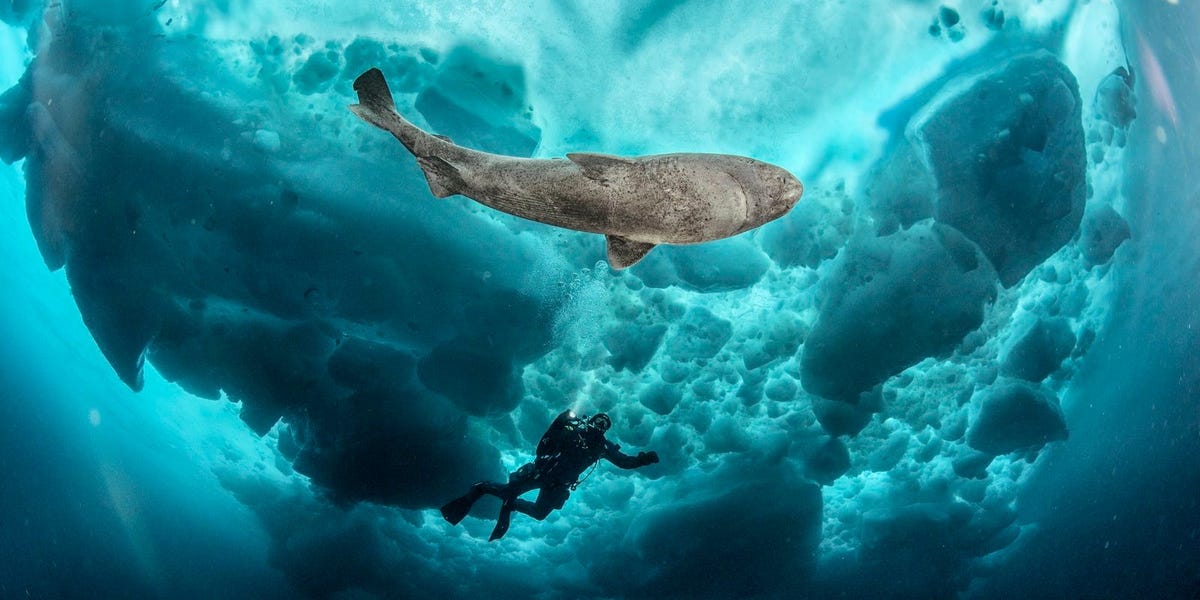
Kiliii Yüyan/National Geographic National Geographic's Pictures of the Year collection highlights striking wildlife photos. Out of over 1 million photos taken by National Geographic photographers in 2026, 25 images were named Pictures of the Year.For its annual year-end issue, National Geographic magazine highlighted the defining photos of the past 12 months, showcasing rare wildlife sightings, split-second nature shots, and how the changing climate is affecting humans and animals alike.Nathan Lump, editor-in-chief of National Geographic, called the Pictures of the Year collection "a testament to the boundless curiosity and relentless persistence of our photographers in their quest to help us better understand our world.""Together, these images remind us how much there is still to discover about our planet, and that the deeply human work of documenting what's real is more valuable than ever in a time when fakes are everywhere," he said.Here are seven of National Geographic's Pictures of the Year, plus the history-making cover photo. The entire collection can be viewed on National Geographic's website. National Geographic's December 2026 issue highlights its Pictures of the Year. The cover of the December 2026 issue of National Geographic. National Geographic The cover photo, taken by Tony Wu, shows a male moray eel releasing the female's jaw during spawning in the waters of Kagoshima, Japan.Wu and his team captured the first-ever images of moray eels reproducing in the wild. Spawning lasts less than two seconds, so it took hundreds of hours to catch the eels in the act. Ralph Pace's photo shows a pygmy blue whale feeding on krill in South Taranaki Bight, New Zealand. A pygmy whale in New Zealand. Ralph Pace/National Geographic Pace took the photo while diving with researchers studying how warming waters caused by the climate crisis are affecting krill and whales. It took Jaime Rojo 10 days to capture this photo of a male resplendent quetzal in flight in Chiapas, Mexico. A resplendent quetzal in Mexico. Jaime Rojo/National Geographic The bird is named for the serpent god Quetzalcoatl because of its long green tail. Prakash Matada photographed a troop of Gee's golden langurs up to some monkey business in Bongaigaon, Assam, India. Gee's golden langurs in India. Prakash Matada/National Geographic Matada used a fisheye lens attached to a telescoping pole to photograph the monkeys, who appeared curious about their reflections. Greenland sharks are the oldest vertebrates on Earth, and Kiliii Yüyan photographed a diver swimming near one. A Greenland shark in Greenland. Kiliii Yüyan/National Geographic Yüyan photographed the shark near diver Philipp Oppermann as they swam beneath a layer of ice over 3 feet thick off the coast of East Greenland.Greenland sharks can live up to 500 years, and Yüyan estimated that this one was born sometime around the Civil War. Jason Gulley captured a rare view of a Gulf sturgeon in Florida's Suwannee River during spawning season. A Gulf sturgeon in Florida. Jason Gulley/National Geographic Prolonged drought left the Suwannee River less murky than usual, giving Gulley a clear shot. In the woods of Kenya's Masai Mara National Reserve, Will Burrard-Lucas photographed two lions crossing a riverbank. Lions in Kenya. Will Burrard-Lucas/National Geographic Lions are usually found in grasslands, not in the depths of the woods, but may have been driven there by deforestation and drought. Gabriel Jensen's photo of a male jawfish aerating eggs near Palm Beach, Florida, was National Geographic's Your Shot Photo of the Year. A male banded jawfish in Florida. Gabriel Jensen/National Geographic After female jawfish spawn, male jawfish hold the eggs in their mouths and spit them out to circulate them with oxygenated water until they hatch. Jensen, a self-taught amateur underwater photographer, worked for months to photograph the banded jawfish with its mouth wide open and submitted the photo to National Geographic's #NatGeoYourShot challenge on Instagram."It's delightful, and shows how a species cares for their young, something humans can all relate to," National Geographic senior managing photo editor Anne Farrar said of the image. "What a cool glimpse into a little-seen world." Read next Business Insider tells the innovative stories you want to know Business Insider tells the innovative stories you want to know Business Insider tells the innovative stories you want to know Business Insider tells the innovative stories you want to know Nature Photography
National Geographic revealed its Pictures of the Year. Here are 8 of the most captivating wildlife photos.
Full Article
Original Source
Read the full article at Businessinsider →KhanList aggregates and links to publicly available news content. We do not host full articles from third-party sources. Always verify important information with original sources.