
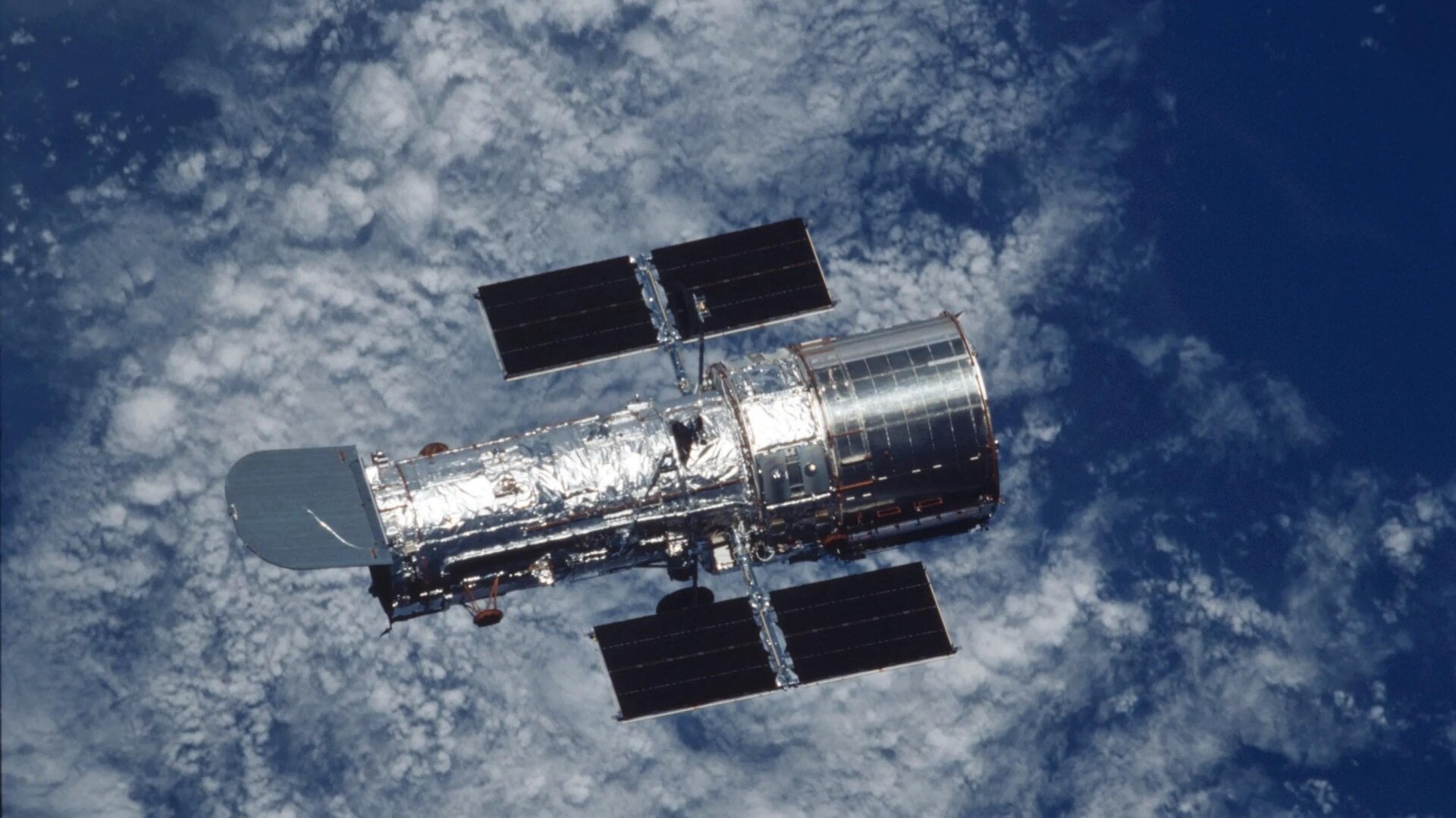
When it comes to photography of the cosmos, the Hubble Space Telescope is one of the best to ever do it—a real astronomical Ansel Adams. Just look at the staggering body of work it’s produced since being launched into low-earth orbit in 1990. While Hubble’s up there snapping jaw-dropping close-ups of our planetary neighbors or gargantuan nebulae light years away, lesser 36-year-old photographers on Earth are sliding into the DMs of the Instagram models they’d “love to collab” with. It’s Hubble’s unparalleled corpus of works that make its current fate all the more upsetting. It’s slowly but steadily losing altitude as it orbits our planet and is predicted to re-enter the atmosphere, falling from the heavens in a fiery blaze, sometime in the early-to-mid 2030s—an ignominious and far-too-soon demise for one of the most significant achievements in the history of science. Given that gravity has a tendency to attract smaller masses to larger ones, Hubble’s expected downward drift is a problem NASA’s been trying to mitigate since before the observatory even launched. They even got Space Shuttle Columbia to nudge it back up in orbit a bit during a 2002 servicing mission. While that may have bought Hubble a few extra years, it was only forestalling the inevitable. And with the Space Shuttle fleet now grounded and spending their retirement years in various museums, NASA’s been forced to look to the private sector for Hubble rescue operation ideas. With no spacecraft of their own left to handle the task, the federal agency released a Request for Information (RFI) on October 29 to see if anyone from the growing commercial space industry might care to offer a proposal on how to boost Hubble’s altitude and/or service it. Failing that, NASA would also be open to exploring ways to execute a controlled disposal of the satellite. Interested parties will need to share details about their company’s current or near-future capabilities for safely capturing and elevating Hubble to an altitude of 373 miles (600 km) or higher and giving the ‘scope a performance enhancing tune-up or simply guiding it on a controlled re-entry back to Earth. Applicants for this mission, which would take place in 2032, must plan the mission themselves, provide and launch their own spacecraft, and recruit the human crew needed for the job (if applicable). No matter the approach taken, no harm must come to Hubble. “Hubble still has important science ahead of it, and we should be looking at every reasonable opportunity to keep it delivering for as long as possible,” said NASA Administrator Jared Isaacman in a post on the agency’s website. “If there are innovative and cost-effective ways to extend the life of an asset already on orbit, we owe it to the American taxpayer and the scientific community to explore them. It certainly would be great if the oligarchs currently clogging up the skies with private satellites and scheming up ways to colonize the universe could take a moment to help out the institutional giant whose shoulders they’re standing on. But with NASA seeking “cost-effective” solutions to contend with their ever-shrinking budget while the Pentagon seems to have an endless supply of multi-billion-dollar Space Force contracts for its capitalist friends, those best equipped to help Hubble may need some convincing. Anyone wishing to lend NASA a hand (or vehicle) must submit their proposals before the November 30 deadline.
NASA’s Begging the Commercial Space Industry to Save the Doomed Hubble Telescope
Full Article
Original Source
Read the full article at Gizmodo →KhanList aggregates and links to publicly available news content. We do not host full articles from third-party sources. Always verify important information with original sources.