
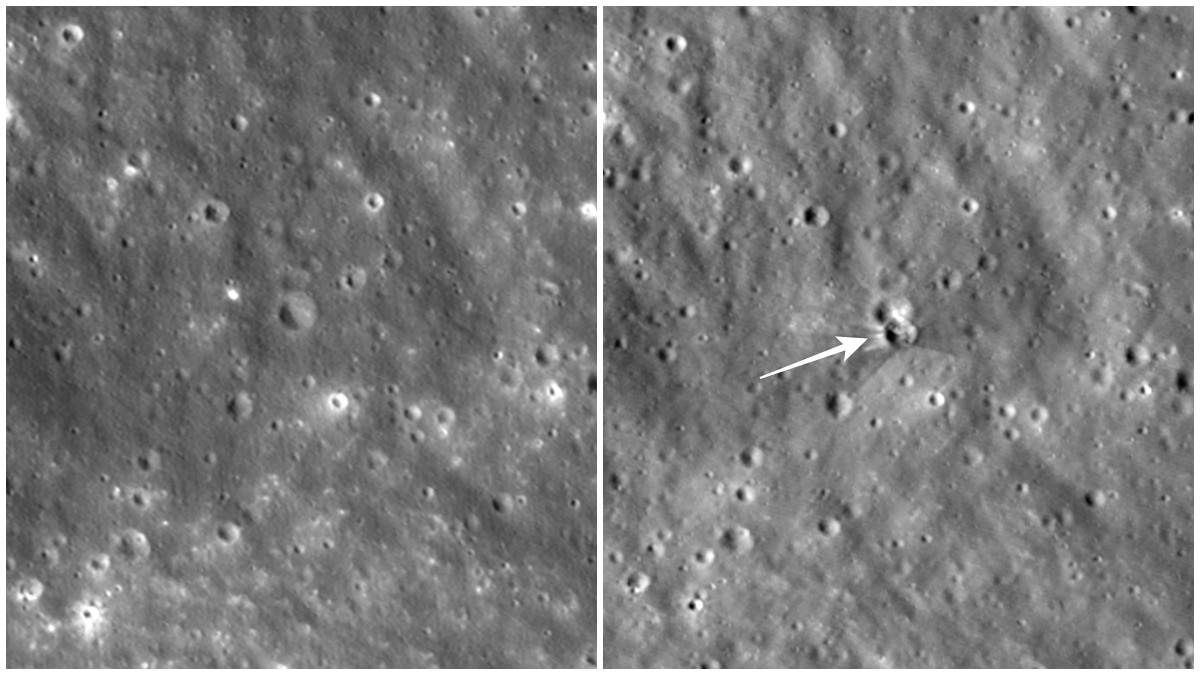
Nasa's Lunar Reconnaissance Orbiter has photographed a fresh Moon crater created by a Falcon 9 upper-stage impact. The images, backed by South Korea's Danuri, have precisely mapped the site and its ejecta patterns.Between August 11 and 12, Nasa’s LRO successfully photographed the fresh impact site. (Photo: Nasa)Nasa’s Lunar Reconnaissance Orbiter (LRO) has returned the most detailed images yet of a newly formed crater on the Moon, created when a SpaceX Falcon 9 upper-stage rocket crashed into the lunar surface earlier this month.The impact occurred on August 5, when the spent Falcon 9 upper stage, originally launched in January 2025 as part of the Firefly Blue Ghost 1 mission, struck the Moon after months in space.Between August 11 and 12, Nasa’s LRO successfully photographed the fresh impact site, providing scientists with a rare opportunity to study a newly formed lunar crater in remarkable detail. Capturing the crater was far from straightforward. Engineers had to carefully tilt the spacecraft during each pass so its cameras could point toward the impact location while flying about 60 miles (100 kilometers) above the Moon at a speed of roughly one mile per second. Because the orbiter circles the Moon every two hours while the lunar surface slowly rotates beneath it, scientists had to wait six days for the target area to come into view.Precision timing was equally critical. Nasa said that if the camera had taken images just 10 seconds too early or too late, the target would have shifted by nearly 10 miles, missing the center of the frame. Using its powerful Narrow-Angle Camera, capable of detecting objects as small as three feet across, LRO observed the crater under multiple lighting conditions. The images revealed a crater approximately 60 feet (18 meters) wide and less than 10 feet (3 meters) deep.The photographs also exposed striking bright and dark rays radiating from the impact site. Scientists say the darker streaks consist of older lunar soil altered over billions of years by solar wind, cosmic rays, and micrometeorite bombardment.The brighter rays are fresh material excavated from deeper beneath the lunar surface during the collision.Locating the impact site required an international effort. Independent astronomers first tracked the rocket's trajectory using publicly available data, while Nasa’s Center for Near Earth Object Studies refined impact predictions.The coordinates were then shared with South Korea’s Korea Pathfinder Lunar Orbiter (Danuri), which successfully imaged the crater shortly after impact and confirmed predictions within about 0.6 miles.Combining observations from Danuri and LRO, scientists have now precisely mapped the crater, offering a unique glimpse into how human-made objects continue to reshape the lunar landscape.- EndsPublished By: Sibu Kumar TripathiPublished On: Aug 19, 2026 11:58 IST
Nasa orbiter sends detailed image of new crater on Moon after rocket crash
Full Article
Original Source
Read the full article at Indiatoday →KhanList aggregates and links to publicly available news content. We do not host full articles from third-party sources. Always verify important information with original sources.