
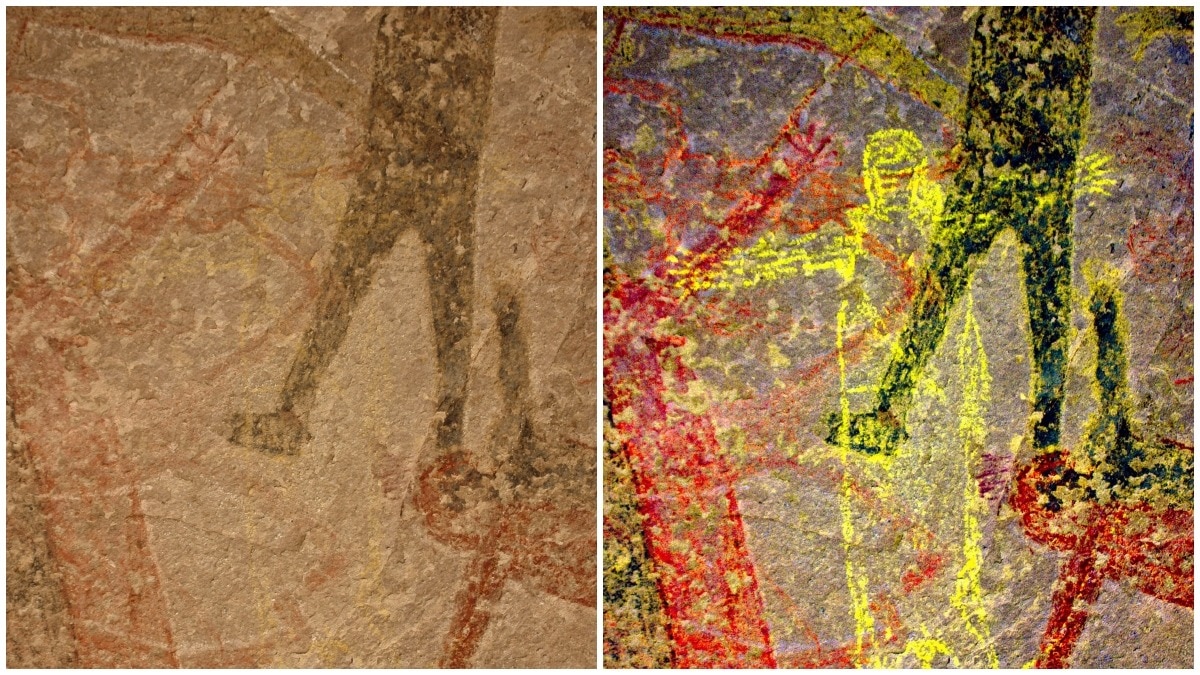
A Nasa imaging technique first used to study Mars is helping archaeologists reveal faded paintings, rock art and preserved tattoos on Earth. The crossover shows how space-age tools are recovering traces of ancient civilisations hidden in plain sight.As Jon Harman was developing the Dstretch plug-in, he applied it to this image from the Cave of San Borjitas in Baja California, Mexico. When the yellow figure appeared in the middle of the picture, he knew he had something useful. (Photo: Jon Harman)New Delhi,Sep 25, 2026 13:01 ISTA technology originally developed by Nasa to study the surface of Mars is helping archaeologists uncover hidden ancient paintings, decipher faded rock art and even examine tattoos preserved on mummified human remains.The technique, known as decorrelation stretch, enhances subtle colour differences in digital images, making features invisible to the naked eye stand out. It has been used to discover hundreds of ancient paintings at Cambodia's Angkor Wat temple complex and study archaeological sites across the world.At Angkor Wat, an archaeologist using the technique discovered paintings between 2010 and 2012, including images of horseback riders and a traditional musical ensemble high in the temple's central tower. Thousands of visitors pass the faded artwork every day without noticing it.The discoveries were part of a larger collection of around 200 paintings identified across the ancient Cambodian temple complex. FROM MARS TO ANCIENT ROCK ARTThe technique's journey from space exploration to archaeology began around 2005, when rock art enthusiast Jon Harman noticed how Nasa images of Mars revealed significantly more surface detail after decorrelation stretch was applied.Harman, who also had experience in medical imaging, realised the same approach could help researchers study ancient paintings that had faded over centuries. "I Googled it and found a Nasa paper that explained how to do the algorithm," Harman said. "I knew from my medical imaging experience that I could do it, so I did."The original research paper was written in 1996 by Ronald Alley, an employee at Nasa's Jet Propulsion Laboratory (JPL) in Southern California.Alley was developing applications for the Advanced Spaceborne Thermal Emission and Reflection Radiometer (ASTER), a Japanese imaging instrument aboard Nasa's Terra satellite. The technique was designed to help scientists extract additional information from satellite imagery.Harman subsequently developed DStretch, a plug-in for ImageJ, an open-source image-processing programme created by the US National Institutes of Health.REVEALING HISTORY HIDDEN IN PLAIN SIGHTDStretch has since become a widely used tool in archaeological research. It has helped researchers identify and clarify ancient rock art at sites in Norway, Mexico, Canada and Egypt.Beyond paintings, the technique has also been used to identify buried remains of ancient Greek buildings and examine tattoos on mummified human remains.Harman said he receives around 200 requests for DStretch each year. He also developed smartphone applications that replicate the technique, which have been downloaded thousands of times.While its use in rock art research was expected, Harman said the variety of applications developed by researchers had surprised him.The technology demonstrates how techniques created for planetary exploration can help scientists uncover details of humanity's past, bringing faded and forgotten traces of ancient civilisations back into view.- Ends
Nasa built it for Mars. Now, it's revealing ancient secrets hidden on Earth
Full Article
Original Source
Read the full article at Indiatoday →KhanList aggregates and links to publicly available news content. We do not host full articles from third-party sources. Always verify important information with original sources.