
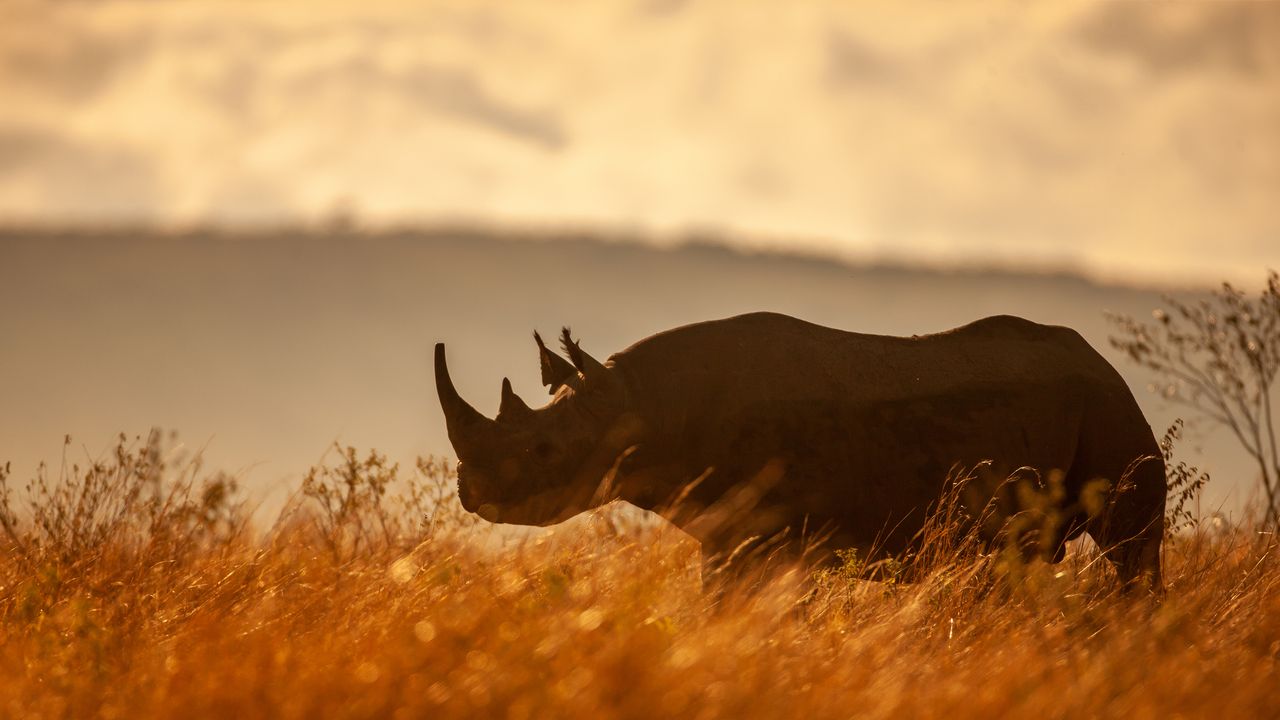
Home to the world’s largest population of black rhinos, this corner of Namibia offers a compelling vision of conservation, resilience, and change.GettyWe’d been looking for nearly five hours—scanning the dry grass for upturned pebbles and the horizon for a dark, lumbering shape—when we spotted the rhino bull. Next to me, tracker Mensley Karutjaiva shook his head with a resigned chuckle. We’d been up since daybreak, alongside three other members of the Save the Rhino Trust, looking for critically endangered black rhinos in Damaraland, a land of flat-topped mountains, rocky hills, and stark plains in the Kunene region of northwestern Namibia. While we scrambled about in the heat, the bull had been dozing in the shade of a milk bush. We watched as he stood up, as if posing for us, before lying back down to resume his nap.I was traveling in a loop around northwest Namibia that took me to three new (or recently renewed) camps. Since photographic safari tourism began here over a century ago, Namibia has largely been known amongst international travelers as a self-drive vacation—a destination with plenty of do-it-yourself road trips through otherworldly desert landscapes. Unknown to many visitors, though, human-wildlife conflict—population activities that negatively affect animals through habitat loss or resource competition— has been an ongoing challenge, and past decades of poaching threw rhinoceros populations into a tailspin. But, in the past few years, Namibia has seen a lot of positive conservation momentum, with these northwest reaches acting as a bellwether. From innovative government measures to an Indigenous-stewarded private reserve, this region is now a story of forward-looking change.In May 2026, the country’s government launched a new conservation finance deal called Namibia for Life in partnership with the World Wildlife Fund. Worth approximately $63 million, it sets aside funds for Namibia’s 86 community-supported conservancies, which span more than 49 million acres.Gazing at the black rhino, I felt a thrill as my eyes followed the magnificent swoop of the animal’s two intact horns, the larger of the two over three feet long. In an attempt to deter poachers, wildlife management will often cut down a rhinos’ horns—a humane, if humbling, procedure—so that the sight of a rhino, especially one of this critically endangered sub-species, often entails seeing just nubs.Wild black rhino populations in Namibia came close to extinction in the mid 90s, but thanks to conservation efforts, have recovered. GettyRhino horn can fetch up to $5,400 a pound in the illegal wildlife trade—so just seeing this intact horn was a triumph in itself. Decimated by poaching throughout the 1970s and 80s due to demand in Asia and the Arabian Peninsula, wild black rhino populations had dropped by 96 percent in the mid 90s. They came so close to extinction that only 2,410 were left on the entire planet.That sighting was a harbinger of better days to come. Thanks to conservation efforts, today some 6,000 black rhinos now roam free, with an estimated half of those living in Namibia. In July 2026, the World Wildlife Fund announced that Namibia had experienced a 53 percent drop in rhino poaching since 2024, reaching its lowest numbers of rhino poaching instances in over a decade.“Over the past 39 years of visiting Namibia regularly, I’ve been heartened to see a growing understanding of the importance of conservation and community-based tourism–and more recently, how to sustain it,” said travel advisor Nicola Shepherd, who arranged my itinerary. “Namibian organizations such as the nonprofit Integrated Rural Development and Nature Conservation are investing in practical ways to reduce conflict and protect both people and wildlife.”The founder of the conservation-focused Explorations Company, Shepherd and her team have been arranging customized trips to this country for decades. In the past few years, she’s noted a shift in the advent of luxury accommodations, including Zannier Hotels, Habitas, and others, that have broadened the country's appeal to travelers seeking high-end experiences. It’s all welcome news for the country, which is experiencing an uptick in traveler interest—just two months after my trip, local publications reported that the country’s hotel room occupancy was having one of its strongest years.***More than twice the size of California, Namibia’s expanse includes coastline, semi-arid desert, dry and wet woodlands, and golden savanna. The northwest corner is a rich mix of these terrains–including the otherworldly, white-tipped grasslands I walked through as we returned to Wilderness Desert Rhino Camp after our morning rhino sighting.“In this area of the Palmwag Concession, the rotation of tourism helps protect rhinos,” Karutjaiva told me. I heard this sentiment echoed wherever I went, although specific numbers are carefully guarded. “It’s a state secret. The only thing I can say is that the population is growing,” he said. The guardedness is understandable, as the threat of poaching is still everywhere. And growth isn’t restricted to the rhino populations.The lounge area at the intimate Wilderness Desert Rhino Camp, which was formerly a field station for wildlife research. Courtesy Wilderness Desert RhinoAt Desert Rhino Camp, a full rebuild in 2024 resulted in six stand-alone tented suites, where materials like timber, leather, and stone evoke a modern, desert-chic style. With the Etendeka Mountains rising in the distance, red basalt boulders form the walls of the open-air dining lounge where I enjoyed a delicious slow-cooked lamb potjie stew for dinner.“We really realized how important tourism was during the pandemic, when most businesses closed and a lot of people lost their jobs,” lodge manager Fanus Katondoka told me that evening, as we sipped on rooibos iced teas. “Now we know it. Operators are building a lot of facilities, lodges, hotels–it's booming.” That growth means more resources for community-supported conservation, so Karutjaiva and his team can continue their work protecting rhinos and other species.Rhinos have adorned conservation headlines recently, but they’re far from the only draw in northwest Namibia. A new camp from outfitter Natural Selection recently opened about an hour’s flight north, in the desert Kaokoveld region, highlighting another species of desert-adapted wildlife. A few days later, I was headed to see it.***Sitting in the cockpit seat of a tiny four-seater Cessna, I waved goodbye to the rhino trackers and flew over the Namib Desert, one of the oldest arid regions in the world. The landscape flowed in ridges and mountains of faded yellow and whisper pink, where welwitschia–large, low-lying plants that live to be hundreds of years old–sprawled like relics from a Dune film set.The Namib Desert stretches along the Atlantic coast of Namibia and features some of the highest sand dunes in the world. GettyIt was a fitting introduction to my next stop: the Hoanib Valley, home to a new camp with a mission that’s a bit bigger than rhinoceros. I quickly learned what that something was when guide Howard Groenewaldt picked me up from the airstrip, nosed our vehicle toward camp, and then abruptly cut the engine.We had stopped at the Hoanib River, a seasonal waterway that runs west from the desert until it reaches the Skeleton Coast on the Atlantic Ocean. Now in the dry season, it turned into a sandy avenue lined with camelthorn and giant ana trees that age more than 100 years old. It was a nature-born runway—and something was stirring around a bend.A giant, desert-adapted elephant slowly walked toward us. His long tusks were pale white; the bottoms of his feet splayed out wide under his skinny legs, the better to stabilize on sand. There was no sound except the breeze that was stirring the wizened, banana-shaped seed pods in the branches above my head, and the soft fwump of the elephant’s footsteps. I watched, transfixed, as he paused and delicately trailed the tip of his trunk on the groundThe author looks on at a desert-adapted elephant. Samantha FalewéeThis is exactly the kind of encounter the new Natural Selection Hoanib Elephant Camp was built around. Located off the northern bank of the river, its 10 solar-powered suites bring a new level of comfort to the valley. Between game drives, guests here lounge on the veranda overlooking the desert hoping to spy more elephants, or relax in their suites with a massage or nap. Each of the natural-hued suites include a private plunge pool, a deep king-size bed, and a writing desk. Dinner is a multi-course affair in the shared lounge; afterward, a bonfire crackles under the stars. During my stay some visitors curled up on the couches against the evening desert chill, sipping hot drinks spiked with Amarula, a South African liqueur, surrounded by flickering candles.While the resort is stylish and deeply comfortable, Natural Selection’s approach to community partnership also reflects the shift in this region toward local collaboration. The evening I arrived at camp, I met Petty Daniels, who hails from the nearby Torra Conservancy and brings an acutely local perspective. Years ago, she began working in hospitality as a waitress—today, she’s the manager of both this new camp and its giraffe-focused sister property, the Hoanib Valley Camp. Roughly 97 percent of staff are from surrounding community conservancies, creating a working model of local investment in supporting companies that protect their homeland.Sundowner drinks are accompanied by a knowledgable guide on a Hoanib Elephant Camp safari. Natural SelectionWithin Daniels’ generation, change has been flourishing in the hearts and minds of locals. “Before tourism, people drove wherever they wanted, shooting animals to provide food for their families,” she said. “Not anymore. People are getting into conservation tourism and understanding why they shouldn’t do that.”Even so, human-wildlife conflict is still a problem. Elephants ramble into gardens and cheetahs kill the occasional goat, but the overall opinion of locals is shifting, especially as the Namibian government signals support for conservation that’s more in step with local interests.Namibia’s Hoanib Valley was made famous by its desert-adapted elephants. Anton Crone / Natural Selection“Namibia’s communities already help look after lions, elephants, rhinos, water, plants and open land,” Rob Moffett explained a few days later, soon after I arrived at my third and final destination in northwest Namibia. “Instead of saying, ‘Good luck finding money every year,’ the Namibia for Life fund says, ‘Here is a proper money box, a rule book, and a team to help you keep protecting nature.’”Moffett is the general manager of sales and marketing at Ongava Game Reserve, a private stretch of savanna and mopane woodlands that stretches more than 74,000 acres next to Etosha National Park, one of the country’s biggest visitor attractions. It’s also the site of another positive–and long overdue–story of change.Wilderness operates single-engine flights from camp to camp that come in handy. Samantha FalewéeTo reach it, I rented a gas-electric hybrid car from ATI Holidays and drove east from the Hoanib Valley. This type of travel is still popular in Namibia, with strong infrastructure supporting visitors. After a detailed briefing with an ATI staff member, I was kitted out with a folder packed with maps, a Namibian cell phone pre-programmed with key contacts, and a first-aid kit. I drove for several hours, listening to music and watching the desert scenery flash by. But driving solo can be tiring, and I was glad for the air travel between previous camps, seamlessly arranged by the Explorations Company. For US travelers unaccustomed to driving on the left side of the road, and often juggling a few shorter vacations, brief single-engine flights from camp to camp are increasingly preferred by high-end resorts opening in the northwest.The new Horizon by Ongava, where I had arrived, is one of those. Consisting of just three hilltop villas, the property debuted from renovations and a name reset in April 2026, and prioritizes seclusion and comfort. My accommodations unfolded in a graceful series of rooms with couches, a four-poster bed, and a dual-vanity bathroom. Outside, overlooking a plain of the greenest scenery I’d seen so far, a wide deck hugged the hillside, and included two dining spaces, an outdoor shower, and a private plunge pool. My favorite touch was the large bench in the walk-in dressing room, carved in the shape of a serval—a wild cat native to sub-Saharan Africa.The dining, led by chef Festus Ilyambo, is a feat in its own right. That evening, in the open-air lounge, I asked Ilyambo for the recipes behind his potato pavé—thinly sliced, buttery potatoes infused with organic thyme and fresh cream, then sautéed with garlic—and filet mignon, served with a jus and cognac sauce.Raised walkways lead to villas at the new Horizon by Ongava. Samantha FalewéeAlfresco dinners at Horizon by Ongava are a highlight of the day. Samantha FalewéeThe next morning, longtime guide Pascalis Kazimbu led me on a private walking safari in Ongava Game Reserve, pointing out everything from lilac-breasted rollers to white rhino mothers with calves tottering close behind and wildebeest that bleated—“gnuu, gnuu”. Later that afternoon we set out on a game drive, pausing at a watering hole for sundowner drinks as dusk began to settle. I was sipping a local Tafel lager in the safari vehicle when a deep, reverberating roar sounded behind me, vibrating in my bones. Moments later, a male lion strolled out of the thin trees behind me, settling by the pond for a drink.With game viewing like this, verdant Ongava and its neighboring Etosha National Park are a welcome coda to the scenes of desert and dunes I’d left behind. The circular route of my trip is a popular one: travelers arrive into the capital of Windhoek, travel in a rough circle that begins with awe-inspiring desert and ends near Etosha, and then head back to Windhoek to begin their journey home.A new community-led concession and lodge in Ongava will protect thousands of acres and help conserve species, including the Southern Yellow-billed Hornbill. Samantha FalewéeBut a coming Ongava project will add a new element for curious travelers. In 2024, the Indigenous San (or Bushmen) Hai//om community and Ongava agreed to a legally binding agreement to partner to manage a new concession, including a new lodge, on the southeast border of Etosha National Park. Slated to open in 2028, the new reserve will secure thousands of acres of land, strengthening wildlife corridors and helping to protect an important waterway called the !Gobaob Spring, where black rhinos and many other species gather to drink in the dry season.“That place is a miracle,” Ongava manager Moffett said. “In the Hai//om’s oral history, it’s the one spring that has never failed in their entire existence.”The implications of this new initiative, called the Ongava-Hai//om Joint Venture, extend far beyond wildlife. The concession carries profound historical significance because it includes part of the ancestral homeland of the Hai//om people, who were forcibly removed from Etosha by the government in the 1950s. “Today, most Hai//om people are living scattered on the outside of the park, but this is their home,” Moffett said. “For them to reclaim management and ownership of this concession has the potential to become one of the most special community conservation stories of our time.”When the 25-year joint venture ends in 2049, the entire business will transfer from its current shared management to the Hai//om community. By protecting endangered wildlife while empowering the Hai//om people to build long-term prosperity, the new concession promises benefits for all involved, including visitors.The stakes are high for the black rhino, but now, there is also hope. GettyLearning about this project felt like an encapsulation of everything I’d seen and heard on this journey in northwest Namibia, where community-focused conservation held hands with high-end hospitality. I thought back to the rhino I’d seen in my first days here, and the slow but steady work locals like Karutjaiva are doing to protect the species from the knife’s edge of extinction.In Namibia, the stakes are high, but so is the promise of a more prosperous, wild future.Northern Namibia is one of our Best Places to Go in 2026. Find our full guide here.Samantha Falewée is a freelance travel journalist with over a decade of experience working across print, digital, and social platforms. She seeks enriching stories at the intersection of luxury travel, wildlife conservation, and Indigenous culture. Her work has taken her to the unceded Algonquin Anishinabeg Territory in Ottawa, Ontario, to ... Read More
Namibia' Black Rhino Is One of Africa’s Most Exciting Conservation Stories
Full Article
Original Source
Read the full article at Cntraveler →KhanList aggregates and links to publicly available news content. We do not host full articles from third-party sources. Always verify important information with original sources.