
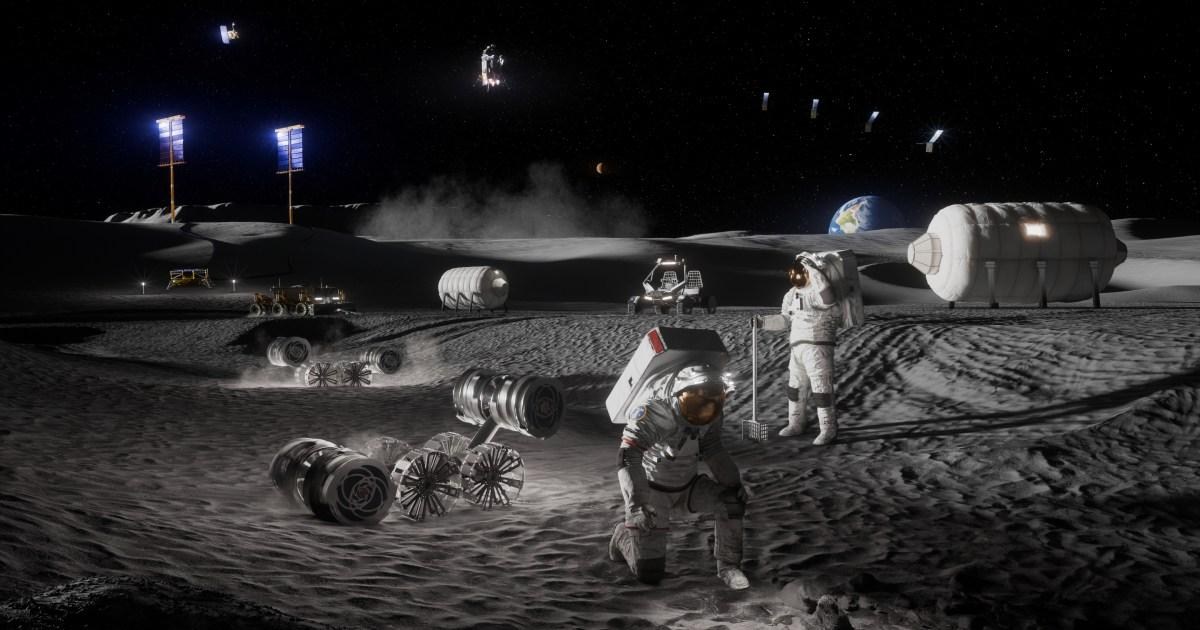
The Marius Hills pit is a possible skylight in a lava tube in an ancient volcanic region of the Moon (Picture Nasa/GSFC/Arizona State University/Cover Images) Scientists are investigating whether a strange ‘pit’ spotted on the surface of the Moon could provide a base for humans. Nasa is looking into a large underground cave that may extend beyond the Marius Hills Pit (MHP), a large hole in one of the moon’s most volcanically diverse regions. Scientists say such a cave could one day provide astronauts with a safe haven from radiation and the extreme temperature swings experienced on the lunar surface. The Geophysical Instruments for Marius Lunar pit Investigation (GIMLI) project, led by the Planetary Science Institute (PSI), will send scientific instruments and robots, built by Honeybee Robotics, to the area to see if the cave could provide safe haven. The project is also being carried out in partnership with the Norwegian Space Agency. ‘GIMLI represents the type of ambitious planetary science that PSI was built to pursue,” said PSI director and chief executive Amanda Hendrix. ‘Than and his team are taking a scientific question we’ve been studying from orbit and have developed a way to investigate it directly on the Moon. We’re excited to have PSI leading this effort and to be partnering with Nasa and Honeybee Robotics to learn more about the Moon and its volcanic past.’ Artist’s rendering of potential future human activity at the Moon Base (Picture Nasa/GSFC/Arizona State University/Cover Images) Observations from lunar orbit have provided compelling evidence that caves and lava tubes could exist beneath the Moon’s surface. GIMLI will focus on the MHP, as it could provide an opening into underground spaces that may have formed during ancient volcanic activity. The mission will allow scientists to investigate the pit directly from the lunar surface. PSI Associate Director and Senior Scientist Than Putzig said: ‘It’s long been a desire of mine to reintroduce intentional active-source seismic methods to planetary science, as it has essentially not been done since the Apollo astronauts conducted the first seismic surveys on the Moon. ‘Combining that method with ground-penetrating radar and gravity measurements makes it all the more exciting, as these methods together will allow us to get a much better understanding of subsurface properties – including the anticipated detection of a lava tube extending away from the Marius Hills pit.’ GIMLI will use ground-penetrating radar, seismic sensors and a gravimeter to examine what lies beneath the surface. To view this video please enable JavaScript, and consider upgrading to a web browser that supports HTML5 video Cameras will provide images of the lunar surface and the walls of the pit. Together, the instruments will search for an underground void extending from MHP and, if one is found, help scientists determine its size. Even if GIMLI finds no cave or lava tube beneath the surface, its measurements could help answer an important question: how did the pit form? Studying the surrounding subsurface could provide clues about the origin of MHP, as well as the geology and volcanic history of the region. The team will also examine the area around the pit. The region has a long history of volcanic activity, while the walls of MHP expose layers of regolith and lava flows that are normally hidden beneath the surface. Studying those layers could reveal how lava travelled across the Moon and whether long periods of time separated different eruptions. Lunar pits are of interest not only because of the geological record preserved in their walls. To view this video please enable JavaScript, and consider upgrading to a web browser that supports HTML5 video Any underground spaces could also contain evidence of the volcanic processes that shaped the moon. ‘Confirming a substantial lava tube would give us an insight into how volcanism operated on the moon,’ explained Gareth Morgan, PSI senior scientist and deputy principal investigator on the GIMLI programme. ‘Lava tubes are a common feature of basaltic volcanism on Earth, so identifying them on themoon means we could use knowledge of such terrestrial caves to better understand lunar history.’ The wider GIMLI team includes co-investigators from Boise State University, Johns Hopkins University, the Lunar and Planetary Institute and the University of Oslo. Arrow MORE: Nasa developing humanoid robots to work alongside astronauts on moon and Mars Arrow MORE: Nasa shares image of spooky ‘witch head’ spotted lurking in deep space Arrow MORE: ‘Phoenix planet’ born from star’s ashes could tell us what will happen when our sun dies News Updates Stay on top of the headlines with daily email updates.
Mysterious cave spotted on surface of moon could provide safe haven for human base
Full Article
Original Source
Read the full article at Metro →KhanList aggregates and links to publicly available news content. We do not host full articles from third-party sources. Always verify important information with original sources.