
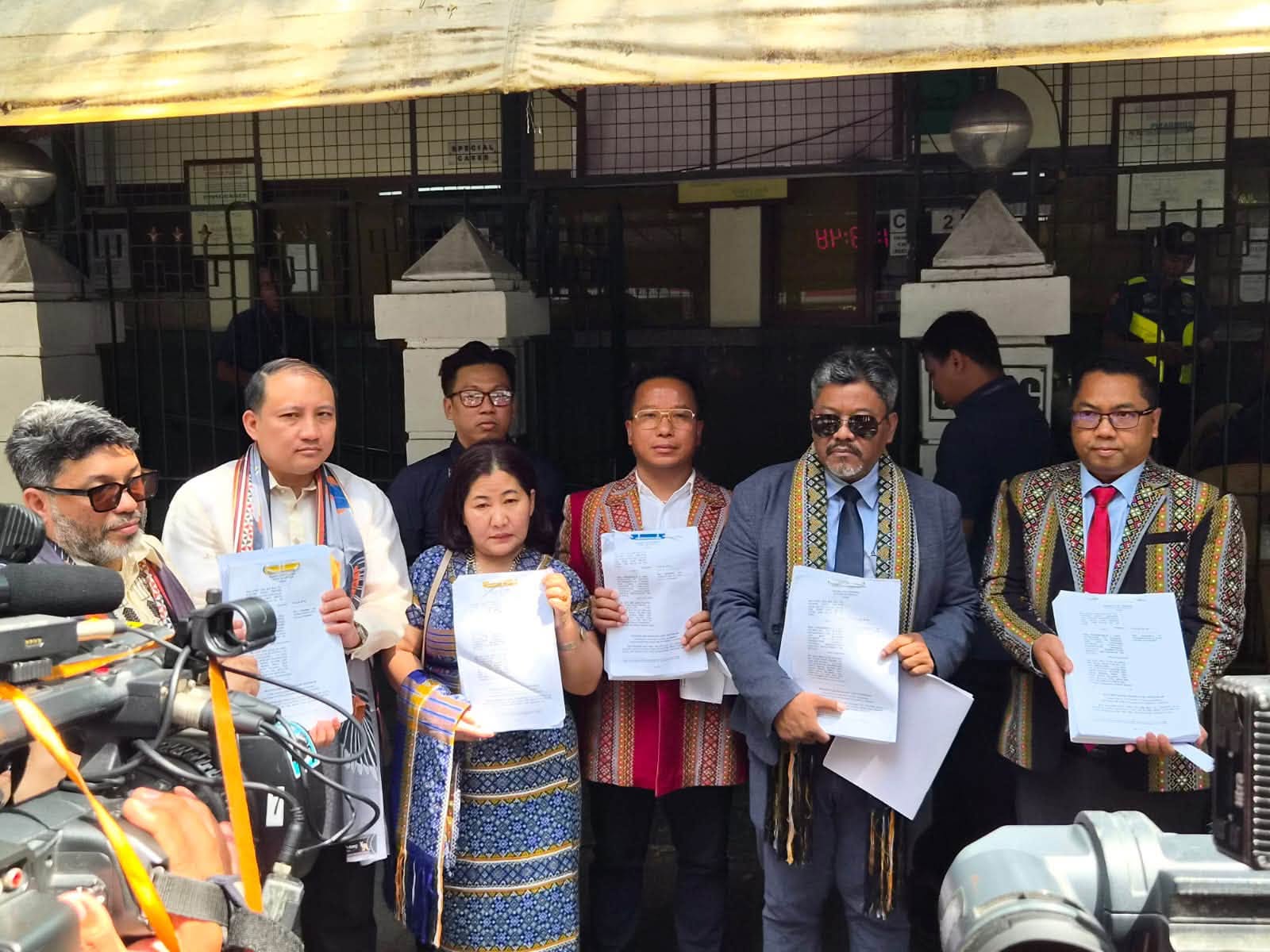
FILING. Members of the Chin Human Rights Organization and their lawyers file a petition with the Court of Appeals to compel the Department of Justice to act on their complaint. Chin Human Rights Organization Petitioners invoke universal jurisdiction, a legal concept under which countries are obliged to prosecute grave crimes in the world due to the belief that all nations have equal duties to mankind Burmese complainants filed a petition with the Philippine Court of Appeals to compel the Department of Justice to act on their complaint against Myanmar's ruling junta for war crimes. The complaint, which has been pending for almost three years, alleges atrocities committed by junta forces in the Chin state of Myanmar, including the burning of homes and killings. This is AI-generated. Read the article for full context. Report any errors. MANILA, Philippines – In another bid to seek justice, some Burmese people asked the Philippine Court of Appeals (CA) to compel the local Department of Justice (DOJ) to act on the complaint they filed against Myanmar’s ruling junta. On Tuesday, November 3, five Chin complainants filed a petition with the CA. They want the appellate court to order the DOJ to docket their almost three-year-old complaint and probe the war crimes allegations against Myanmar’s Senior General Min Aung Hlaing and nine other junta officers. “The Petition for Mandamus and Certiorari under Rule 65 names Justice Secretary Fredderick A. Vida and Prosecutor General Richard Anthony D. Fadullon as public respondents. It asks the Court to compel them to resolve the motion for reconsideration pending since 11 April 2024 and to docket the complaint, filed under Republic Act No. 9851 (the Philippine Act on Crimes Against International Humanitarian Law, Genocide, and Other Crimes Against Humanity), and conduct a preliminary investigation,” said the petitioners. On October 25, 2023, the Myanmar natives filed a complaint with the DOJ over the torching of their houses and the killing of their families in the besieged Chin state, located in western Myanmar. The Chin state pushed back against junta forces when the military coup ousted Aung San Suu Kyi in 2021. But in retaliation, the soldiers went to their place and burned down the town. According to the Chin people, when their natives tried to put out the fire, they were shot and killed. As of writing, the Philippine DOJ has yet to docket or formally act on the complaint. It does not make sense at first to file a complaint in Manila for crimes that allegedly happened in Myanmar. But the petitioners invoked universal jurisdiction, a legal concept under which countries are obliged to prosecute grave crimes in the world due to the belief that all nations have equal duties to mankind. The complaint is lodged under RA No. 9851, the local law that transformed international criminal law into a domestic law. The law’s Section 17 states that Philippine “authorities may surrender or extradite suspected or accused persons in the Philippines to the appropriate international court, if any, or to another State pursuant to the applicable extradition laws and treaties.” (READ: PH may surrender suspects to international court, says DOJ) According to the petitioners, the DOJ refused to act on the complaint because it read this section as requiring the accused to be present in the country. “Mandatory universal jurisdiction means that when crimes of international concern, such as war crimes, are brought before Philippine prosecutors, the State has a legal duty, not a mere option, to investigate and, where the evidence warrants, prosecute them, whatever the perpetrators’ nationality and wherever they are. The petition traces this duty to the peremptory (jus cogens) prohibition of war crimes, which the Constitution makes part of Philippine law, and to Section 2(e) of the Act,” said the petitioners. “Section 17(b) speaks of an ‘accused,’ a status acquired only when charges are filed in court; at the preliminary investigation stage, persons are merely respondents. The opening clause of Section 17 covers persons ‘suspected or accused.’ On the DOJ’s reading, the ban on double jeopardy would also protect only foreigners found in the Philippines, an absurd result,” they added. The petitioners also raised concerns about the delay in resolving their complaint. They also invoked the constitutional right to the speedy disposition of cases and the guarantee of due process. “The right to the speedy disposition of cases is not a courtesy. It is a guarantee written into Article III, Section 16 of our Constitution. Three years of silence is not neutrality. For a displaced population whose witnesses are aging, every month of delay is prejudice,” said Romel Bagares, co-counsel for the petitioners. “If Section 17 is robust enough for the State to wield in other cases, it cannot be too weak for these Chin victims to invoke in theirs,” Gilbert Teruel Andres, co-counsel, added. – Rappler.com How does this make you feel? Loading
Myanmar natives ask CA: Compel DOJ to act on war crimes complaint vs junta
Full Article
Original Source
Read the full article at Rappler →KhanList aggregates and links to publicly available news content. We do not host full articles from third-party sources. Always verify important information with original sources.