
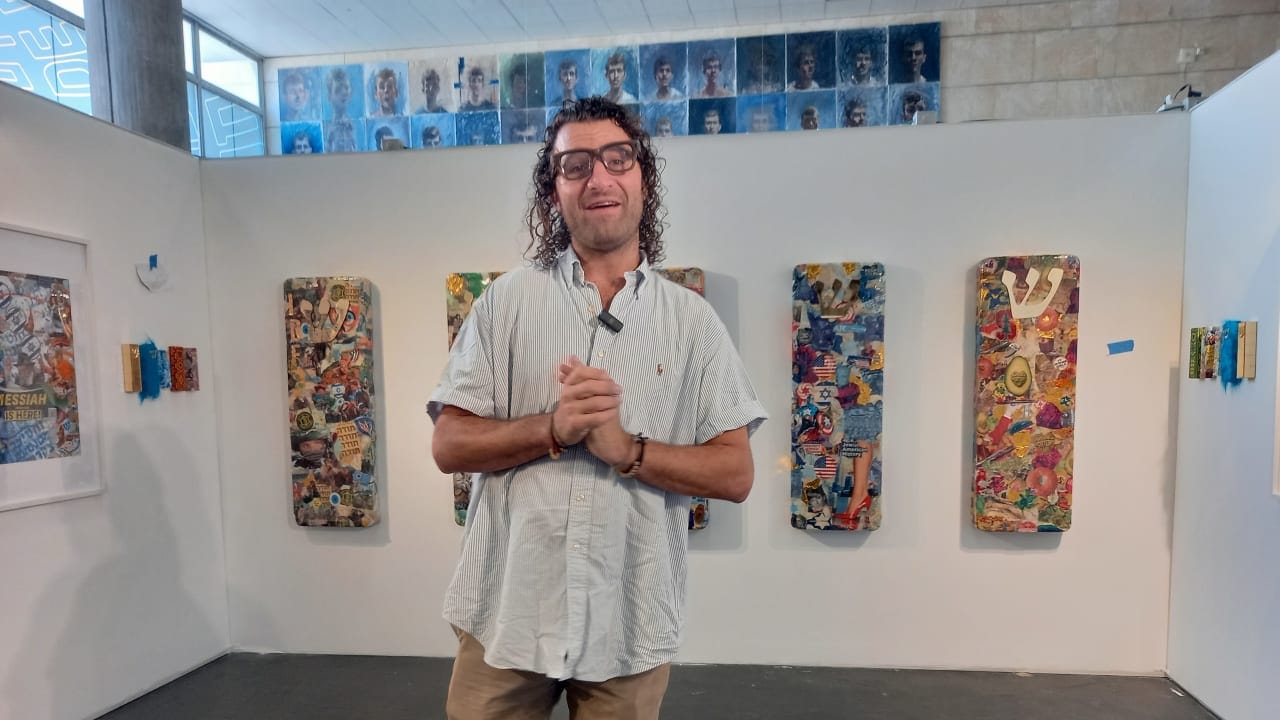
OCTOBER 2, 2026 14:40If the proverbial picture is worth a thousand words, the Jerusalem Biennale 2026 has too many words to count – many of them prayers, pleas, and thanksgiving.This is the seventh Jerusalem Biennale since it was founded in 2013, and like its predecessors, it is dedicated to a theme, but individual artists have been literally creative in the way they chose to interpret it.Jerusalem Biennale founder Ram Ozeri told a press tour last week that he chose the theme “De Profundis,” “Out of the Depths,” or “Mima’amakim” in Hebrew, after the opening words of Psalm 130: “Out of the depths I call You, O Lord.” It was the psalm many Jewish communities added to their prayers following the horrors of October 7, 2023, the war, and especially the fate of the hostages held in Gaza. Even now, a year after the last living captives returned home, the Hamas-led invasion and mega-atrocity of October 7, when 1,200 were murdered and 251 abducted, continues to haunt us.ARIANE LITTMAN’S ‘Incantation Bowl,’ inscribed with the date 7.10.23, at the Jerusalem Biennale. (credit: LIAT COLLINS)Ozeri noted that choosing the Latin “De Profundis” was based on a large bank of works, including the letter by Oscar Wilde in Reading Gaol with the oh-so-quotable: “Where there is sorrow there is holy ground.” Ozeri sees art as a form of prayer, and also as a part of the recovery and healing process – a way of bringing the collective subconscious to the surface.Displaying works of more than 250 Israeli and international artists in 42 exhibitions across 21 venues throughout the capital, JB2026, running through November 12, is the biggest yet, but was one of the most challenging to assemble.The Jerusalem Biennale was created to give space to contemporary art, beyond Judaica, mixing with the Jewish and Israeli experience, although not all the artists are Jewish. Despite its starting point in the depths, there is also optimism in JB2026, which Ozeri sees as “creating a dialogue among different communities… celebrating Jewishness rather than hiding it.”While some artists abroad were afraid of a possible backlash for participating in the event in Israel, others were delighted at the chance to push back against the cultural boycott.The press tour took place at the Biennale’s main venue at the former National Library at the Hebrew University’s Givat Ram campus. It was a chance to remember the charm of the old building that has been overshadowed since the opening of the new National Library, a nearby architectural gem.Undoubtedly, the outstanding feature of the building itself is the monumental stained-glass windows created by Mordecai Ardon, three immense panels reflecting Isaiah’s “Vision of Eternal Peace.” Dr. David Sperber and artist Porat Salomon, the curators of the Or Chozer (Reflected Light): An Active Vision exhibition, made good use of Ardon’s work as an impressive backdrop.Art to bring us out of the depthsThere was too much to relate to everything within the constraints of this column, but some sights and insights made a particular impact.In a combination-confrontation between the old and the new, Isaiah’s Still Waiting, by Andi LaVine Arnovitz, is composed of mounted old-fashioned View-Masters, the black-and-white scenes of the wheel changing with every click of the device, using the light of the windows.Close to Ardon’s panel depicting the swords turned into plowshares are powerful works by Swiss-born Jerusalem artist Ariane Littman. One component is an “incantation bowl,” reminiscent of the ancient amulets often buried under the entrance to a home as a form of magical protection.Littman’s bowl is covered with the date 7.10.23, written in spiraling form in red ink. It was the first work she was able to produce, a month and a half after the attack, and she describes it as “a counter-curse of that horrific day.” Next to it, Littman, who works a lot with gauze, has “blood-soaked” (red ink) bandages hanging from meat hooks in a work called “Sanguine Fields.”Richard McBee has completed 100 paintings in 35 years based on the biblical figures of Abraham and Isaac, and God’s command to the father to sacrifice his son. McBee told the journalists: “After the Holocaust, we Jews are all Isaac,” even more so after October 7, when “the modern world turned its back on Israel.”The six paintings on display start with the question: “Where is the lamb?” and Abraham’s reply: “God will provide,” and ends with Isaac abandoned, alone, on the mountaintop after the intervention of the angel and the sacrifice of a ram instead. I was struck by the extent to which the “Akeida” was a test of Isaac no less than Abraham.The One Who Dwells in This House, curated by Shoshana Gugenheim Kedem and Ahuva S. Zaslavsky, is described “as a visual commentary on what it means to grieve, to be marginalized, vulnerable, witnessed, and to return again.” The curators told the press tour how their Portland, Oregon Jewish community – known for its progressive politics – suffered painful fissures following October 7, like many similar Diaspora communities. A group of local artists grappled with these issues through their Art Lab.Zaslavsky’s To Move a Mountain II is a work in slow motion. Visitors are invited to scoop soil from a central pile into small linen bags in something that feels like a reverse burial service, while Gugenheim Kedem contemplates loss and grief through works based on burial shrouds.Abraham’s Children, by artist Mel Brown and curator Ori Z. Soltes, broadens the dialogue even further. Brown described the dilemmas of being a Torah-observant Jew who started working as an artist at a relatively late stage in life. Acutely aware of the Second Commandment not to make a graven image, he produces abstract works on biblical themes.Together with Soltes’s input, the exhibition extends to include, among others, Muslim artists – including a Turkish father and son in exile, and a painter from the United Arab Emirates. Unlike Christian art, which readily depicts human forms, Muslim and Jewish art have traditionally been non-representational. The result is a reminder of what we have in common.Czech photographer David Tesinsky, who is not Jewish, said he wasn’t bothered by negative comments and the small number of followers who dropped from his Instagram account. He has seen it in other places he has visited, including Russia, Ukraine, Iran, and Pakistan.Tesinsky captures street scenes with his camera, and Jerusalemite visitors will recognize places he visited in the capital – including Mahaneh Yehuda, Mea She’arim, and downtown Jerusalem –as part of his The Light Within series.American artist Rina Nissel Shalhov provides a positive note in her acrylic work, A Sabra is Born. Shalhov, who is married to an Israeli, explained that the desert fruit has become “a symbol of the national pride and patriotism of the Jewish state. The sabra cactus faces tremendous challenges as it struggles to survive in a hostile environment…“After years of dormancy, the cactus blooms, producing vibrant flowers that eventually transform into bright, vivid fruit. Upon closer inspection, the thick outer skin is covered in prickly bumps and more barbed needles. Only those patient enough to carefully peel back the tough layers will discover the sweetness and complexity hidden within.”The metaphor is as clear as the blue desert sky above the “prickly fruit” in her painting.Coming out of the depths, the sky is not the limit: Mexican artist Alejandro Glatt makes a truly uplifting contribution to this year’s Jerusalem Biennale in his Mezuzah to the Moon exhibition. Glatt is as colorful as his artwork and proud of both elements of his Mexican-Jewish identity.In 2024, a representation of one of his papaya works landed on the moon as part of the Lunaprise mission. Now he aims to similarly elevate one of his striking mezuzot in some form. I can imagine a UN debate on “Jewish colonization” when news of a mezuzah landing on the moon gets out, but as this Biennale proves, the fear of antisemitism should not leave us grounded.Navigating around Jerusalem at a time of massive construction can feel as challenging as space travel (although Mayor Moshe Lion is credited with helping make this year’s Biennale possible), but planning visits to the multiple venues is a reminder of Jerusalem’s special cultural map.We have come out of the depths, bearing the scars both physical and emotional, but Glatt’s vision of Jewish art one day landing on the moon left me raising my eyes to the heavens with a sense of hope.Follow us on Google
My Word: The art of resilience - opinion
Full Article
Original Source
Read the full article at Jpost →KhanList aggregates and links to publicly available news content. We do not host full articles from third-party sources. Always verify important information with original sources.