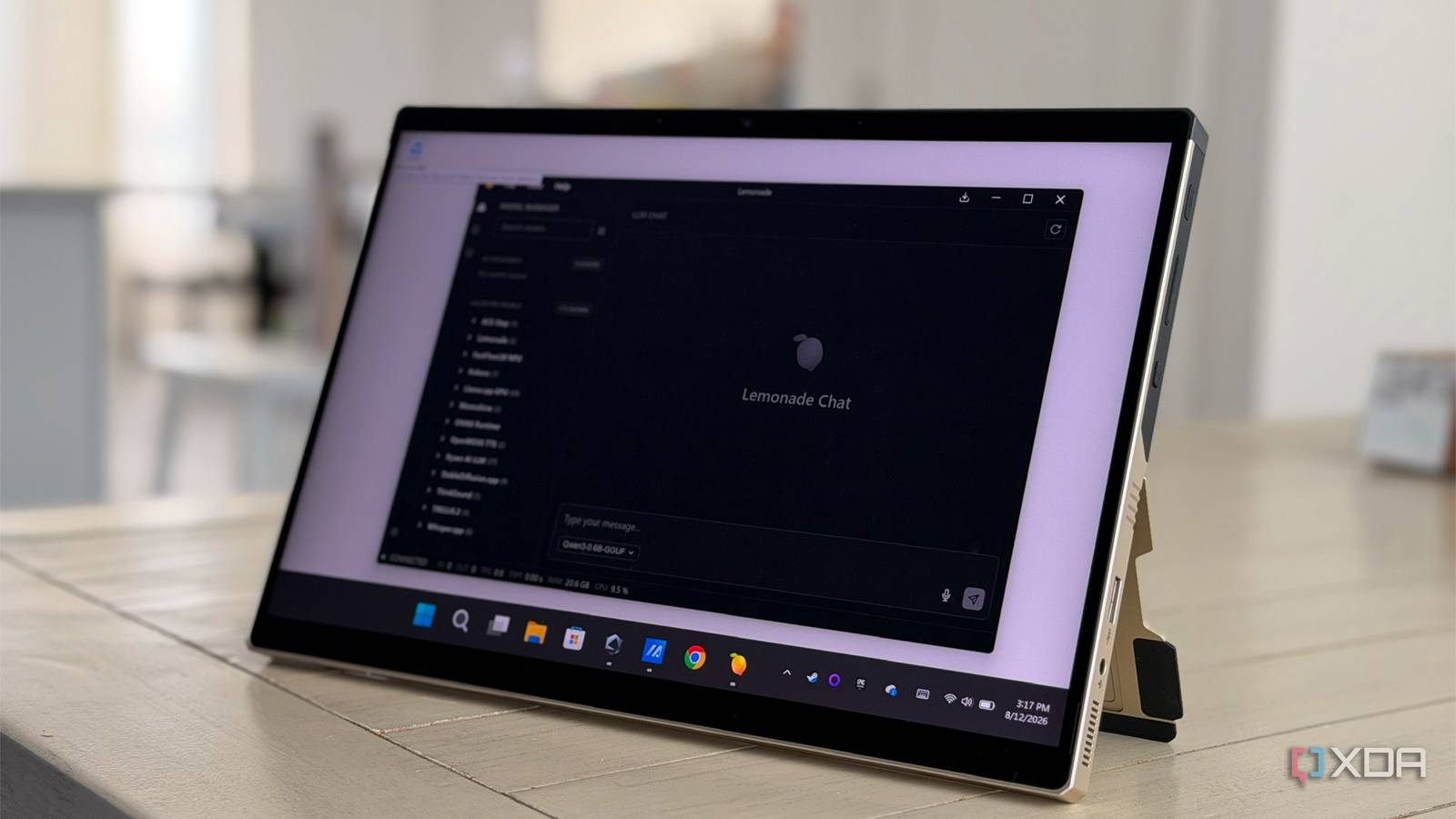
Published Aug 15, 2026, 10:30 AM EDT Maker, meme-r, and unabashed geek, Joe has been writing about technology since starting his career in 2018 at KnowTechie. He's covered everything from Apple to apps and crowdfunding and loves getting to the bottom of complicated topics. In that time, he's also written for SlashGear and numerous corporate clients before finding his home at XDA in the spring of 2023. He was the kid who took apart every toy to see how it worked, even if it didn't exactly go back together afterward. That's given him a solid background for explaining how complex systems work together, and he promises he's gotten better at the putting things back together stage since then. There are three Strix Halo machines in my office, and until this week, the Asus ROG Flow Z13 was the one doing the least AI work. The least work at all, in fact, as it was being used to play Death Stranding 2 and not much else. But after putting Lemonade on every other box I run LLMs on, I wanted to see how well the tablet would do. After all, it’s the same powerful APU with 128 GB of unified memory that the mini PCs use, and those are running my Proxmox server and the main LLM server in my home lab. But I wanted to do something a little different, because being able to run a heavy model isn’t the same as wanting to use it for every task. It’s a little like the adage about everything being a nail if all you have is a hammer. But with Lemonade, I can set up a model router so that heavy questions go to a 120B beast, while everything else gets routed to progressively smaller LLMs. And it’s now my favorite PC to pick up for agentic coding. The same powerful APU as my mini PCs, but in a tablet 128GB of unified memory gives you options Now, the Z13 in question isn't just a 128 GB Ryzen AI Max+ 395; it's the Ludens special edition made with Kojima Productions. Yeah, that Kojima, famed video game auteur. It's sci-fi enough that it feels natural to use LLMs on it, and the Radeon 8060S iGPU has 96 GB of memory carved out in AMD’s Adrenalin software. That turns a 2-in-1 tablet into an LLM beast that runs the same lineup as my desktop. Tier Model Size on disk Job Tiny Qwen3.5-2B ~2 GB Greetings, trivia, quick hitters Daily (default) Qwen3.5-9B ~7 GB Everyday writing plus vision fallback Coder Qwen3-Coder-30B-A3B ~19 GB Code and all agentic tool-calling Heavy gpt-oss-120b (MXFP4) ~59 GB Hard reasoning, long pastes, overrides Router brain Qwen3.5-0.8B ~1 GB A difficulty judge for the routing logic The heavy tier is the one that makes me grin every time I use it. The 120B is a 56 GB file, and this tablet loads it in 27.6 seconds, starts answering in 0.86 seconds, and generates at 52.03 tokens per second. Those are numbers I’d be happy with on any device, and the fact that it’s on a tablet will never stop being fun. And with that much RAM, all four tiers can stay in memory at once. 85 GB of model weights sitting ready in memory, ready to feed the iGPU. At one point, I misconfigured the router, and the 120B ran a CPU-only benchmark, crawling at 0.44 tokens per second while using the same RAM pool. Same hardware, same file, same prompts. Over a hundred times slower. ASUS ROG Flow Z13-KJP The Asus ROG Flow Z13 Ludens Edition is a Kojima-branded tablet with power and style. A custom router means I never pick a model again I can still reach for the big guns if I need them The router itself is a Lemonade policy called a collection, and it looks like any other OpenAI-compatible endpoint to your apps. Calling that model name sets off a chain of events that results in the prompt being sent to one of the models inside. I have a small LLM model that classifies incoming prompts and handles routing, and it’s now working as I intended. What I like most is that it logs the thinking behind the routing. Every response includes a header indicating which rule fired, and I can trace the full decision-making process to troubleshoot issues. Which is just as well, because I had a little trouble with the 0.8B model that’s used for a difficulty judge. The problem was that it’s a hybrid thinking model, and I forgot to turn off thinking, so the first run had it arguing with itself over how to classify “hey, what’s up?” It ran out of tokens before it could route things to the easy tier, and I can empathize because I don’t like making decisions either. A little prompt-fixing later, and it was sticking to the rule-based routes I’d created. If I need more grunt, I can set force: heavy in the request, and the router flips to the 120B model without questioning whether it should use a different rule. When the model is sitting in memory, it answers in less than two seconds, and I get desktop-class responses. Agentic coding from a tablet is the killer use case for me But I needed to conquer one troublesome setting first But I didn’t build this for chat. It was to power my favorite coding agent, Crush. An agent is the worst thing to use with a single model, because it will use every token it can get to reason about the simplest things, even if it has the power to refactor codebases. Crush maps one OpenAI endpoint to, and the router’s tool rule ensures that the right tier is used for every request. The same slab I use to watch YouTube in bed and deliver virtual packages can generate 52.34 tokens per second with Qwen3-Coder-30B-A3B-Instruct-GGUF with a 13,927-token context. I did have one thing to fix first, though. Crush sends its full tool schema in every message, and a simple “hi” was 13,072 tokens sent to Lemonade. That wouldn’t be a problem given the tablet's RAM, but Lemonade launches every model with a 4,096-token context window by default. Setting Lemonade’s default to 32,768 tokens fixed it, and now I can happily code from the couch. The best place to run a 120B model in my house is now a tablet Sure, my desktop still wins on sustained throughput, and my growing pile of mini PCs isn’t going anywhere. Well, maybe into a mini-rack, but only to keep the cables tidy. But the device I reach for most is the one I don’t have to think about which model I’m going to use. Throwaway questions get a tiny 2B model, while a coding beast is waiting when I have a trace of inspiration. And there’s always a 59 GB beast a two-word override away.
My tablet runs the same LLMs as my PC, and it's become my favorite way to use them
Full Article
Original Source
Read the full article at Xda-developers →KhanList aggregates and links to publicly available news content. We do not host full articles from third-party sources. Always verify important information with original sources.