
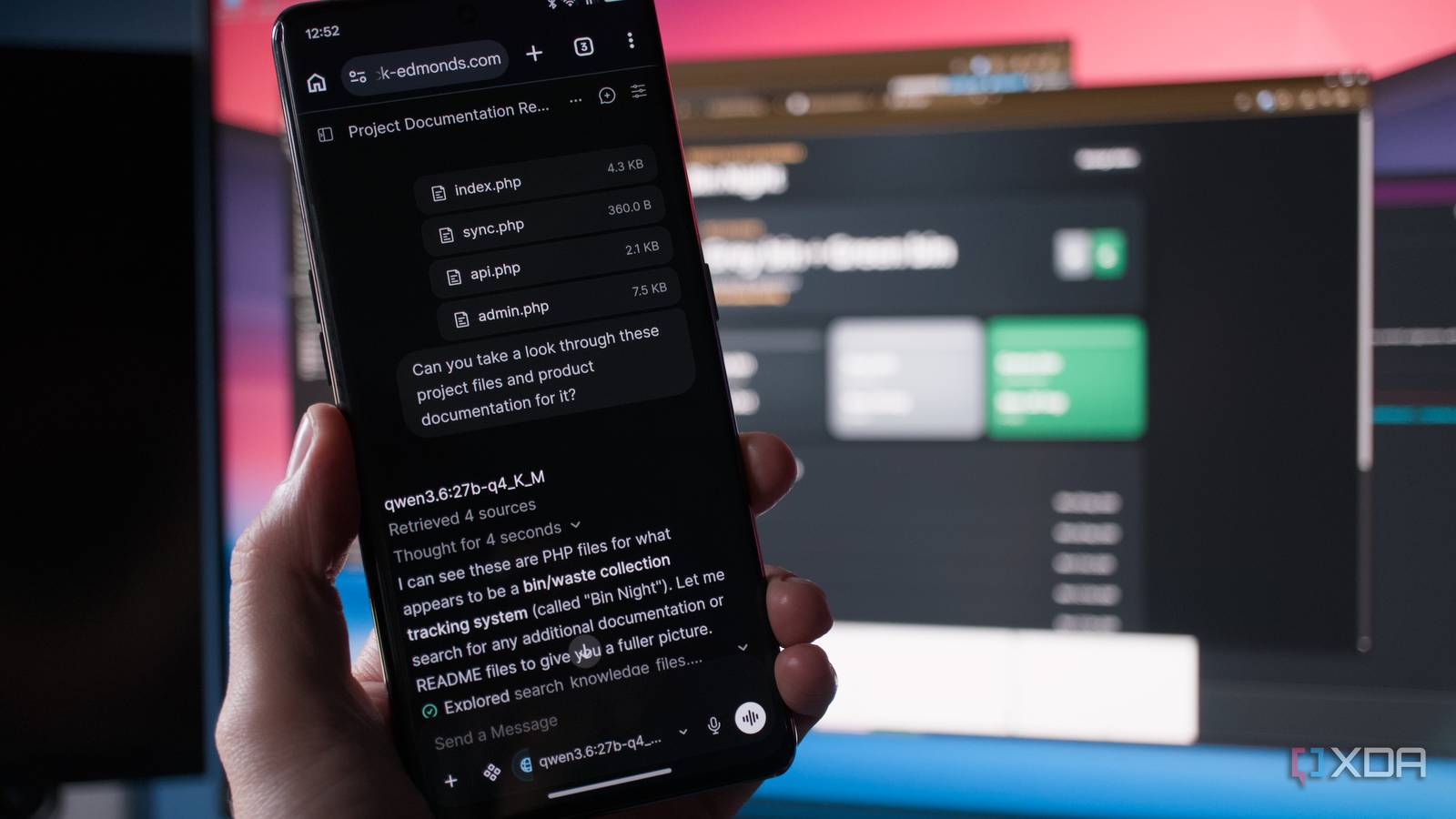
Published Sep 25, 2026, 4:00 PM EDT Richard is the PC Hardware Lead at XDA and has been covering the technology industry for almost two decades. He's been building PCs since young, and when not creating content, you can often find him inside a chassis somewhere. There are some tests one can do to see just how capable a locally hosted large language model (LLM) actually is. It's one thing to fire up Ollama and choose a model to ask it some general queries and something completely different to request something more in-depth. I thought about how well LLMs can put together documentation, using project files as a source, so I decided to see how well my Qwen 3.6:27b-q4_K_M would handle it. Unsurprisingly, it did a fine job. Starting with something really basic A MyBB plugin for affiliate links MyBB is a brilliant community platform for handling discussions, and it's fairly straightforward to build plugins and themes for. One extension I designed for the software is an automated affiliate management tool. Designed for publications, content creators, and general community owners, it takes affiliate codes and appends them to posted URLs from members in threads. It works like browser extension Honey by rewriting URLs, but does it legally and as expected from an administrative point for view. The entire plugin is just one file, which creates a new admin area for managing retailers and link overrides. When a new reply is posted to the database, the plugin scans the message for URLs matching those listed in supported domains and appends the configured affiliate parameters before rendering it. Everything is cached too so not to negatively affect performance. On the public front, it should (and does) act without guests and members knowing a thing. Qwen went through and checked over the file, knowing the context of it being a MyBB plugin, and documented it as such. It's essentially launch-ready and could be copied across the repo where the project is stored. No external help other than checking to see how MyBB plugins should be constructed, and it did it all in good time with the hardware available. Getting help taking out the trash A small web package, scraper, and private API The first project I used the LLM to produce documentation for was my waste bin collection microsite, which scrapes my local authority's website to check which bin is to be collected each Monday. It also has an api.php for handling remote access from Home Assistant, so it's all presented within the same platform everyone within the household uses to manage everything else. It works remarkably well, and I wanted to see how it would handle documenting everything. Turns out, Qwen 3.6 has no trouble, obviously. It's a small project, measuring just 4.3 KB for the index.php, 360 B for sync.php, 2.1 KB for api.php, and 7.5 KB for admin.php. Four files, totalling less than 15 KB. It wasn't a problem for the LLM, using an AMD Radeon RX 7900 XT with 20 GB of VRAM. It didn't run out of space and didn't invent anything that isn't actually present within the project itself. "Based on the attached PHP files, this project is a lightweight, self-hosted web application designed to track and manage household waste collection schedules." Spot on. Interestingly, this is one of a few projects I didn't create any documentation for because it's so simple. If something breaks or requires attention, I won't need to reference anything since the files are so small and compact, and there are not really that many lines of code. I didn't even comment anything within the code, but I thought this may prove useful for anyone else who needs to check the bin tool. My spouse already knows how to load the internal IP or see the card on Home Assistant, but what if she needed to do something else? That's where the documentation came in. The LLM produced a run-down of how the entire project works. It covered the main dashboard (index.php) with views, legend support, and knowing how everything interconnected. The management portal (admin.php) was correctly parsed and documented, covering user management and using anchor dates. manual overrides, and setting toggles. The JSON endpoint for Home Assistant (api.php) was correctly detected as being optimized for smart home automations. Even local LLMs can help document stuff Turns out, a locally hosted LLM is almost as good as I am at documenting my own projects. This makes sense since the agent simply parses through the supplied files, takes note of various functions and works out how everything works. That forms the perfect basis for documenting how a project can be interacted with and makes for quite the easy read for someone who has no idea what's going on. Instead of explaining to someone, I can show one of these docs. I started writing up a basic PHP-based online game, similar to Melvor Idle if you've played it on mobile or desktop. The Qwen model successfully parsed through 16 PHP files, some controllers, others services, and a few frontend public app files that are loaded in the browser. It missed a few things but did a pretty good job comprehensively nailing most of the backend functions. I had just added mining as the only skill and offline calculations with a slight penalty. Overall, I'm fairly happy with the results, and it's not something I would have considered doing. Will I use LLMs to document projects going forward? It'll depend on the project and whether I require each and every bit stored in files to be analyzed. There's also the case of scale since larger projects will likely completely saturate the available space a locally hosted LLM has on my server.
My local LLM reconstructed deleted project documentation from just the code, and it was nearly perfect
Full Article
Original Source
Read the full article at Xda-developers →KhanList aggregates and links to publicly available news content. We do not host full articles from third-party sources. Always verify important information with original sources.