
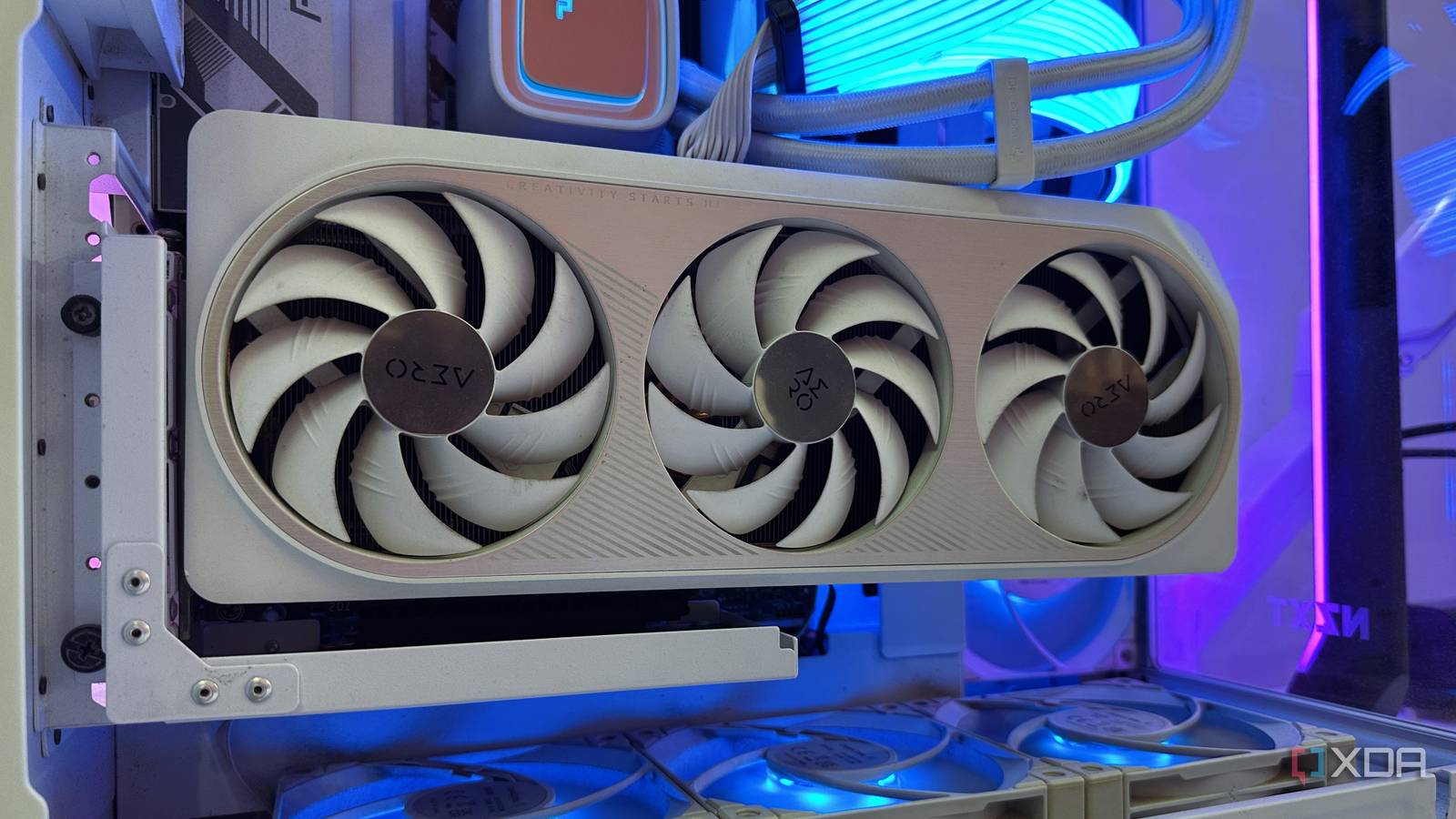
Published Sep 13, 2026, 12:30 PM EDT Abhinav pivoted from a career in banking to pursue his first love in writing. Even while working full-time, he continued contributing as an editor-at-large, a role he has held for more than 7 years. A lifelong tech enthusiast who has built three gaming and productivity powerhouse PCs since 2018, his passion for technology keeps him closely following the semiconductor industry, from NVIDIA and AMD to ARM. His MSc dissertation explored how artificial intelligence will reshape the future of work, reflecting his curiosity about the wider social impact of emerging technologies. Since the first ChatGPT model came out in November 2022, I've realized that my reliance on AI has climbed steadily. It started as nothing more than a better search engine. Then, reasoning models became a thing, and it became about in-depth analysis and deep research. Once vision and coding followed, it crept more and more into my daily workflow. At some point between all of that, I got used to the efficiency, and it turned into a dependency. Which is probably why one summer evening I realized that I had spent over $300 on Anthropic usage credits in a single month without noticing. As you'd realize, there was a problem with this approach. I'd been routing everything through paid cloud AI platforms, including the smaller tasks that never warranted a paid service in the first place. There was a solution to the monetary part of the problem, and it had been slotted into my PC's PCIe x16 slot all this time. My RTX 4070 Ti Super could do a lot more for my workflow 16GB of GDDR6X memory was too expensive to be doing nothing 99% of the time When I bought my RTX 4070 Ti Super in February 2024, it was an impressive component in its own right. 16GB of GDDR6X on a 256-bit bus ran every AAA title at 1440p I threw at it, and the performance has never once given me room to complain. For the money, it was doing exactly what I bought it to do. What I didn't realize was just how much more valuable those specs would become as local AI models advanced. At the time, my Python coding workflow ran exclusively through the cloud. Every single prompt, refactor, and throwaway question related to architecture went to whatever the flagship model of Claude was, and I carried on like that until a newer model arrived a few months later. All this time, my Ada Lovelace GPU that I had paid good money for just watched me burn through my usage credits, hit my 5-hour usage cap, and wait for the reset before I could dive back in. I must confess, I was a little late to the local AI inference scene. Part of it was because I severely underestimated what open models could do, and part of it was because I never realized what the models could do for me until I ran my first Qwen model. Open-weight models have become scary impressive There's a specialized model for nearly every task, and they all run for free In the past few months alone, open-weight models have become a lot better than they were, and because the landscape moves so fast, most people have a dated estimate of the capabilities of newer models. For a very, very long time, I was one of those people. The models now run faster, hold up well across various quantizations, and a growing number now handle vision and coding. I won't over claim and tell you they match the flagship cloud models when it comes to raw capability, because in a one-to-one comparison, they usually don't. What I will say, is that there are three things that work in their favor. The first, and the main one, is cost. They're free to run, with no meter and no ridiculous 5-hour usage quotas to exhaust, which counts in a workflow like mine where I need to iterate and send an endless array of questions. The more I ask, the more gets answered, and the better the product becomes. The next, and I'd argue, just as important, is specialization. You can find a highly capable model for nearly every task. I think of Gemma models for vision and general assistance, like documentation analysis or sentiment and trend analysis, look to the Qwen family for anything that requires writing code, and Stable Diffusion for image generation. So, with the cost and capability accounted for, the final remaining concern becomes quality, which is one aspect that either makes or breaks adoption rates amongst users. Perhaps it was this aspect that surprised me most in my experience with local models, but only when I got the model size, quantization, and specialization done right. In a recent reverse-engineering test, Adam Conway was able to get Qwen3.8-27B to recover a deliberately obscured key from a commercial app's license check through static analysis alone, and that's a model that can run on a consumer workstation, which provides a decent sense of where the ceiling is at currently. The key was to complement my cloud models, not replace them The GPU takes the first pass, and the model refines it Whenever I make this case in person, it always gets misconstrued as my advocating for the total and complete replacement of cloud AI tools. That's an approach that hurts more workflows than it helps. You can absolutely go fully local, and with enough VRAM, you won't run out of room. What you will, however, run out of, is features. Even an RTX 5090 with 32GB of VRAM cannot generate a video the way Gemini Omni can, or hand you a prototype the way Claude Design does. For those very features, local models can free up your cloud budget, by taking care of everything that you don't need a frontier model's capabilities for. The goal was always less cloud dependence, but not zero cloud dependence. For instance, instead of dropping an entire essay about how I want a certain Pygame written straight through to Claude Fable 5, I can just drop it into Qwen3:30B, which can produce a working build at 75 tokens per second without touching a single usage cap. What reaches Fable 5 is a functioning program, and building from here is a lot cheaper than starting from scratch. After all, it's the arithmetic average between an operation that costs $20 a month versus one that costs $0. To confirm this, I ran an experiment on a Pygame called Asteroids. I gave Claude Code an identical specification twice, once starting from nothing and once starting from a working build that Qwen3:30B had already produced locally. Both sessions ran on Fable 5 with no prior context. Building the clone from scratch cost $1.35, whereas refining Qwen's build cost $0.77, which was a 43% reduction as I'd expected. I haven't canceled any of my subscriptions, but the additional costs that I would pile on top of them are gone. With my Qwen and Gemma models on both my laptop and my PC, I find that I stay inside the 5-hour window on Claude, and the credit top-ups that once cost me $300 a month have stopped entirely. The GPU was already paid for, and now it's paying me back In pursuit of the latest, flashiest flagship model that promises the next stellar breakthrough, it's easy to forget the capable hardware that's sitting inside your own PC. My RTX 4070 Ti Super still spends its evening on games, but the rest of the day, it handles the many passes that keeps my credit top-ups to Anthropic in check. If you find yourself in a similar place, it can literally pay you to put your GPU at work.
My GPU subsidizes all my AI subscriptions, and it has saved me hundreds in cloud AI usage credits
Full Article
Original Source
Read the full article at Xda-developers →KhanList aggregates and links to publicly available news content. We do not host full articles from third-party sources. Always verify important information with original sources.