
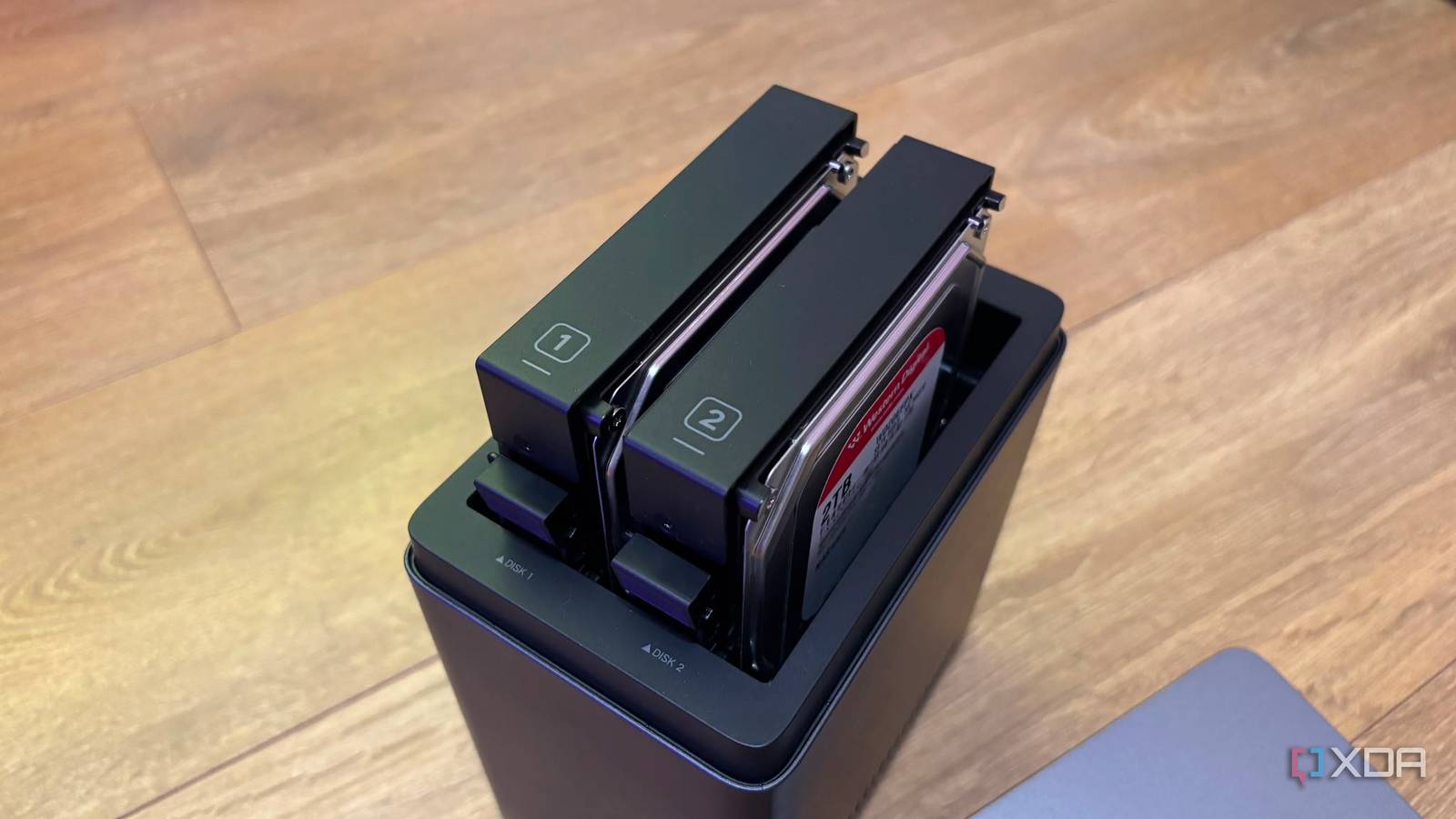
Published Sep 4, 2026, 8:00 AM EDT Jasmine is Software and PC Hardware Author at XDA with years of tech reporting experience ranging from AI chatbots right down to gaming hardware, she's covered just about everything. Whether it's breaking news about the latest AMD NPUs or creating video tutorials on social media platforms, Jasmine has contributed to the world of AI and tech in a variety of ways including interviewing the CEO of Razer, AMD's Director of Product Marketing and the VP of Lenovo. Passionate about gaming and PC technology, she has built countless computers, keyboards and other peripherals - knowing them inside and out. When setting up a smart doorbell, you might easily be hooked into monthly subscriptions that total over $100 a year, whether that's Nest Aware or Ring Protect. Even then, you just get generic "person was detected" notifications, sometimes even 10 seconds after they've already walked away. The reality of cloud-based doorbells is that they beam unencrypted 24/7 video streams of your front porch and neighborhood street into third-party cloud servers, subject to vendor terms of service, server outages, and law enforcement subpoena requests. However, with a home lab, someone walks up to your porch, and before you even glance at your phone, no cloud subscriptions, no third-party APIs, and no video data leave your local land. The entire neural network interface can run on an ordinary NAS sitting inside a cupboard and is a simple project to set up. The software stack required You don't need anything fancy Tapo D210 Video Doorbell Camera is the best investment I've made thanks to the lack of monthly fees.Tapo D210 Video Doorbell Camera is the best investment I've made thanks to the lack of monthly fees. To run AI locally, you don't need an enterprise server farm. You can run it quite comfortably once you understand the architecture. The first thing is having a local RS RTSP, which allows for stream ingestion. The camera feeds a low-resolution, low-bitrate RTSP substream (for example, 720p at 5 FPS) to the NAS 24/7 for zero-CPU motion detection while maintaining a high-res mainstream, like 2K or 4K, for archival and snapshot analysis. Stage 2 is taking advantage of Frigate NVR motion and object detection. Frigate uses hardware acceleration, whether that's Intel QuickSync, Google Core, TPU, or NVIDIA Tensor RT, in order to actually process the low-resolution stream. Motion bounding boxes filter out wind, leaves, and shadows. When a person's object bounding box exceeds a confidence threshold (e.g., 75%), Frigate crops the high-resolution face bounding box. Next, you can implement DoubleTake, which is essentially a middleman orchestrator. DoubleTake will listen to Frigate's MQTT event stream, and when a person event fires, DoubleTake will grab the pristine full-resolution snapshot directly from Frigate's API and route it to the facial recognition engine. Lastly, it runs either CompreFace or InsightFace, which uses neural inference. CompreFace runs a lightweight facial recognition model inside a Docker container. The model itself can be InsightFace: it vectorizes the detected face, compares the embedding against a local database of tagged family members and friends, calculates a similarity score, and then outputs the match back over MQTT. Of course, you can never have 100% confidence in the AI detection, so it's worth keeping that in mind. While this does sound like a lot of steps, the total end-to-end latency should be less than 400 to 800ms from the moment the subject steps onto the porch to when the notification pings on your device. The hardware you need is essential But fear not, it's still modest Once you understand the required software stack, it's time to understand the hardware architecture. Running machine learning on a NAS can be difficult. You need hardware acceleration, as software CPU-only video decoding can choke an everyday NAS processor. By using Intel QuickSync, which is featured on many iGPUs and the Intel 11th, 12th, and N series chips like the ubiquitous Intel N100 you can handle hardware-accelerated video decoding with near-zero CPU load. The inference silicon can be important too. Using a Google Core or USB TPU, you get 100+ fps object detection for under $60. Or run OpenVINO on an Intel iGPU by running CompreFace/InsightFace directly on Intel integrated graphics execution. This means that you don't require a dedicated discrete graphics card. A 24/7 continuous rolling recording stored on a local NAS hard drive, with zero cloud upload bandwidth consumption, also gives you the benefit of local storage and privacy. It unlocks so much potential You could configure a range of home automations Tapo D210 Video Doorbell Camera is the best investment I've made thanks to the lack of monthly fees. Once you have all of this in place, of course, you have the benefit of being able to know who is at your front door thanks to facial recognition. You can also unlock a range of next-level automations too. You can have dynamic text-to-speech announcements. For example, if the facial recognition identifies a family member coming home, it can welcome that person home by name, which is broadcast quietly in the hallway. That way, other members of the house know that you're home too. Or, if it identifies a delivery courier based on uniform or truck detection, it can announce that a delivery driver is at the door. If the person detected at your door is unknown, then this could also trigger a security notification with an attached snapshot directly to your phone via the Home Assistant Companion app. This means that even if you're not home, you will immediately get a snapshot of someone approaching your door so you can determine whether it's an emergency. You can also activate a guest arrival welcome mode that pauses indoor motion security alerts and other measures you have in place when a guest arrives at your home. It can also pause robot vacuums and any other hazards you may have around your home. You don't need to pay a monthly fee Unlock premium features on your own local hardware Modern consumer tech has tried to convince homeowners that artificial intelligence requires renting space on a multinational cloud server and paying hundreds of dollars a year for the privilege. In reality, modern computer vision models are lightweight enough to actually run on modest, power-efficient local silicon. Instead of paying a monthly doorbell subscription, it might be time to pick up an RTSP-capable camera, spin up a Frigate container on your NAS, and experience the speed, privacy, and power of a sovereign smart home, as well as the benefits of the privacy and security you get, too.
My doorbell tells me who's at the door before I look, and the recognition runs on the NAS in my cupboard
Full Article
Original Source
Read the full article at Xda-developers →KhanList aggregates and links to publicly available news content. We do not host full articles from third-party sources. Always verify important information with original sources.