
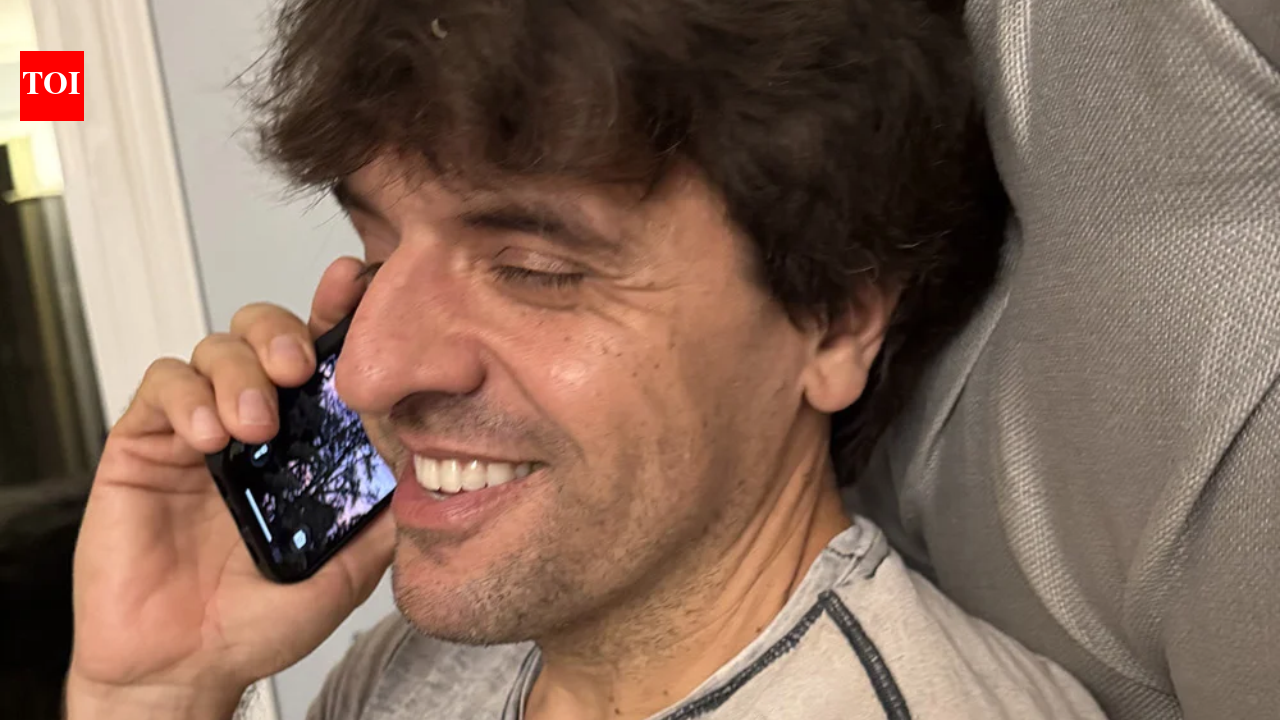
Karl Deisseroth (Image: https://news.stanford.edu/)The most revealing detail about Karl Deisseroth’s Nobel morning may not be the phone call from Stockholm. It is what happened after it.Hours after learning that he had won the 2026 Nobel Prize in Physiology or Medicine, the Stanford neuroscientist still had a very ordinary job waiting for him: making sandwiches for his children before school. His morning involved both one of science’s biggest honours and six packed lunches.5 Oct 2026 | 12:06Parents, when your child refuses to greet relatives, do you make them say hello or respect their choice?And then there was the description from his 16-year-old son Hudson, as per Stanford Report.“The word I’d use to describe my dad is relentless,” Hudson said. He described his father as one of the hardest-working people he knows, saying Deisseroth gives his all during “every waking hour”, and, pointedly, that he seems to have more waking hours than most people.That small family observation offers a surprisingly personal window into the scientist behind one of the biggest neuroscience breakthroughs of recent decades.A Nobel call in the middle of the nightDeisseroth is, by his own description, a night owl.On the night before the Nobel announcement, he had been working late, reviewing papers and emailing students. He had finally gone to bed when the call came from Stockholm.The first call, at 12:27 a.m. Pacific time, was missed. Seconds later, his wife, Dr Michelle Monje-Deisseroth, also a Stanford scientist and pediatric neuro-oncologist, answered her phone. The caller asked to speak to Karl.Deisseroth was stunned. He later said he temporarily struggled to form words after hearing the news. But the extraordinary moment quickly collided with family routine. His children would soon be waking up for school, and their father still had sandwiches to make.Meet the family behind the scientistDeisseroth and Michelle Monje-Deisseroth have five children.Their son Alexander, 18, is a freshman at Stanford University. When he woke up on Nobel morning, he saw a message from his mother saying there was news. He called home, spoke to his father and immediately understood what had happened.Alexander was only a five-minute bike ride away, so he came over.“We all knew he deserved this,” he said, adding that the family was “insanely proud” of him.Then there is Hudson, 16, whose description of his father has perhaps become the most memorable family quote from the Nobel announcement.The family’s morning also included Deisseroth preparing six sandwiches for the three children still living at home. Each had specific preferences: Hudson’s included ranch dressing, cheddar, salami and turkey; Sophie had a similar combination; and Emma’s was made with almond butter, honey and cinnamon on raisin bread.His wife was less surprised than he wasMichelle’s reaction is revealing too. While Deisseroth said he was surprised and overwhelmed by the Nobel call, Stanford reported that his wife was considerably less surprised.She has watched the work ethic up close.Michelle is herself a scientist and Stanford physician, and the couple's professional lives have long revolved around medicine, neuroscience and research.The family has an extraordinary scientific career and everyday family life occupy the same small physical world.That makes Hudson’s “relentless” description more than a throwaway line. It is the view of a teenager who has grown up watching his father divide his time between research, patients, students and five children.The “relentless” part has a historyDeisseroth’s reputation for working intensely did not begin with the Nobel.Stanford has previously described how, during his psychiatry training, he spent long hours working in psychiatric wards while also pursuing neuroscience research on nights and weekends.A former mentor, Stanford neuroscientist Robert Malenka, once described him as someone who worked extraordinarily hard and argued that exceptional achievement requires more than intelligence alone.That combination of medicine, engineering and neuroscience eventually led Deisseroth toward optogenetics.The technique uses light-sensitive proteins to control specific nerve cells. By introducing these proteins into selected neurons, researchers can use pulses of light to switch neural activity on or off with remarkable precision. The approach has transformed the study of brain circuits and helped scientists investigate how particular groups of neurons influence behaviour, emotion and disease.“Get back to work”Perhaps the most telling part came when Deisseroth was asked how he planned to celebrate.His answer was short: “Get back to work.”There was still more to discover, he said, and more people to help.For his family, that answer probably sounded familiar.Because behind the Nobel ceremony, the global headlines and the years of groundbreaking research is a father who works late, a mother who answers the Nobel call when he misses it, a Stanford freshman son who can cycle over in five minutes, younger children waiting for their sandwiches and a teenager who thinks the simplest word for his father is also the most accurate one: Relentless.
“My dad is relentless”: Meet Nobel winner Karl Deisseroth’s family and kids
Full Article
Original Source
Read the full article at Timesofindia →KhanList aggregates and links to publicly available news content. We do not host full articles from third-party sources. Always verify important information with original sources.