
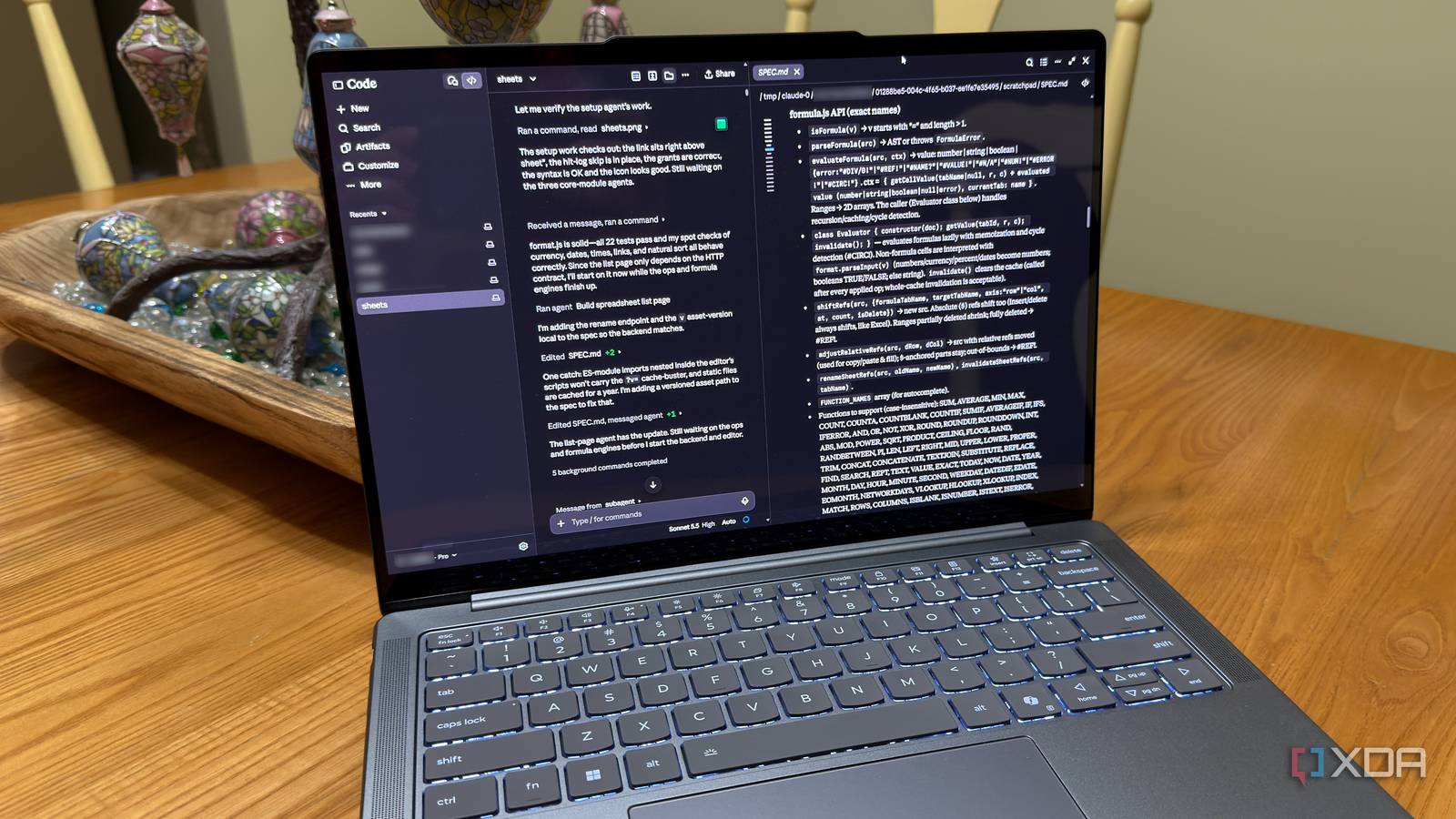
Published Nov 3, 2026, 12:31 PM EST Korbin is a Linux system administrator who spends most of his time in a terminal figuring out how things actually work. Over the last decade he's written hundreds of articles about Linux configuration, troubleshooting weird problems, and using open-source tools in the real world. He also works a lot with Windows systems and networking, especially in mixed environments where things don't always behave the way the documentation says they should. Writing things down is how he makes sense of it all and hopefully saves someone else a few hours. I feel that my Claude Pro subscription has been money well spent, given all the projects it has developed for me. There's only one recurring problem: the limited weekly usage sometimes isn't enough to finish a sizable codebase. Claude can certainly handle the complex projects. It's just a question of whether the usage capacity will let it. Last week, I gave Claude a huge task of coding a replacement for Google Sheets. I normally rely on Sonnet for development work, as it's much lighter on the tokens but still proves capable. For this project, though, I knew I'd need to resort to Opus. To extend my usage beyond what's normally possible, I told Opus to spawn Sonnet and Haiku sub-agents for the actual implementation work. This ended up being the perfect combo: it let me build a huge app while still leaving me usage to spare before the weekly reset. I let Opus do the orchestration And had lighter models do implementation The secret to utilizing Opus without burning through usage credits in a matter of minutes is to limit the model strictly to the orchestration of the task. Then, it can delegate the actual implementation and testing to sub-agents running models like Sonnet and Haiku. Those models get their assignments from Opus, carry out the work, test it out, and report the results back to Opus. I turned on Opus and gave it a pretty thorough prompt about what I wanted it to build. It was to construct a replacement for Google Sheets that I could run on my personal website. At the very top of the prompt, here's what I said about spawning sub-agents: You are going to orchestrate the following project. I don't want you to actually implement any part of this; instead, you should delegate tasks out to numerous inexpensive sub-agents that you spawn (whichever models and whatever number of them you deem appropriate). Have the agents report back to you and then verify their work. Also verify at the end that everything works as expected. Opus began the task by splitting it into phases, then spawned four sub-agents to work in parallel on completing the first phase. It was three Sonnet agents doing most of the heavy lifting, with a Haiku agent spinning up a test environment for everything. As the sub-agents ran, Opus sat back and waited, which meant that it wasn't contributing to running up my usage. The five-hour usage limit is still a problem It turned a three-hour project into 12 hours Anthropic enforces a weekly usage limit, as well as a rolling five-hour window. That one is relatively easy to hit, especially with Opus. Developing a Google Sheets replacement is no small task, so the build process went over my five-hour usage limit twice while waiting for everything to complete. Whenever that limit was reached, I was stuck waiting a few hours before Claude could resume. I can't be certain about exactly how much usage went to Opus versus the other models, but it didn't seem like much. I've used Opus on smaller tasks in the past and could hit my cap in mere minutes, whereas this project was worked on for over an hour before hitting the five-hour limit each time. Based on my experience with running the various models, it seems to me that my limited usage was mostly being allotted to the sub-agents doing all the real work. Doesn't Opus do a better job? Lighter models are capable with good directions It'd be ideal if we could just use Opus (and eventually Fable) for everything, of course. If it wasn't such a usage hog, we wouldn't need to resort to the less powerful models at all. Telling Opus to spawn inexpensive sub-agents is more of a trick than anything. You get the intelligence and power of Opus to do all your planning and overseeing, then let the cheaper and faster models do the actual coding. That's a pretty nice way to get the best of both worlds. From my experience with this project, it seems that the less powerful models are perfectly capable of implementing all components of a hefty project, as long as they have a good supervisor. Having Opus split everything into five phases and delegating small tasks to each sub-agent was what made everything come together so smoothly. It also helped that I'd told Opus to test everything thoroughly before moving on to the next step. I had used Opus 5 for all of the initial orchestration and first version of the project. The final result was a very usable product, but I've uncovered lots of niche issues and unwanted quirks in my time using the app since its inception. To fix these, I just describe the problem to Claude (sometimes I'll provide reference screenshots, too), and it patches them. For those prompts, I've switched to Sonnet 5.5. At first, I was still using Opus, but found that it kept wanting to spawn sub-agents and do a lot of testing over small bug fixes. Big projects no longer consume my weekly cap I used to avoid using Opus after seeing my usage evaporate in only a few minutes. Now that I tell it to explicitly limit its involvement to the planning and orchestration of a project, I'm able to get the power of Opus and still have some more room left over for other tasks.
My Claude weekly limit lasted longer once I made Opus a project manager
Full Article
Original Source
Read the full article at Xda-developers →KhanList aggregates and links to publicly available news content. We do not host full articles from third-party sources. Always verify important information with original sources.