
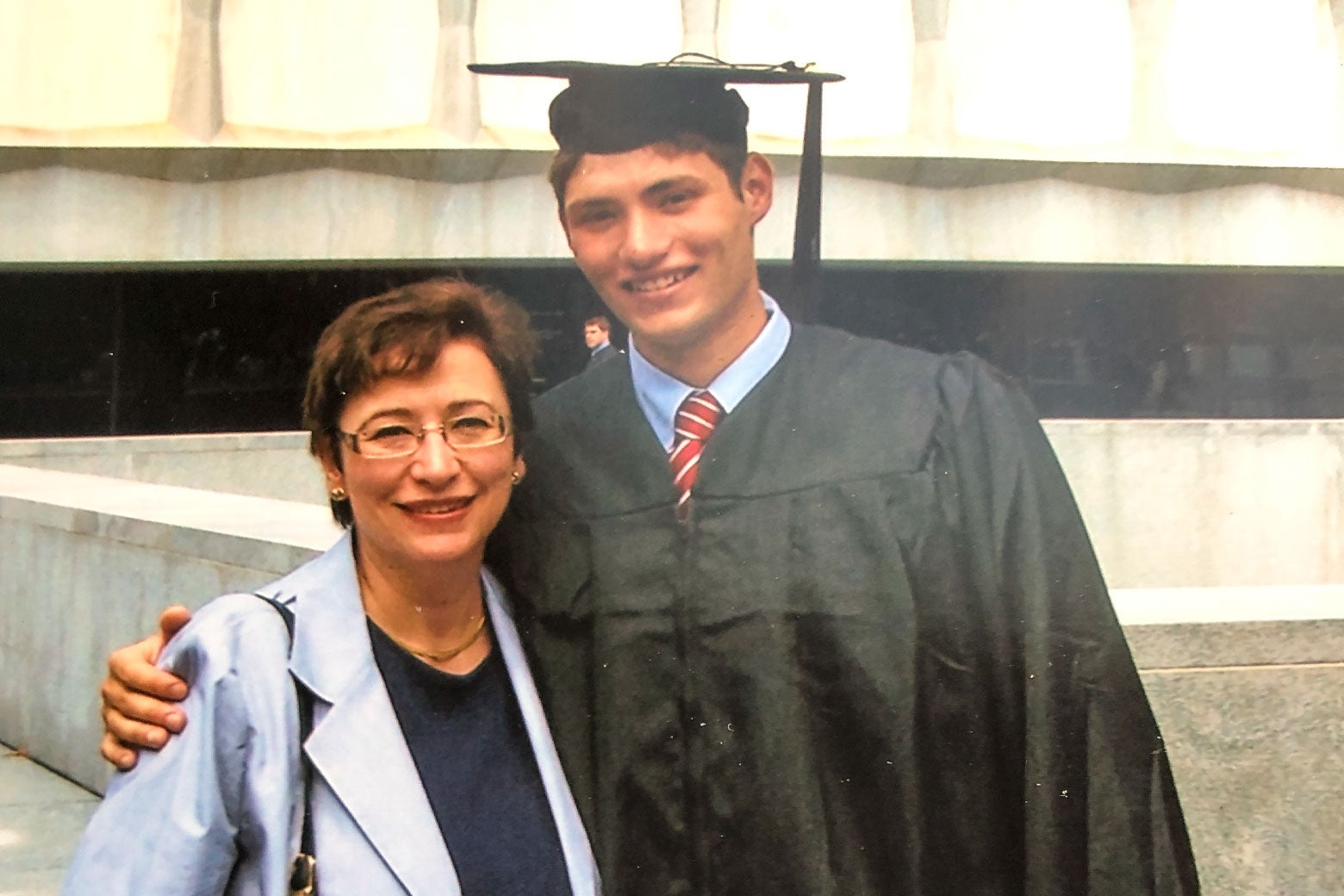
Family There’s no “over” for people dealing with mental illness like Lindsay Clancy—or my brother. Vince Granata Sign up for the Slatest to get the most insightful analysis, criticism, and advice out there, delivered to your inbox daily. Eleven years ago, I listened to a prosecutor detail how my brother killed our mom. He presented a litany of evidence—bagged knives, coroner’s report, bodycam footage of Tim wailing “I hope she isn’t dead”—to prove that Tim had committed this crime. But no one questioned this fact. Tim’s trial was to determine if he had been in control of his mind. Before Tim killed our mom, he’d followed a well-worn path, one that began with mild symptoms in his late teens. Maybe he’s just eccentric? Maybe he’s just depressed? In his early 20s, there were sharper signs, delusions that his landlord had poisoned his food or that demons stalked him across his sylvan college campus or that an enchanted coin hovered above his head. He visited his school’s counseling center and kept a handful of appointments with psychiatrists, but these half-steps were no match for his accelerating illness. Threats of suicide led to a hospital admittance, but his stay was combative and brief. He retreated home, flushed pills down the toilet, and sealed himself behind his locked bedroom door. That story does not make him unique. That story is familiar to thousands who have witnessed loved ones trapped in cycles of illness and ineffectual care. That story rarely makes news. After Tim killed our mom, newspapers plastered our family home on front pages beneath the word Matricide. Many of the accompanying articles noted “there was a history of mental illness.” A long tail coiled behind the headline, distilled into a single sentence. Over the past weeks, I—like many—have followed updates from the Lindsay Clancy trial. I’ve watched the story metastasize. During a fantasy football draft, my friends debated Clancy’s guilt with an intensity usually reserved for comparing the merits of rookie wide receivers. At the playground, while pushing my daughter on the swing, I caught fragments of a nearby conversation—but was she even hearing voices? It’s not surprising that Clancy’s trial captured our attention. When faced with an “un” crime—one that is unimaginable, unfathomable, unbearable—it’s in our nature to theorize how mental illness may have played a part. We want to know why, for an explanation and verdict to deliver catharsis. But then, we want to move on. Absent a horrific crime or the plot twists of a cinematic trial, serious mental illness rarely makes news. We neglect the larger crisis that persists between these flashpoints. Before my brother killed our mom, I knew very little about our failure to understand and treat serious mental illness. I didn’t care enough to learn what was behind occasional headlines. I didn’t care until it was too late. A year after my mom died, I discovered her cache of hidden books. I was in her bedroom, sifting through all that she’d left behind. Though it had been a year, we’d kept her things. We needed more time. As I approached her nightstand, I stubbed my toes against something under her bed. I knelt and found nearly 20 books coated in a year of quiet dust. I yanked them into the light—Surviving Schizophrenia: A Family Manual; I Am Not Sick, I Don’t Need Help: How to Help Someone with Mental Illness Accept Treatment. All of them covered similar ground. Each one was creased and dog-eared. After Tim’s trial, I read my mom’s books. They showed me the breadth of what I didn’t know. I didn’t know about anosognosia, a neurological facet of psychotic disorders that prevents the person suffering from being aware that they are ill. I didn’t know how to help someone experiencing a mental health crisis, how to approach in a way that doesn’t deny their experience—in the past, I’d told Tim: “You know that’s not real.” I didn’t know about our woeful shortage of psychiatric hospital beds, or how assessing psychiatric patients on their perceived dangerousness means that many who need treatment go without, or how insurance policies frequently deny patients the level of mental healthcare they require. I didn’t know any of this because these are things we rarely talk about. I wrote a book about Tim. I wanted my book to find readers who still had time to help their loved ones. While I hope that this has happened, that I’ve spared people some pain, most of the messages I receive are from readers who found my book after experiencing a similar tragedy. It would be irresponsible for me to diagnose Lindsay Clancy without deep knowledge of her clinical history—though this certainly hasn’t stopped many. But I do know that most of us underestimate the potential power of untreated psychotic disorders. I know that while it is rare, postpartum psychosis is often ignored or mistreated. I know that sustained, meaningful mental healthcare is often impossible to access. And I know that for every case like Clancy’s, there are thousands who face quieter horror, a mother searching shelters for her ill unhoused child, a sibling fearing that their brother’s erratic behavior might lead to a deadly encounter with police, a daughter terrified that her isolated father is growing delusional because he hasn’t received his medication. These stories don’t make headlines or ignite debate at fantasy football drafts or local playgrounds. I’ve met too many people who care too deeply about the crisis of serious mental illness to abandon hope. I know that many flocked to Clancy’s trial not to spread conspiracy theories or to call for “righteous” punishment, but to speak, loudly, about the systemic neglect of postpartum mental health. But I fear, too, that whenever the Clancy story “ends”—for us, not for her or her family—our attention will drift. We’ll wait for the next flashpoint. We’ll guarantee that tragedies like the one that struck my family will persist. At the end of my brother’s trial, a three-judge panel declared him not guilty by reason of insanity. This was not an “acquittal” and Tim did not walk free. He left under the custody of the state psychiatric review board, a body that will dictate his institutionalization for many years. When I left the courthouse with my family, news vans greeted us at the curb. Reporters asked how we felt at the conclusion of the trial. The following day, they published articles that explained the verdict, the end of a disturbing story. I saw Tim a week later. I visited him at the psychiatric facility that would house him, out of view, for many years. During his trial, I’d rarely seen his face. I’d been seated on a bench behind him, but Tim had been prohibited from turning toward me. If he even slightly rotated his head, he received a quick rebuke. Face forward. When I saw him, waiting for me in the visiting room, he didn’t look relieved that his trial was over. He didn’t look like anything was over. After the trial, after the verdict, after the articles punctuating the end of his public story, Tim faced years and years of battling his persistent illness. Those years, like the years of accelerating symptoms and ineffective care preceding his crime, wouldn’t spark interest, wouldn’t make news. I stood in front of him, at the beginning of this endless epilogue, not knowing how to start. Crime Health Care Mental Health
My Brother Killed Our Mom. I Know What It’s Like to Be in the Headlines for a Horrible Crime. I Also Know What Comes After.
Full Article
Original Source
Read the full article at Slate →KhanList aggregates and links to publicly available news content. We do not host full articles from third-party sources. Always verify important information with original sources.