
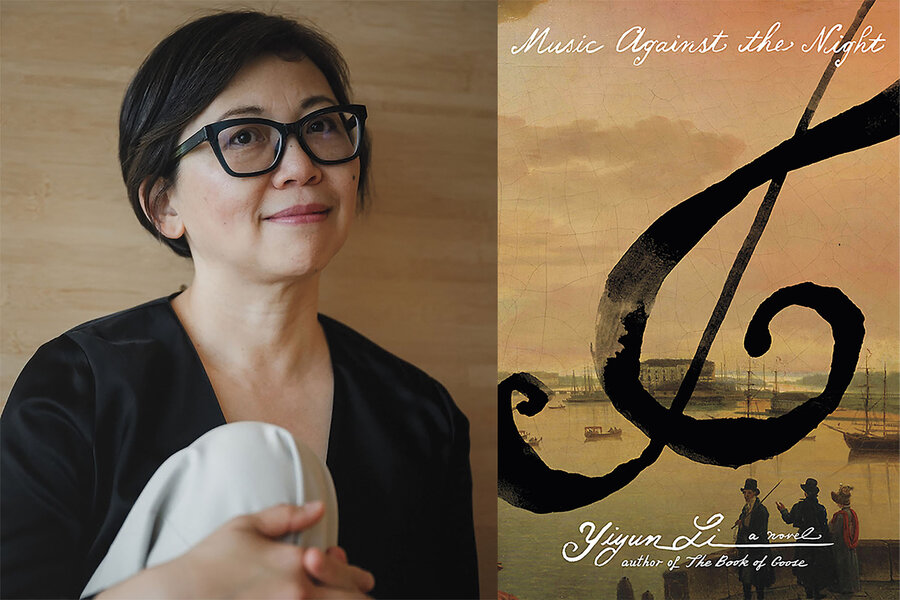
Yiyun Li came to the U.S. from China in 1996 to study immunology, but she discovered a different calling. She has since become one of America’s most accomplished and awarded writers. Much of her work, including this year’s Pulitzer Prize-winning memoir “Things in Nature Merely Grow,” and her story collection “Wednesday’s Child,” a finalist for the 2024 Pulitzer Prize for fiction, involves people struggling to bear up under great distress. Some are mothers who, like Li, have lost a child.Li’s latest novel, “Music Against the Night,” is a masterful exploration of the tolls of ambition and expectations on gifted children and adults. She approaches this subject through the life stories of two musical prodigies. Both were actual people born in the late 18th century who, despite their best efforts, became mere footnotes in musical history. Irish-born pianist and composer John Field (1782-1837), credited with inventing the nocturne (later immortalized by Frédéric Chopin), is mentioned in passing in Chopin’s biographies and Tolstoy’s “War and Peace” (which Li has studied and written about extensively). Little is known about Field’s talented student, Adelaide Percheron (1790-1869), whom he married in 1810.Li moves these largely forgotten virtuosos center stage in order to explore the demands, discipline, jealousies, personal sacrifices, and inevitable disappointments that go hand-in-hand with exceptional talent as they strive to live up to their promise. The novel’s focus is on their struggles more than their successes. Ever rigorous and diligent, Li creates vivid cradle-to-grave portraits of her two protagonists. She does this against the backdrop of an era of global turmoil, revolution, and wars that profoundly rocked France and Russia.Time is a key component of both music and literature, and Li plays it like an instrument. For the most part, her sweeping narrative alternates in four movements between John, born into a musical family in Dublin, and Adelaide, who was orphaned soon after her birth in Pondicherry, French India, and brought up by her imperious grandmother.Cleverly spaced preludes, codas, and interludes break up the novel’s chronological march. They create an effect somewhat akin to motifs that wind through a musical composition. Before scrolling back to John’s birth, Li packs a lot of information into the novel’s first pages. She introduces Adelaide, middle aged and alone in Smolensk, Russia, in 1837. Adelaide receives news of John’s death from their son, Adrien. We learn that the couple had been separated for decades. John took up with one of his lovers. He described Adelaide’s rival as being easy to love, like a “pet rabbit, soft and compliant” – unlike her. But Li deliberately withholds – for more than 300 pages – how John and Adelaide met. Time unspools slowly, at an andante tempo, in her characters’ early years. The slow-burn storytelling reflects the characters’ plodding childhoods, utterly lacking in carefree play. John, whose aptitude for the pianoforte is recognized early by his father and grandfather, is brought up with the single-minded goal of becoming the next Mozart so that he will bring fame and fortune to his family. (Talk about pressure.) His small stature enables them to subtract nearly two years from his age, which extends his reign as a prodigy.Li captures the drumbeat drills that shape these youngsters. If you think the commercialization of art is new, think again. John is warned repeatedly that there are “more forgotten giants than remembered ones,” and that “what makes one musician different from another is not the notes he can play, but how to turn music into a commodity.” His teacher Muzio Clementi says, “Bank notes, rather than musical notes, sustained musicians.” He takes the boy into his lucrative side business of publishing music and selling musical instruments.Meanwhile, Adelaide’s grandmother belittles the pianoforte the girl pines for, calling it an expensive toy. The matriarch urges the headstrong girl to be more ambitious and ingratiating – in order to attract a good husband. “The essential thing was to move up, not down,” she lectures Adelaide. “Hardship makes a good story in retrospect, provided it is redeemed by success.” Deepen your worldviewwith Monitor Highlights.Politics with respectGet political stories with respectful analysis.There‘s a world of new ideas in everyBooks newsletter.There‘s more to life, enrich yours withCulture & Learning weekly.Follow humanity‘s discoveries withScience & Nature stories in your inbox.Gain a spiritual perspectivefrom the stories in your inbox.Want to understand the deeper impact of critical events? Learn the Monitor‘s insight.Already a subscriber? Log in to hide ads. Periodically, Li injects her narrative with commentary set off in long parenthetical asides. These informative passages function similarly to footnotes, but without the disruption of having to read minuscule print at the bottom of the page. Well before John reaches his peak, we pick up in a parenthetical that his behavior and career both deteriorated early.It is dangerous to read fiction – even historical fiction – for autobiographical clues. But it is clear that “Music Against the Night” hits many personal notes up and down Li’s literary keyboard, beginning with its title. It is also not a stretch to say that this virtuoso writer brings intimate understanding to what she calls “the tormenting hope of greatness and fear of not being good enough.” She asks, “What musician is free of it?” And, one might add, what writer, what exceptional child, and what parent is free of such pressures? ALREADY A SUBSCRIBER? LoginReal news can be honest, hopeful, credible, constructive.The Christian Science Monitor was founded in 1908 to lift the standard of journalism and uplift humanity. We aim to “speak the truth in love.” Our goal is not to tell you what to think, but to give you the essential knowledge and understanding to come to your own intelligent conclusions. Join us in this mission by subscribing.
‘Music Against the Night’ plays like a major literary composition
Full Article
Original Source
Read the full article at Csmonitor →KhanList aggregates and links to publicly available news content. We do not host full articles from third-party sources. Always verify important information with original sources.