
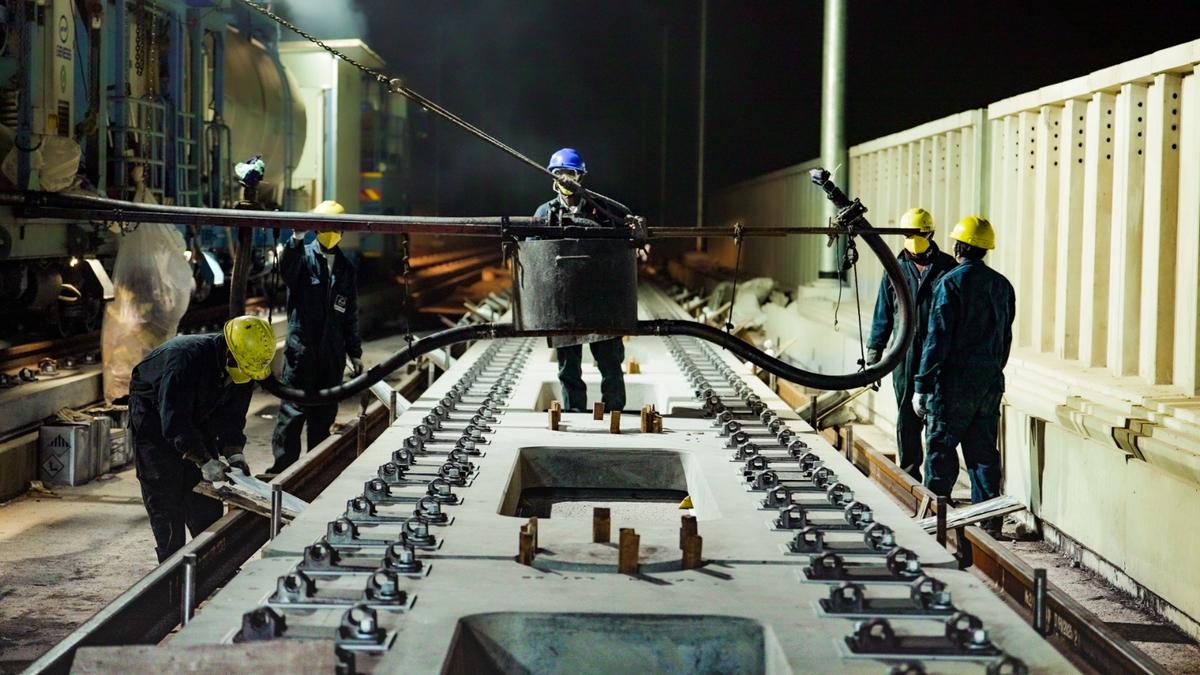
The senior official said that Japan is not in a position to declare when the project will be completed, but maintained that, despite the delay, the project is now making “steady progress”. File. | Photo Credit: Special Arrangement The rate of progress on the Mumbai-Ahmedabad high-speed rail corridor project has not “lived up to” Japan’s initial expectations, a senior official of Japan’s Ministry of Foreign Affairs said on Monday (September 28, 2026). India’s first bullet train project is being supported, financially and technically, by Japan.Speaking exclusively to The Hindu, the official said that Japan is not in a position to declare when the project will be completed, but maintained that, despite the delay, the project is now making “steady progress”.India and Japan will convene the ‘two plus two’ dialogue by the end of the year, the official said. On the issue of disputed territories, the Japanese official asserted that all countries “must respect international maritime laws in the South China Sea and the East China Sea”, including in the Senkaku islands that Japan claims as part of its sovereign territories and China claims as the Diaoyu islands.No concrete timeline“I have to admit the timeline has not lived up to our expectations as originally envisaged,” the Japanese official said, with regard to the Mumbai-Ahmedabad rail project. However, he expressed confidence that the project is now “moving forward”. After years of feasibility studies and multiple-level reviews, the project was kicked off on September 14, 2017, when Prime Minister Narendra Modi and the late Japanese PM Shinzo Abe laid its foundation stone in Ahmedabad.Also read: Mumbai-Ahmedabad bullet train to get ballastless track system“Both sides are committed to bringing high-speed trains to India, among other things. Construction of high-speed infrastructure is also developing steadily on the ground both in Mumbai and Gujarat, and we hope high-speed trains will start to move in a few years in India,” the official said, without giving a concrete timeline for the project’s completion.His comments come months after former Japanese Minister Hideki Makihara blamed the delay on the “sheer recklessness” of Indian officials, adding that Japan had been excluded from key safety components, such as the signalling system.Asked by The Hindu about Mr. Makihara’s remarks, the MoFA official said, “I don’t want to endorse any comments outside of the negotiation.” He said that Japan is going ahead with works related to the “signal system, rail structure.” He added: “We have been training railway workers to operate high-speed railways... It has been taking time, though at the same time, we have been moving forward.”Investment plansThe official highlighted Japan’s investment plans for India over the coming decade. Japanese Prime Minister Sanae Takaichi had showcased Tokyo’s interest in boosting bilateral trade by taking representatives of 200 Japanese business houses to India during her visit in the first week of July. The two sides are also in talks to conduct trade settlements in Japanese Yen and Indian Rupees.He also presented Japan’s interest in long-term investments in the biogas sector, announcing that Japan plans to build around 2,000 biogas facilities in India.The ‘two plus two’ dialogue featuring the Foreign and Defence Ministers of both nations will be held by the end of the year, the MOFA official said, adding that the official announcement of the meeting is expected to come within a month.Disputed islandsThe MOFA official expressed Japan’s concerns about Chinese land reclamation efforts in the South China Sea, where Chinese military activities have triggered regional concern. Referring to the disputed islands in the East China Sea that China has been claiming, he said, “The Senkaku islands are our territory and closer to Japan geographically. We are increasingly concerned about China’s escalation activities, regarding getting control of Senkaku.” China, however, claims what it refers to as the Diaoyu islands.The Japanese official asserted that the South China Sea is “vital” for Japan’s economy. “China must respect international maritime laws as provided in UNCLOS (United Nations Convention on the Law of the Sea). Their activities when it comes to the reclamation of the shoals, coral islands violate international maritime laws,” he said.Opinion | India and the plausible multilateralism of BRICSThe official maintained that Japan did not have a “negative” view of the recent BRICS summit in Delhi, which Chinese President Xi Jinping had attended. Most of the “controversial items” were either “contained or moderately addressed” under India’s chairmanship, he said. Published - September 28, 2026 08:21 pm IST
Mumbai-Ahmedabad bullet train timeline fails to meet Japan’s expectations, but is now ‘moving forward’
Full Article
Original Source
Read the full article at Thehindu →KhanList aggregates and links to publicly available news content. We do not host full articles from third-party sources. Always verify important information with original sources.