
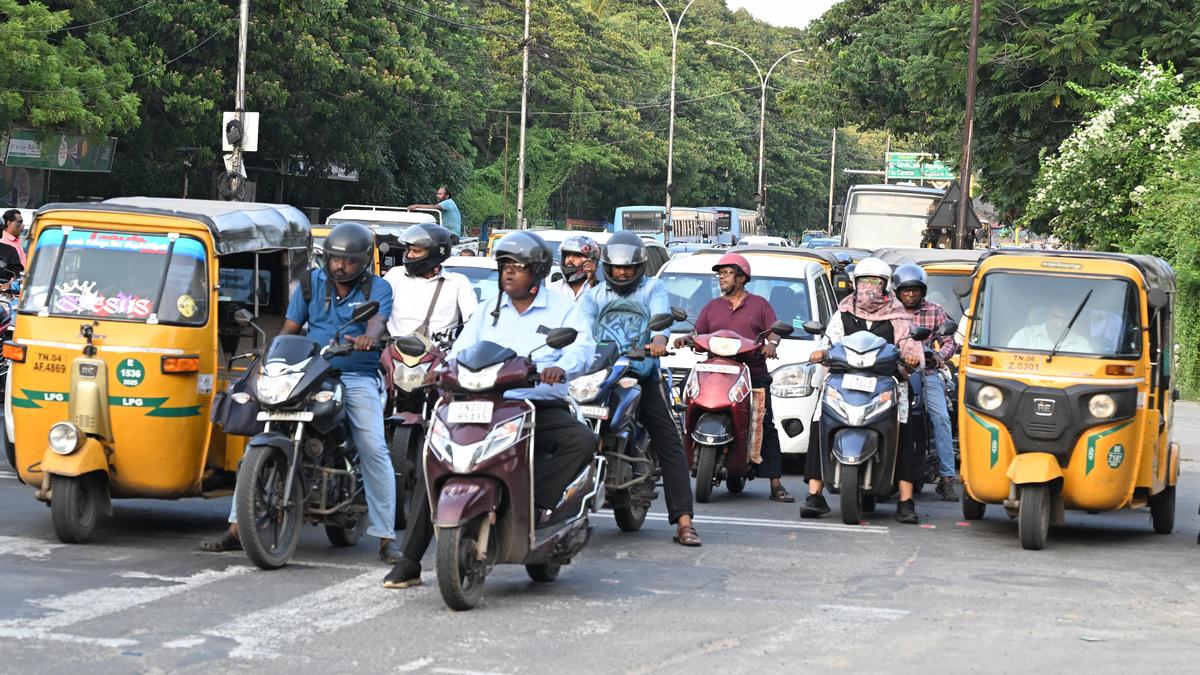
The ATCS detects traffic density, vehicle arrivals, queues, and movement patterns arm-wise using cameras and sensors installed at each junction. | Photo Credit: S.R. RAGHUNATHAN The adaptive traffic control system uses real-time traffic conditions to adjust green light times for each approach at a junction, ensuring ones with heavier traffic flow receive suitable priority. The system is currently under operation at 105 signals in the cityThanks to the Greater Chennai Corporation’s Intelligent Transport System, traffic has started moving faster, with 10% to 15% time saved per junction at 105 locations across the city.Even as the adaptive traffic control system (ATCS) of the Intelligent Transport System is expected to be launched in December at 154 junctions on Greater Chennai Corporation (GCC) roads and highways, 105 signals have already started operations, with testing under way in other locations. According to data compiled by civic agencies, the average time saved per junction ranges from 10% to 15%. “When compared with the old fixed-time signal system, ATCS operation on the EVR Periyar Salai Corridor showed a positive impact. On average, around 15 seconds per cycle per junction was saved. This reduction may appear small for a single signal cycle, but across multiple junctions, repeated cycles, and thousands of daily commuters, the cumulative benefit becomes significant,” an official said.“The primary commuter benefit is reduced waiting time at signals. Vehicles are not forced to wait for a fixed period when there is limited traffic in the other phase. Instead, the system allocates green light time based on demand, improving traffic flow, reducing idling, and supporting smoother movement along the corridor,” he said.ATCS is an intelligent signal control solution that uses real-time traffic data from cameras and sensors installed at each junction. These devices installed at 105 of the 154 junctions have started detecting traffic density, vehicle arrivals, queues, and movement patterns arm-wise.Based on this information, the system automatically adjusts the green light time for each approach, so ones with heavier traffic receive suitable priority, and ensures approaches with lower demand are not allocated unnecessary time. Thus, allowing the signal to understand the traffic condition and respond accordingly. This means motorists will not have to wait for longer than necessary.Within Chennai, 165 junctions were originally identified for conversion under the ATCS system. These junctions are part of the city’s broader intelligent traffic management initiative, where adaptive signal control is being used to improve travel efficiency, reduce delay, support better corridor movement, and provide safer crossing opportunities for pedestrians. Owing to Metro Rail work, work on 11 junctions will be delayed.After installation in 105 junctions, the ATCS system was tested to understand its impact. For this assessment, the EVR Periyar Salai Corridor was selected as the representative. The EVR Periyar Salai Corridor is approximately 8.8 km long and consists of 21 signalised locations — 19 vehicular traffic signals and two high-footfall pedestrian crossing signals, one near Vaishnav College and another near Everest Hotel.Apart from these, pedestrian demand is also supported at ATCS junctions by pelican signal facilities. These signals operate based on push-button requests from pedestrians, helping them cross safely whenever required. Based on the observed time savings and the conversion of these savings into monetary benefits, the EVR Periyar Salai Corridor alone is estimated to provide substantial annual benefits. The value of time savings is estimated at ₹62 crore per year, calculated based on commuter time savings and per capita income. In addition, the corridor is estimated to generate ₹21.6 crore per year in fuel savings and ₹2.3 crore per year in carbon emission reduction benefits, the official said.The EVR Periyar Salai Corridor demonstrates how adaptive signal operation can create measurable benefits for commuters, the economy, and the environment. Since Chennai has various corridors under the broader traffic improvement network, similar ATCS-based optimisation across other corridors can help deliver city-wide improvements in travel time, fuel consumption, emissions, and overall road-user experience, the official added. Published - September 15, 2026 08:19 pm IST
Motorists save 10% to 15% time per junction thanks to GCC’s Intelligent Transport System, data finds
Full Article
Original Source
Read the full article at Thehindu →KhanList aggregates and links to publicly available news content. We do not host full articles from third-party sources. Always verify important information with original sources.