
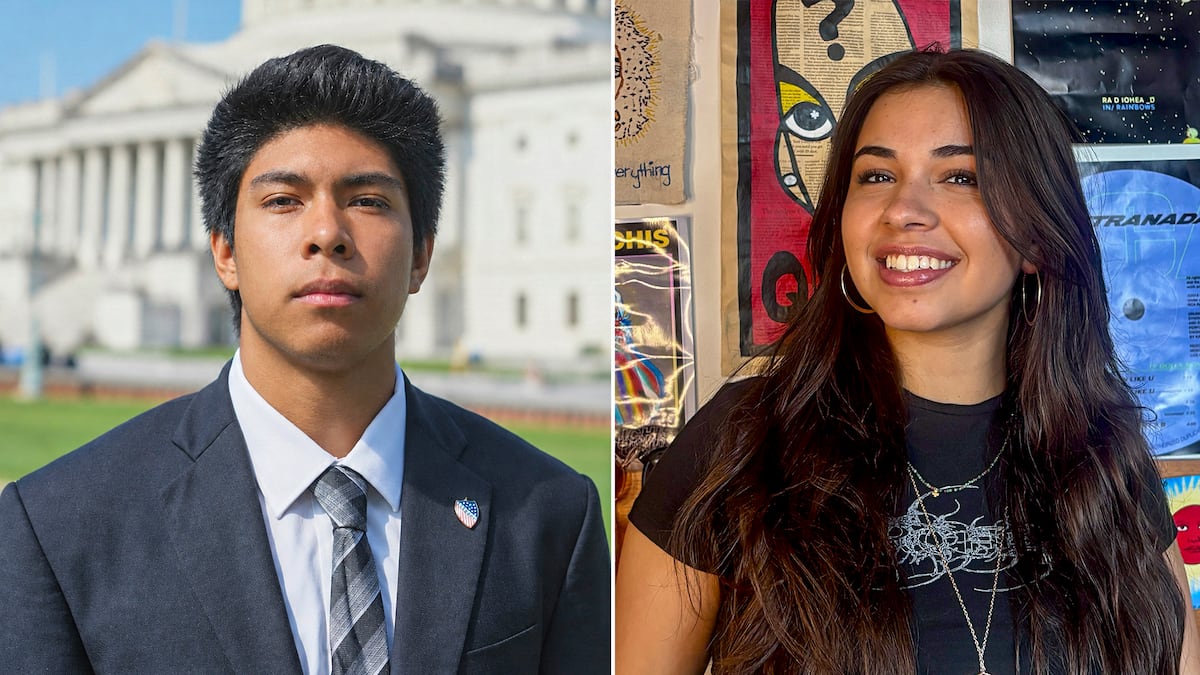
More than four million Latinos have turned 18 since the last midterm elections in 2022 and will be able to vote for the first time in the midterms on November 3. For years, Latino advocacy groups have pointed to the community’s growing political potential, noting that every 30 seconds, a Latino comes of age in the United States.Hispanics have become the fastest-growing electoral force in the United States over the past two decades. With 39 million eligible voters, they account for 16% of all voting-age citizens, a pool of roughly 250 million people, second only to non-Hispanic white voters. While that group has been shrinking since 2006, the share of Hispanic voters has nearly doubled.Joining this new generation of Latino voters are also one million naturalized Hispanic citizens. Together, they mean that 5.2 million more Latino voters will be eligible to cast a ballot for the first time in these midterm elections than four years ago. It is yet another reminder that the Latino vote could prove decisive in determining whether Republicans retain control of both chambers of Congress or Democrats reclaim them.The Latino electorate is diverse, but one characteristic stands out: its youth. The median age of eligible Hispanic voters is 39, compared with 45 among Black voters, 47 among Asian Americans and 52 among white voters. Some 30% of eligible Latino voters are between 18 and 29 years old, compared with 20% of the overall electorate and 17% of white voters. Only 14% of eligible Hispanic voters are 65 or older, compared with 24% of the electorate as a whole.Their youth brings priorities that differ in some respects from those of older generations, including issues such as the war in Gaza and climate change. At the same time, they have also felt the impact of U.S. President Donald Trump’s anti-immigration policies and, like their parents, are deeply concerned about the economy, having witnessed the toll that rising living costs and immigration arrests have taken on their households. Some are the children of undocumented immigrants and have relatives or friends who have been detained by Immigration and Customs Enforcement (ICE). Others have had to leave school in order to help support and care for their families.They approach these midterm elections eager to make their voices heard. Three of them spoke with EL PAÍS about their motivations and hopes in voting for the first time in a national election.Madeline Cortez, 19: ‘I will vote on immigration policy and abortion rights’Madeline was born a U.S. citizen. Her family is of Mexican origin but moved to Texas and California many years ago. When she was three, they relocated to the state of Maryland, where she lived until finishing high school. She speaks to EL PAÍS by videoconference from her room at the University of Wisconsin, where she just moved to begin her studies in environmental science.Having turned 19, she is eager to vote for the first time. Her main motivation is the Trump administration’s immigration agenda. The president’s second term has been decisive. “It was the first time I really understood how much the person in leadership influences people’s everyday lives. Before, I didn’t think voting made much difference, but after seeing the direct impact it had on so many people — for some it became a matter of life or death — my perspective changed,” she says.When she was younger, between nine and 12, she was interested in politics, a period that coincided with Trump’s first presidency. “In the 2016 election I got very involved; I was always talking to my friends about it. Then, when [Joe] Biden was elected in 2020, I stepped back a bit,” she says. “I guess I didn’t feel as angry anymore,” she adds.Her attitude changed with Trump’s return, and she is now looking for the best way to oppose his administration. Although she has lived almost all her life in Maryland, she chose to register to vote in Wisconsin because she believes her Democratic vote will be more valuable there. Maryland is a predominantly Democratic state, while Trump narrowly won Wisconsin in 2024, and it is one of the battleground states in deciding who controls the House of Representatives.Two factors weigh most in Madeline’s decision: immigration policy and abortion rights. “Lately I’ve been researching two issues: deportation policies and the level of cooperation that states maintain with that agency, and abortion laws,” she explains. “I want to make sure those rights are protected.” In Maryland, Madeline lived in the Silver Spring neighborhood in Montgomery County, an area with many Latinos. “In the neighborhood behind mine, ICE agents would often appear. There were parents who had to ask others to pick up their kids from the school bus stop because they had seen ICE agents in the area. It was really terrifying. A nightmare,” she says.She believes immigration agents could be deployed at polling places. “If they have the nerve to show up at people’s immigration appointments, they probably have the nerve to show up at polling places too,” she says.Juan José Estrada, 19: ‘My main concern is ICE’No ICE raids and relief from the crushing cost of living. With those two concerns in mind, Juan José Estrada, a 19-year-old Californian, voted for the first time in a federal election. “I voted so my rights are guaranteed. We are in a system that wants to take away my rights. I also voted to have a better life,” says Estrada, who cast his ballot by mail.Juan José Estrada was born in Michigan, and his family moved to California a decade ago. His mother was born in Los Angeles, and his father emigrated from Mexico in 1999. He is the youngest of three siblings and studies mechanical engineering at a public university in San Diego, near the California–Mexico border. He aspires to be an architect.He identifies as a Democrat, like the rest of his family. “We’re all together; we have the same ideology when we vote,” he says. His explanation is blunt: “Because Republicans are racist.” Between the two candidates for California governor, he chose Democrat Xavier Becerra without hesitation. Becerra is seeking to become the first governor of Hispanic descent in the state’s modern history. Asked what he would like from a Becerra administration, Juan José says: “Provide free health coverage.”His political views are shaped largely by ICE operations, which he describes as inhumane and responsible for separating many migrant families. “My main concern is ICE. I want them off the streets. It’s very dangerous for them to carry out operations, particularly because they lack proper training and are prone to violence. And many were hired even though it was known they had criminal records,” he says.Juan José shares many people’s fear that President Trump could interfere in the upcoming elections to the point of deploying immigration agents at polling places. “I’m very worried,” he says. To explain why, he reaches for a lesson he remembers from school: “The Nazis sent officials to polling places to vote in their favor. Today ICE is very close to the president. It’s very possible he will use these agents to instill fear so people vote his way,” he says.Christian Acosta, 21: ‘I am asking candidates to be more honest’Christian Acosta was born in Honduras but emigrated to the United States with his mother and two siblings at age three. His father had arrived earlier on a work visa and had saved enough to bring the family over. Christian turned 21 this month and became a naturalized U.S. citizen a year and a half ago. It was not easy. He is the first in his family to go through the process and, in addition to bureaucratic hurdles, he had to make a large financial effort to pay for the procedure, which cost him about $900. “It’s a lot of money, a lot of time; it’s very complicated. And it also scares us a lot,” he says. But he was determined to get it “to feel a little more secure in this country, because things are very difficult for Latinos,” he explains from the office where he’s temporarily working in Washington, D.C.Christian had to use part of the money he receives for his studies to pay for the citizenship process, but says obtaining citizenship was extremely important. “At first I thought that by being a citizen the fear would go away, but the truth is it hasn’t,” he says, “because we know we can be racially profiled by the federal police.” “It really doesn’t matter what papers you have, whether citizenship, legal residency or TPS [Temporary Protected Status].” He knows people who have been detained by ICE and his uncle was deported.He is in his third year at Johns Hopkins University in Baltimore, Maryland, where he studies public health and political science, but he will vote by mail in Texas, where his family lives and where he has permanent residence. He prefers to vote there because the race is more competitive than in Maryland. This semester, he is working with the League of United Latin American Citizens (LULAC), helping with projects of interest to the Latino community and sharing information aimed at encouraging voter participation.His vote will go to Democrats. He supports Senate candidate James Talarico because he believes Talarico will bring people together. He also says his rival, Republican Ken Paxton, “is very corrupt.” What he asks of candidates is “that they be more honest” because “Congress and the states have been bought by powerful, wealthy people.”He will also back Democrat Gina Hinojosa to replace Greg Abbott as governor. Although she is not his “favorite candidate,” he says he is voting against corruption and in favor of improving public education because “Gina is almost the only person who has talked about the importance of education as the main issue.” Christian argues that Texas public schools lack the resources students need.His political views differ sharply from those of his father, who supports Trump, and he prefers not to discuss politics at home. He believes many Latinos who back the president get their information from social media, where misinformation spreads easily.His father works for a company that manufactures equipment for oil extraction, while his mother had to stop working because of diabetes and now sells food to earn extra income. “Sometimes I feel bad because I earn here the same as my father, who works much harder than I do, and out in the sun,” he says.Christian believes Latinos are underrepresented in Congress and argues that there should be more Hispanic candidates so that elected officials can “have a better idea of what Latinos want.”Sign up for our weekly newsletter to get more English-language news coverage from EL PAÍS USA Edition
More than four million young Latinos, the fastest-growing electorate, set to vote for the first time in the midterms
Full Article
Original Source
Read the full article at English →KhanList aggregates and links to publicly available news content. We do not host full articles from third-party sources. Always verify important information with original sources.